Commentary - (2025) Volume 12, Issue 6
Received: 01-Dec-2025, Manuscript No. ijn-26-184027;
Editor assigned: 03-Dec-2025, Pre QC No. P-184027;
Reviewed: 17-Dec-2025, QC No. Q-184027;
Revised: 22-Dec-2025, Manuscript No. R-184027;
Published:
29-Dec-2025
, DOI: 10.37421/2376-0281.2025.12.664
Citation: Molina, Beatriz. ”Restoring Daily Living After Neurological Injury.” Int J Neurorehabilitation Eng 12 (2025):664.
Copyright: © 2025 Molina B. This is an open-access article distributed under the terms of the Creative Commons Attribution License, which permits unrestricted use, distribution and reproduction in any medium, provided the original author and source are credited.
Restoring daily living activities post-neurological injury necessitates a comprehensive, multidisciplinary strategy. Effective rehabilitation programs are designed to integrate both motor and cognitive retraining, often leveraging advanced technologies such as virtual reality and wearable sensors to enhance the therapeutic process. The cornerstone of successful recovery lies in early, consistent, and personalized therapy, with a primary focus on functional recovery, adapting to any residual deficits, and ultimately promoting long-term independence and an improved quality of life for individuals [1].
The critical role of occupational therapy in the process of regaining Activities of Daily Living (ADLs) after a brain injury cannot be overstated. Occupational therapists employ a range of specialized interventions, including task-specific training, strategic environmental modifications, and the utilization of assistive devices to facilitate patient progress. A key emphasis is placed on helping individuals adapt to their limitations and maximizing their participation in meaningful daily activities, encompassing everything from basic self-care routines to reintegration into the community. These personalized interventions are carefully tailored to address the unique cognitive and physical challenges that each individual faces [2].
Cognitive rehabilitation emerges as an essential component for restoring ADLs subsequent to neurological damage, particularly when cognitive functions such as executive functions, attention, or memory have been impaired. The strategies employed in cognitive rehabilitation are diverse and include compensatory techniques, metacognitive training, and structured strategy-based learning approaches. The overarching goal is to significantly improve an individual's ability to plan, organize, and execute daily tasks effectively, thereby enhancing their independence and reducing the overall burden placed on caregivers [3].
Technology is playing an increasingly vital and transformative role in the field of neurorehabilitation, especially concerning the recovery of ADLs. Virtual reality (VR) and augmented reality (AR) offer immersive and engaging environments that allow individuals to practice essential skills in a safe and controlled setting. Simultaneously, wearable sensors provide invaluable real-time feedback on performance metrics and gait patterns. These technological tools serve to enhance patient motivation, provide objective data crucial for therapists' assessment and treatment planning, and facilitate the implementation of home-based rehabilitation programs, all contributing to a faster and more comprehensive recovery process [4].
Motor relearning programs are recognized as crucial for individuals who are recovering motor function following a neurological injury, with the ultimate aim of regaining independence in ADLs. These programs are fundamentally based on the principles of neuroplasticity, actively encouraging the brain to reorganize and reroute neural pathways to compensate for damaged areas. Key principles guiding these programs include extensive repetition of tasks, a strong focus on task specificity, and the provision of effective feedback to promote the development of efficient and coordinated movement patterns essential for performing everyday activities [5].
The impact of physical therapy on the functional recovery of ADLs after a neurological injury is profound and significant. Therapeutic exercise, functional mobility training, and specialized balance exercises are core components designed to systematically improve strength, coordination, and endurance. The development and implementation of personalized programs, meticulously tailored to the individual's specific level of impairment and functional capacity, are paramount for maximizing therapeutic gains and achieving a high degree of independence in daily tasks [6].
Family and caregiver involvement plays a critically important role in the successful recovery of ADLs following a neurological injury. Providing comprehensive education to caregivers regarding the patient's specific condition, offering practical training on effective assistance techniques, and ensuring ongoing emotional support can substantially enhance the patient's progress and positively influence their overall well-being. This collaborative, team-based approach fosters a supportive and conducive environment for sustained and meaningful recovery [7].
Emerging neuromodulation techniques, including transcranial magnetic stimulation (TMS) and deep brain stimulation (DBS), are increasingly being explored and utilized as adjuncts to traditional therapies for enhancing both motor and cognitive recovery related to ADLs. These interventions are designed with the specific aim of optimizing neural plasticity and facilitating functional reorganization within the brain. Their potential lies in leading to significantly improved outcomes for individuals who are experiencing persistent functional deficits following their neurological injury [8].
The intricate process of regaining ADLs after a neurological injury is characterized by its highly individualized nature. A multitude of factors, such as the specific type and severity of the injury, the patient's age, and their pre-injury functional status, all significantly influence the trajectory and pace of recovery. Therefore, the development and implementation of a personalized, goal-oriented rehabilitation plan, which meticulously accounts for these diverse variables, is absolutely essential for optimizing patient outcomes and maximizing their level of independence [9].
Accurately measuring progress in the recovery of ADLs requires the use of standardized and validated assessment tools. These instruments are invaluable not only for tracking improvements in functional abilities over time but also for informing and refining treatment planning and for establishing realistic, achievable goals. Commonly employed assessments evaluate a broad range of domains, including self-care skills, mobility, and instrumental ADLs, thereby providing a comprehensive and nuanced picture of the individual's current functional status [10].
Restoring daily living activities following a neurological injury is fundamentally reliant on a multidisciplinary approach that addresses the multifaceted needs of the individual. This comprehensive rehabilitation process integrates both motor and cognitive retraining, often enhanced by the incorporation of advanced technologies like virtual reality and wearable sensors. The success of these interventions is largely determined by the initiation of therapy early in the recovery process, the consistency with which it is applied, and its personalization to the individual's specific circumstances. The ultimate goal is to achieve functional recovery, enable adaptation to any persistent deficits, and foster long-term independence and an improved quality of life [1].
Occupational therapy plays a paramount role in facilitating the regainment of Activities of Daily Living (ADLs) for individuals recovering from brain injuries. Therapists utilize specialized techniques such as task-specific training, carefully designed environmental modifications, and the judicious use of assistive devices. A central tenet of this therapy is helping individuals adapt to their existing limitations while simultaneously maximizing their engagement in meaningful activities, ranging from personal care to broader community reintegration. These interventions are carefully individualized, taking into account each person's unique cognitive and physical challenges [2].
Cognitive rehabilitation is a crucial element in the restoration of ADLs after neurological damage, especially when executive functions, attention, or memory are compromised. The therapeutic strategies involve the implementation of compensatory techniques, metacognitive training, and systematic strategy-based learning. The primary objective is to enhance an individual's capacity to plan, organize, and execute daily tasks, thereby promoting greater independence and alleviating the caregiving burden on family members and support systems [3].
The integration of technology into neurorehabilitation for ADLs is becoming increasingly significant and impactful. Virtual reality (VR) and augmented reality (AR) offer immersive environments conducive to practicing essential skills, while wearable sensors provide immediate feedback on performance and gait. These technological advancements serve to boost patient motivation, supply therapists with objective performance data, and support home-based rehabilitation efforts, ultimately contributing to a more rapid and thorough recovery [4].
Motor relearning programs are instrumental for individuals recovering motor function post-neurological injury, aiming to restore their ability to perform ADLs. These programs are grounded in the concept of neuroplasticity, actively stimulating the brain to find alternative neural pathways. Core principles include extensive task repetition, a focus on specific functional activities, and the provision of feedback to cultivate efficient and coordinated movement patterns vital for everyday life [5].
The impact of physical therapy on the functional recovery of ADLs in individuals with neurological injuries is substantial. Interventions such as therapeutic exercise, functional mobility training, and balance exercises are employed to systematically enhance strength, coordination, and endurance. The development of personalized programs, precisely aligned with the individual's specific impairments and functional status, is essential for maximizing therapeutic benefits and achieving independence in daily activities [6].
Active involvement of family members and caregivers is indispensable for the recovery of ADLs following neurological injury. Educating caregivers about the patient's condition, providing practical training on how to offer assistance effectively, and offering consistent emotional support can significantly accelerate the patient's progress and improve their overall well-being. This collaborative approach cultivates a supportive atmosphere essential for long-term recovery [7].
Neuromodulation techniques, including transcranial magnetic stimulation (TMS) and deep brain stimulation (DBS), are emerging as valuable adjuncts in enhancing motor and cognitive recovery for ADLs. These interventions are designed to optimize the brain's neuroplasticity and foster functional reorganization. Their application holds promise for improving functional outcomes in individuals experiencing persistent deficits [8].
The trajectory of regaining ADLs after a neurological injury is inherently individualized. Factors such as the specific type and severity of the injury, the patient's age, and their functional status before the injury all play a significant role in shaping the recovery path. Consequently, a personalized, goal-oriented rehabilitation plan that carefully considers these variables is crucial for optimizing outcomes and maximizing independence [9].
Effective assessment of progress in ADL recovery relies on the consistent use of standardized and validated tools. These instruments not only document functional improvements but also provide critical information for guiding treatment decisions and setting realistic goals. Commonly utilized assessments cover essential areas such as self-care, mobility, and instrumental ADLs, offering a holistic view of the individual's functional capabilities [10].
Restoring daily living activities after neurological injury requires a multidisciplinary approach, integrating motor and cognitive retraining, often with technology like virtual reality and wearable sensors. Early, consistent, and personalized therapy focuses on functional recovery and long-term independence. Occupational therapy is vital, employing task-specific training and environmental modifications. Cognitive rehabilitation addresses impairments in executive functions, attention, and memory. Technology enhances practice and provides feedback. Motor relearning programs promote neuroplasticity. Physical therapy improves strength, coordination, and endurance through tailored exercises. Family and caregiver involvement is critical for support and enhanced recovery. Neuromodulation techniques like TMS and DBS offer adjunctive benefits. Recovery is highly individualized, necessitating personalized, goal-oriented plans. Standardized assessment tools are essential for tracking progress and informing treatment.
None
None
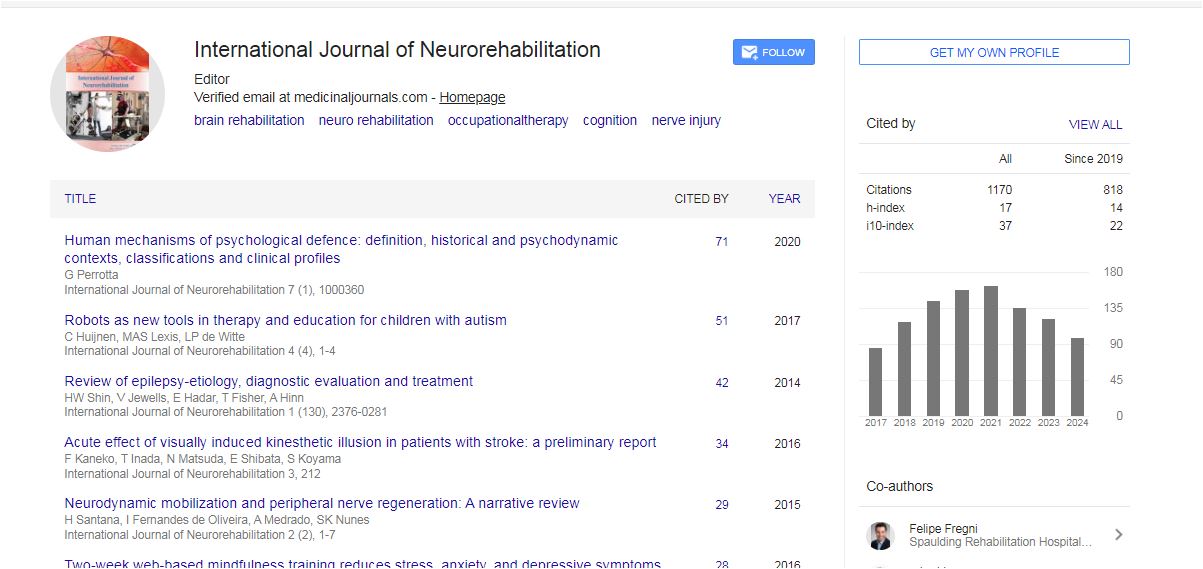
International Journal of Neurorehabilitation received 1078 citations as per Google Scholar report