Short Communication - (2025) Volume 13, Issue 6
Received: 01-Dec-2025, Manuscript No. jpgeb-26-184340;
Editor assigned: 03-Dec-2025, Pre QC No. P-184340;
Reviewed: 17-Dec-2025, QC No. Q-184340;
Revised: 22-Dec-2025, Manuscript No. R-184340;
Published:
29-Dec-2025
, DOI: 10.37421/2329-9002.2025.13.416
Citation: Moretti, Valentina P.. ”Rapid Evolution Driven by Human Impact.” J Phylogenetics Evol Biol 13 (2025):416.
Copyright: © 2025 Moretti P. Valentina This is an open-access article distributed under the terms of the Creative Commons Attribution License, which permits unrestricted use, distribution and reproduction in any medium, provided the original author and source are credited.
Human activities are profoundly altering the planet's ecosystems, compelling various species to undergo rapid evolutionary adaptations to survive in these novel environments. This has led to observable shifts in phenological patterns, morphological characteristics, and genetic makeup across a wide range of taxa. The pervasive influence of anthropogenic pressures, such as habitat alteration and resource availability changes, is driving unprecedented evolutionary trajectories in numerous populations. These changes are not merely passive responses but represent active evolutionary processes in action, demonstrating the remarkable plasticity and adaptive capacity of life on Earth. The intensification of anthropogenic stressors, including pollution and habitat fragmentation, is now recognized as a significant driver of genetic adaptation. These pressures can induce substantial genetic modifications within relatively short timeframes, affecting crucial traits like detoxification mechanisms and the ability of organisms to disperse. Such rapid genetic shifts underscore the potential for evolutionary responses to novel environmental conditions imposed by human actions. Urbanization, a particularly potent form of human-induced environmental change, is fostering distinct evolutionary adaptations in wildlife. Species colonizing urban landscapes are exhibiting altered behaviors and morphology to navigate and thrive amidst human-made structures, noise pollution, and modified food sources. Urban environments act as powerful selective forces, promoting the evolution of traits that are advantageous in these human-dominated ecosystems. Climate change, a monumental anthropogenic pressure, is demonstrably reshaping the migratory patterns and reproductive timing of avian species. Documented shifts in migration routes and breeding seasons are directly attributable to altered temperature regimes and the resultant changes in resource availability driven by global warming. These phenological adjustments are critical for survival and reproductive success in a rapidly changing climate. Overharvesting, particularly in marine environments, is exerting significant evolutionary pressure on fish populations. Intensive fishing practices have been shown to select for individuals with traits such as slower growth rates and later maturation, thereby altering the life-history strategies of exploited species and potentially compromising their long-term viability and ecological roles. The emergence and spread of diseases, often amplified by human-driven habitat alteration and increased global connectivity, play a crucial role in stimulating evolutionary change. Novel pathogens can impose intense selective pressures on host populations, leading to rapid adaptation and significant shifts in community dynamics. This interplay highlights the dynamic nature of host-pathogen co-evolution. Agricultural intensification presents a unique set of anthropogenic pressures that influence the evolutionary trajectories of species associated with cultivated lands. Changes in farming practices, including the widespread use of pesticides and the introduction of genetically modified crop varieties, impose novel selection pressures. These pressures can accelerate the adaptation of associated weed and pest species, presenting ongoing challenges for sustainable agriculture. Invasive species, a frequent consequence of global trade and transportation facilitated by human activities, have profound genetic and ecological ramifications. Introduced species often exhibit rapid adaptation to new environments, enabling them to outcompete native biota and significantly alter established ecosystem functions. This phenomenon underscores the interconnectedness of global human systems and ecological integrity. Plastic pollution, an ever-increasing anthropogenic impact on the environment, is beginning to reveal its evolutionary implications for marine organisms. Research is exploring potential genetic adaptations related to plastic ingestion, degradation, or altered behaviors in response to widespread microplastic contamination, pointing to yet another novel selective pressure. Habitat fragmentation, a direct result of human land-use practices, profoundly impacts the evolutionary dynamics of isolated populations. Reduced gene flow and increased genetic drift can lead to maladaptation, but in some instances, these fragmented patches can also drive rapid divergence and speciation under novel selective pressures within these isolated environments.
This study meticulously examines how diverse species are adapting to environmental changes driven by human activities, with a particular focus on alterations in phenology, morphology, and genetic makeup. It underscores the rapid evolutionary trajectories observed in populations subjected to altered habitats, resource availability, and novel selective pressures stemming from human endeavors, emphasizing the extensive reach of anthropogenic influence on biodiversity. The research highlights the intricate ways life is responding to our planet's changing landscape. The investigation delves into the genetic adaptations occurring within populations experiencing anthropogenic stressors, such as pollution and habitat fragmentation. The findings reveal that selective pressures originating from human activities can instigate substantial genetic changes across a few generations, influencing critical traits like detoxification pathways and dispersal capabilities. This demonstrates the inherent capacity for rapid evolution in response to novel environmental conditions created by human endeavors. This research specifically concentrates on the phenotypic plasticity and evolutionary adaptation of wildlife residing in urban environments. It illustrates how species that colonize urban settings exhibit modified behaviors and morphology as a means to cope with human-constructed structures, pervasive noise, and altered food availability. The study's conclusions suggest that urbanization acts as a potent selective force, actively promoting the evolution of traits that confer advantages in these newly established, human-shaped ecosystems. The research explores the considerable impact of climate change, a significant anthropogenic pressure, on the migratory patterns and reproductive timing of avian species. It meticulously documents shifts in migration routes and breeding seasons that are directly correlated with altered temperature regimes and changes in resource availability, both of which are consequences of global warming. These observed shifts are critical adaptations for survival. This paper critically analyzes the genetic consequences that arise from the practice of overharvesting in fish populations. It provides evidence that intensive fishing pressure selectively favors traits associated with slower growth and later maturation, thereby altering the life-history strategies of exploited species and potentially jeopardizing their long-term viability. This has significant implications for fisheries management. The article examines the pivotal role of disease emergence, a phenomenon often exacerbated by human-induced habitat alteration and global interconnectedness, in driving evolutionary change. It emphasizes how the introduction of novel pathogens can exert formidable selective pressures, catalyzing rapid adaptation within host populations and subsequently influencing the dynamics of entire ecological communities. This study meticulously investigates the effects of agricultural intensification on the evolutionary pathways of crop wild relatives. It discusses how modifications in farming practices, including the extensive use of pesticides and the adoption of altered crop varieties, introduce novel selection pressures. These pressures can lead to the accelerated adaptation of associated weed and pest species, posing ongoing challenges for agricultural sustainability. The article focuses on the genetic and ecological repercussions associated with invasive species, which are a common outcome of global trade and transportation networks driven by human actions. It provides clear examples of how introduced species can rapidly adapt to their new surroundings, effectively outcompeting native organisms and fundamentally altering ecosystem functions. This highlights the far-reaching consequences of human-mediated introductions. This research meticulously probes the evolutionary implications of plastic pollution, a pervasive anthropogenic impact, on marine organisms. It critically examines potential genetic adaptations that may be emerging in response to plastic ingestion or degradation, or changes in behavior prompted by microplastic contamination in marine environments. The findings suggest a novel evolutionary challenge. The paper investigates the evolutionary dynamics within fragmented populations, particularly those impacted by human land use. It highlights how isolation can lead to reduced gene flow and increased genetic drift, potentially resulting in maladaptation. However, it also notes that in certain circumstances, these fragmented patches can foster rapid divergence and speciation due to novel selective pressures encountered within these isolated environments.
This compilation of research explores the profound and rapid evolutionary adaptations occurring in various species due to human-induced environmental changes. Studies highlight how altered habitats, pollution, climate change, urbanization, overharvesting, disease emergence, agricultural intensification, invasive species, and plastic pollution are acting as strong selective pressures. These pressures are driving observable shifts in phenology, morphology, and genetics across diverse taxa, demonstrating the significant impact of anthropogenic influence on biodiversity and the remarkable capacity of life to evolve in response to novel environmental conditions.
None
None
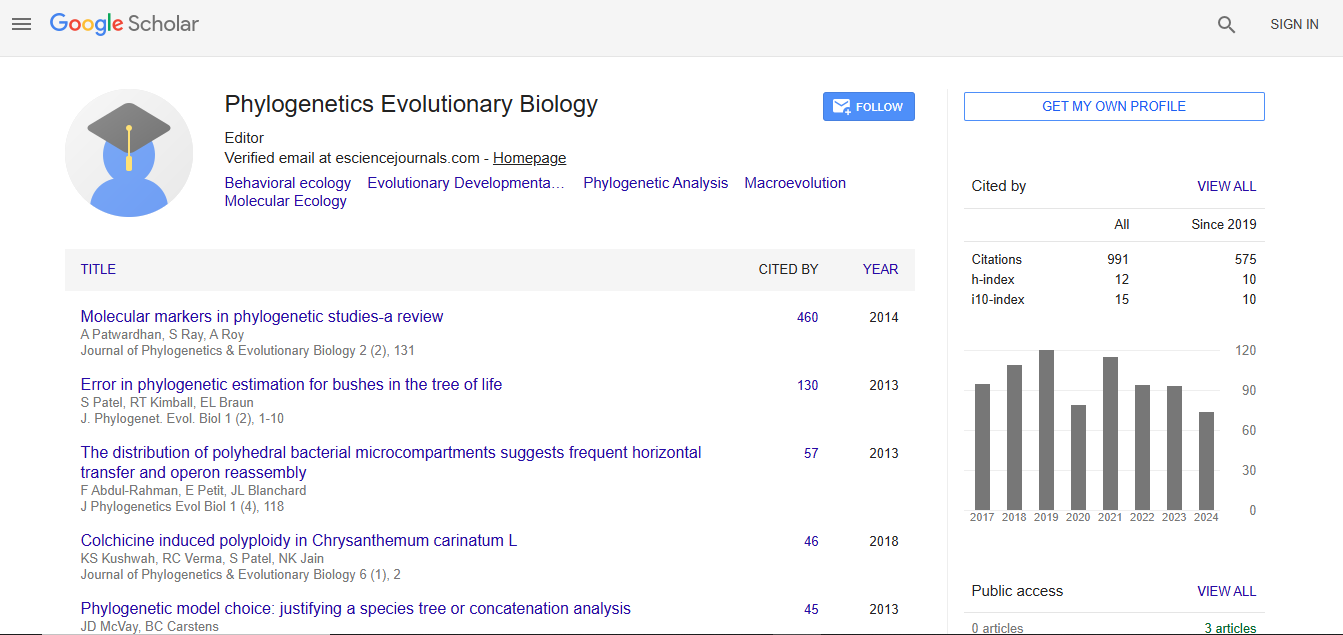
Journal of Phylogenetics & Evolutionary Biology received 911 citations as per Google Scholar report