Brief Report - (2025) Volume 12, Issue 6
Received: 01-Dec-2025, Manuscript No. ijn-26-184019;
Editor assigned: 03-Dec-2025, Pre QC No. P-184019;
Reviewed: 17-Dec-2025, QC No. Q-184019;
Revised: 22-Dec-2025, Manuscript No. R-184019;
Published:
29-Dec-2025
, DOI: 10.37421/2376-0281.2025.12.659
Citation: Suarez, Alejandro. ”Psychotherapy’s Role in Enhanced Neurorehabilitation Outcomes.” Int J Neurorehabilitation Eng 12 (2025):659.
Copyright: © 2025 Suarez A. This is an open-access article distributed under the terms of the Creative Commons Attribution License, which permits unrestricted use, distribution and reproduction in any medium, provided the original author and source are credited.
Psychotherapy occupies a significant position within the multifaceted field of neurorehabilitation, addressing the profound psychological and emotional consequences that often accompany neurological injuries. It offers vital support to individuals as they navigate the complex terrain of altered identity, manage mood disorders such as depression and anxiety, and confront the considerable challenges inherent in functional recovery. Cognitive-behavioral therapy (CBT) and a spectrum of other psychotherapeutic modalities are indispensable for fostering enhanced motivation, ensuring consistent adherence to prescribed rehabilitation programs, and ultimately improving the overall quality of life for these patients [1].
Cognitive-behavioral therapy (CBT) has emerged as a demonstrably effective intervention for ameliorating emotional dysregulation and mitigating depressive symptomatology among individuals undergoing neurorehabilitation, particularly following a stroke. Through its targeted approach to maladaptive thought patterns and behaviors, CBT significantly facilitates a more adaptive response to acquired disabilities and actively promotes greater engagement in tasks aimed at functional restoration [2].
Acceptance and Commitment Therapy (ACT) presents a robust and valuable theoretical framework within the context of neurorehabilitation. It is designed to cultivate psychological flexibility in patients, enabling them to better manage the difficult thoughts and emotions associated with their neurological condition. By encouraging acceptance and commitment to values-driven actions, ACT enhances an individual's capacity to actively participate in rehabilitation efforts and substantially improves their overall life satisfaction [3].
The incorporation of mindfulness-based interventions into neurorehabilitation protocols has proven to be highly effective in enhancing emotional well-being and reducing stress levels in patients who have sustained an acquired brain injury. These techniques are instrumental in fostering heightened self-awareness and promoting a focus on the present moment, thereby aiding in the effective management of emotional lability and strengthening overall coping mechanisms [4].
Family therapy constitutes an essential and integral component of comprehensive neurorehabilitation, recognizing that neurological injuries exert a profound and far-reaching impact on the entire family system. This therapeutic approach is adept at addressing complex communication breakdowns, alleviating the substantial burden experienced by caregivers, and facilitating a process of mutual adaptation to altered family dynamics, ultimately fostering a more supportive and conducive environment for the patient's recovery [5].
Psychosocial interventions, encompassing both individual and group therapy formats, are critically important for the effective management of post-stroke fatigue and the enhancement of social participation. These therapeutic modalities equip patients with essential coping strategies and provide crucial support in rebuilding social connections, which are frequently compromised and disrupted in the aftermath of a stroke [6].
Motivational interviewing (MI) stands out as a highly effective therapeutic approach within neurorehabilitation, specifically tailored to bolster patient engagement and improve adherence to demanding rehabilitation regimens. MI is adept at helping individuals navigate and resolve ambivalence concerning necessary changes, thereby nurturing and strengthening intrinsic motivation for the recovery process [7].
Psychoeducation plays a pivotal and empowering role throughout the neurorehabilitation journey. It is instrumental in equipping patients and their families with comprehensive knowledge regarding their specific condition, the anticipated trajectory of recovery, and the array of available support resources. This enhanced understanding serves to diminish fear and anxiety, thereby fostering more active and informed participation in the rehabilitation process itself [8].
Group psychotherapy offers a distinctive and highly therapeutic environment for individuals navigating the challenges of neurorehabilitation. It actively cultivates peer support, facilitates the sharing of common experiences, and significantly reduces feelings of isolation. This modality is particularly beneficial for those individuals who are contending with similar functional impairments and analogous emotional struggles [9].
The effective management of post-traumatic stress symptoms (PTSS) is a matter of critical importance in neurorehabilitation, especially for individuals who have experienced a traumatic brain injury. Trauma-focused psychotherapies are specifically designed to assist individuals in processing their traumatic experiences, thereby reducing the severity of their symptoms and enhancing their capacity to reintegrate effectively into their daily lives [10].
Psychotherapy is a cornerstone of neurorehabilitation, addressing the psychological and emotional aftermath of neurological injury, including identity shifts, mood disorders like depression and anxiety, and recovery challenges. Cognitive-behavioral therapy (CBT) and other psychotherapeutic methods are crucial for boosting motivation, adherence to rehabilitation, and overall quality of life [1].
CBT has proven effective in improving emotional regulation and reducing depression post-stroke. By targeting maladaptive thoughts and behaviors, it helps individuals adapt to disabilities and engage better with functional recovery tasks [2].
Acceptance and Commitment Therapy (ACT) provides a framework for developing psychological flexibility in neurorehabilitation. It guides patients to accept difficult thoughts and feelings related to their condition and commit to values-driven actions, enhancing rehabilitation engagement and quality of life [3].
Mindfulness-based interventions can significantly improve emotional well-being and reduce stress in patients with acquired brain injury. These techniques promote self-awareness and present-moment focus, aiding in the management of emotional lability and enhancing coping mechanisms [4].
Family therapy is essential in neurorehabilitation as neurological injuries affect the entire family system. It addresses communication issues, caregiver burden, and promotes adaptation to new family dynamics, creating a supportive environment for recovery [5].
Psychosocial interventions, including individual and group therapy, are vital for managing post-stroke fatigue and improving social participation. They equip patients with coping strategies and help rebuild disrupted social connections [6].
Motivational interviewing (MI) is highly effective in neurorehabilitation for increasing patient engagement and adherence to challenging programs. MI helps resolve ambivalence about change, fostering intrinsic motivation for recovery [7].
Psychoeducation is pivotal in neurorehabilitation, empowering patients and families with knowledge about their condition, recovery trajectory, and support resources. This understanding reduces fear and promotes active participation in rehabilitation [8].
Group psychotherapy offers a unique therapeutic environment for neurorehabilitation patients, promoting peer support, shared experiences, and reduced isolation, especially beneficial for those with similar functional impairments and emotional challenges [9].
Managing post-traumatic stress symptoms (PTSS) is critical post-traumatic brain injury. Trauma-focused psychotherapies help individuals process traumatic experiences, reduce symptom severity, and improve reintegration into daily life [10].
Neurorehabilitation is significantly enhanced by various psychotherapeutic interventions. These approaches address the psychological and emotional sequelae of neurological injuries, including mood disorders, identity changes, and functional recovery challenges. Cognitive-behavioral therapy (CBT) and Acceptance and Commitment Therapy (ACT) are highlighted for their effectiveness in improving emotional regulation, adapting to disabilities, and fostering psychological flexibility. Mindfulness-based interventions and psychoeducation empower patients with coping skills and knowledge about their condition. Family therapy is crucial for supporting the entire family unit, while psychosocial interventions and group therapy help manage fatigue, improve social participation, and reduce isolation. Motivational interviewing (MI) is effective in increasing patient engagement and adherence to rehabilitation programs. Trauma-focused therapies are essential for managing post-traumatic stress symptoms following brain injuries. Collectively, these psychotherapies aim to improve patient motivation, adherence, emotional well-being, and overall quality of life.
None
None
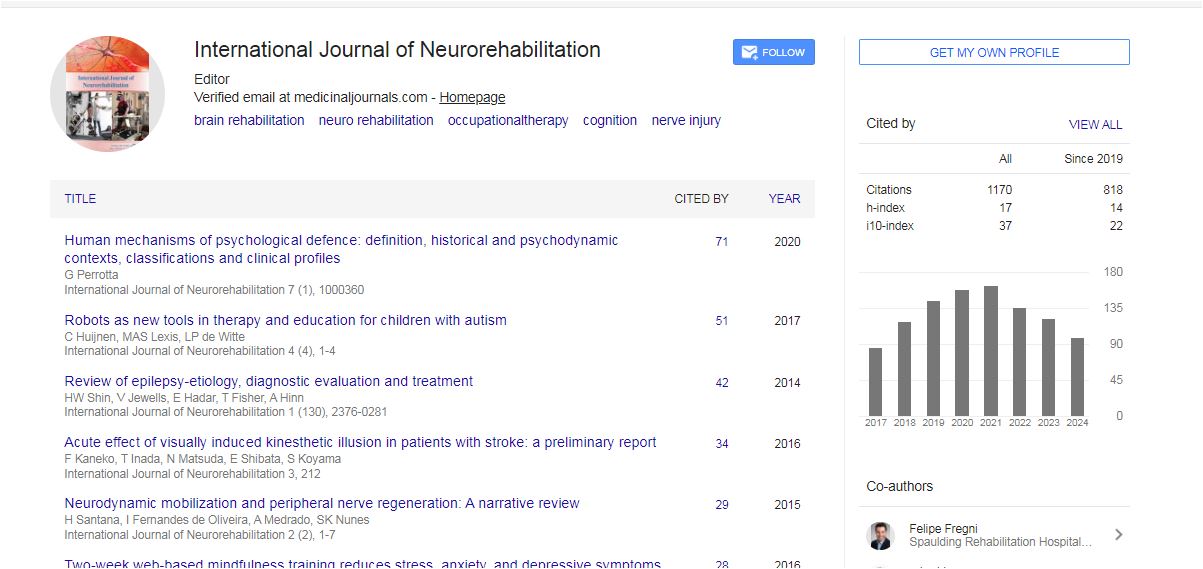
International Journal of Neurorehabilitation received 1078 citations as per Google Scholar report