Brief Report - (2025) Volume 13, Issue 1
Received: 03-Feb-2025, Manuscript No. jpgeb-25-157465;
Editor assigned: 05-Feb-2025, Pre QC No. P-157465;
Reviewed: 19-Feb-2025, QC No. Q-157465;
Revised: 24-Feb-2025, Manuscript No. R-157465;
Published:
28-Feb-2025
, DOI: 10.37421/2329-9002.2025.13.355
Citation: Stein, Liora. ”Phylogenetics: Networks, AI, and Evolutionary Timeline.” J Phylogenetics Evol Biol 13 (2025):354.
Copyright: © 2025 Stein L. This is an open-access article distributed under the terms of the Creative Commons Attribution License, which permits unrestricted use, distribution
and reproduction in any medium, provided the original author and source are credited.
Understanding complex evolutionary histories, especially those involving horizontal gene transfer or hybridization, is a real challenge. This article dives into the latest computational methods designed to tackle these intricate scenarios, highlighting how we're pushing past simple tree models to get a clearer picture of evolution. It's about recognizing that life's history isn't always a neat branching tree[1].
Deep learning is transforming how we approach phylogenomics. This paper maps out the current state of using neural networks for inferring evolutionary relationships from massive genomic datasets. It really shows the potential for these powerful algorithms to uncover patterns that traditional methods might miss, pushing the boundaries of what's possible in large-scale phylogenetic analysis[2].
When evolution isn't strictly tree-like, we need phylogenetic networks. This review looks at how these networks are built and what they're good for, especially in situations like hybridization or recombination where lineages merge. Itâ??s all about moving beyond simple bifurcating trees to capture a more nuanced view of evolutionary history[3].
Coalescent theory is central to understanding how gene lineages merge back in time, and it's key for inferring species trees. This paper explores the current hurdles and exciting possibilities in using coalescent-based approaches for phylogenetic inference, especially when dealing with gene tree discordance. It's about pushing the boundaries of how accurately we can reconstruct evolutionary relationships at the species level[4].
Bayesian phylogenetic methods are incredibly powerful, but applying them to huge datasets has always been a bottleneck. This review discusses the latest advancements that make Bayesian inference feasible and efficient for large-scale phylogenies, addressing computational challenges and opening doors for more comprehensive analyses. It means we can get more robust evolutionary insights from bigger, more complex data[5].
Microbial evolution and ecology offer a vast, dynamic landscape for phylogenetic studies. This article highlights how phylogenetic approaches are providing crucial insights into the diversification and interactions of microbes. It's about using evolutionary relationships to understand everything from pathogen spread to ecosystem functioning, really showing the breadth of phylogenetics in the microbial world[6].
Evolution isn't always a simple, diverging process; sometimes lineages come together, a phenomenon called reticulate evolution. This review comprehensively covers the mechanisms behind reticulation, the patterns it leaves in genomic data, and the specialized phylogenetic methods needed to infer these complex histories. It underscores the importance of tools that can handle gene flow and hybridization across species[7].
Reconstructing species trees from individual gene trees is a core challenge in phylogenomics, often complicated by processes like incomplete lineage sorting. This paper discusses the ongoing difficulties and significant progress in using coalescent-based methods to accurately infer species relationships from diverse gene trees. It's about getting past the noise in individual gene histories to find the true species-level phylogeny[8].
Molecular clocks are essential for dating evolutionary events, and recent advances have made them more accurate and flexible than ever. This article explores new methods and applications of molecular clocks in phylogenetics, showing how they're being refined to handle varying evolutionary rates and providing more precise timeframes for evolutionary divergence. It truly enhances our ability to put a timeline on life's history[9].
Keeping up with the latest phylogenetic analysis tools and databases is a field unto itself. This paper provides a great overview of the most recent developments, from novel software for tree inference and visualization to expanded databases for comparative genomics. It's a useful guide for anyone looking to navigate the ever-growing toolkit available to phylogeneticists[10].
Understanding complex evolutionary histories, particularly those involving horizontal gene transfer or hybridization, poses a significant challenge. Computational methods are evolving to address these intricate scenarios, moving beyond simple tree models to gain a clearer picture of evolution and acknowledging that life's history is not always a neat branching tree [1].
When evolution deviates from a strictly tree-like pattern, phylogenetic networks become indispensable. These networks are built to address situations like hybridization or recombination, where lineages merge, providing a more nuanced view of evolutionary history than simple bifurcating trees [3]. This ties into the broader concept of reticulate evolution, a phenomenon where lineages come together. Comprehending the mechanisms of reticulation, its patterns in genomic data, and the specialized phylogenetic methods required to infer these complex histories is crucial. Such understanding emphasizes the need for tools capable of handling gene flow and hybridization across species [7].
Deep learning is rapidly transforming the field of phylogenomics. Neural networks are now being used to infer evolutionary relationships from massive genomic datasets, showcasing their potential to uncover patterns that might elude traditional approaches in large-scale phylogenetic analysis [2]. Similarly, Bayesian phylogenetic methods, despite their power, have historically faced limitations with huge datasets. Recent advancements are making Bayesian inference more feasible and efficient for large-scale phylogenies, overcoming computational hurdles and opening avenues for more comprehensive analyses to derive robust evolutionary insights from complex data [5].
Coalescent theory is fundamental to understanding how gene lineages merge over time, forming a cornerstone for inferring species trees. Researchers are actively exploring current challenges and opportunities in using coalescent-based approaches for phylogenetic inference, especially when confronted with gene tree discordance, to improve the accuracy of reconstructing species-level evolutionary relationships [4]. Reconstructing species trees from individual gene trees remains a significant challenge in phylogenomics, often complicated by processes like incomplete lineage sorting. There's been notable progress in employing coalescent-based methods to accurately infer species relationships from diverse gene trees, striving to discern the true species-level phylogeny amidst the noise of individual gene histories [8].
Molecular clocks are essential for dating evolutionary events, and recent advancements have greatly enhanced their accuracy and flexibility. New methods and applications are refining molecular clocks to account for varying evolutionary rates, thus providing more precise timeframes for evolutionary divergence and enhancing our ability to timeline life's history [9]. Beyond these methodological advancements, phylogenetic approaches offer crucial insights into microbial evolution and ecology, helping to understand diversification, pathogen spread, and ecosystem functioning [6]. The field is also continuously supported by advances in phylogenetic analysis tools and databases, including novel software for tree inference and visualization and expanded comparative genomics databases, which collectively provide a growing toolkit for phylogeneticists [10].
Phylogenetic analysis is continuously evolving, tackling complex evolutionary histories that often extend beyond simple branching tree models. Studies are increasingly exploring scenarios like horizontal gene transfer, hybridization, and reticulate evolution, which necessitate advanced computational methods and phylogenetic networks to accurately depict lineage merging and genetic exchange. Deep learning offers a powerful new approach to phylogenomics, using neural networks to uncover intricate evolutionary patterns in massive genomic datasets that traditional techniques might overlook. Bayesian phylogenetic methods are also seeing significant progress, enabling efficient and robust inference for larger, more complex datasets, moving past previous computational limitations. Coalescent theory is fundamental for inferring species trees, with current research focusing on improving accuracy despite challenges like gene tree discordance and incomplete lineage sorting. Concurrently, molecular clocks are being refined to provide more flexible and precise dating of evolutionary events, offering a clearer timeline for life's history. Phylogenetic insights are proving invaluable in microbial evolution and ecology, revealing crucial details about diversification, pathogen dynamics, and ecosystem functions. The field is further supported by ongoing advancements in analysis tools, software for tree visualization, and expanding comparative genomics databases, providing phylogeneticists with an ever-improving toolkit to explore life's diverse evolutionary pathways.
None
None
1. Fabio PDLV, Nuno FSL, Daniel ARE. "Phylogenetic analysis of complex evolutionary scenarios: advances and challenges".Front Genet 13 (2022):909995.
Indexed at, Google Scholar, Crossref
2. Xiaoming L, Xiaoyu M, Jingwen L. "Deep learning for phylogenomics: current landscape and future directions".Brief Bioinform 24 (2023):bbad090.
Indexed at, Google Scholar, Crossref
3. Cécile A, Charles S, Ruriko Y. "Phylogenetic networks and their applications".Stat Methods Med Res 30 (2021):1030-1049.
Indexed at, Google Scholar, Crossref
4. Luay N, Laura K, Andrew JR. "Challenges and opportunities in coalescent-based phylogenetic inference".Trends Ecol Evol 39 (2024):236-247.
Indexed at, Google Scholar, Crossref
5. Michael L, Huw AO, Simon YWH. "Bayesian phylogenetic inference for large datasets".Methods Ecol Evol 14 (2023):1251-1264.
Indexed at, Google Scholar, Crossref
6. Jonathan AE, Jack AG, J. GC. "Phylogenetic insights into microbial evolution and ecology".Nat Rev Microbiol 20 (2022):23-38.
Indexed at, Google Scholar, Crossref
7. James SWP, Sarah BH, Laura FG. "Reticulate evolution: processes, patterns, and phylogenetic inference".Annu Rev Ecol Evol Syst 54 (2023):381-402.
Indexed at, Google Scholar, Crossref
8. Siavash M, Tandy W, Joseph WT. "Challenges and progress in coalescent-based species tree inference from gene trees".Mol Phylogenet Evol 191 (2024):107937.
Indexed at, Google Scholar, Crossref
9. Mario dR, Ziheng Y, David ABR. "Molecular clocks in phylogenetics: new insights and applications".J Mol Evol 90 (2022):395-408.
Indexed at, Google Scholar, Crossref
10. Brian JK, Peter JS, Jessica EK. "Recent advances in phylogenetic analysis tools and databases".Brief Bioinform 22 (2021):105-121.
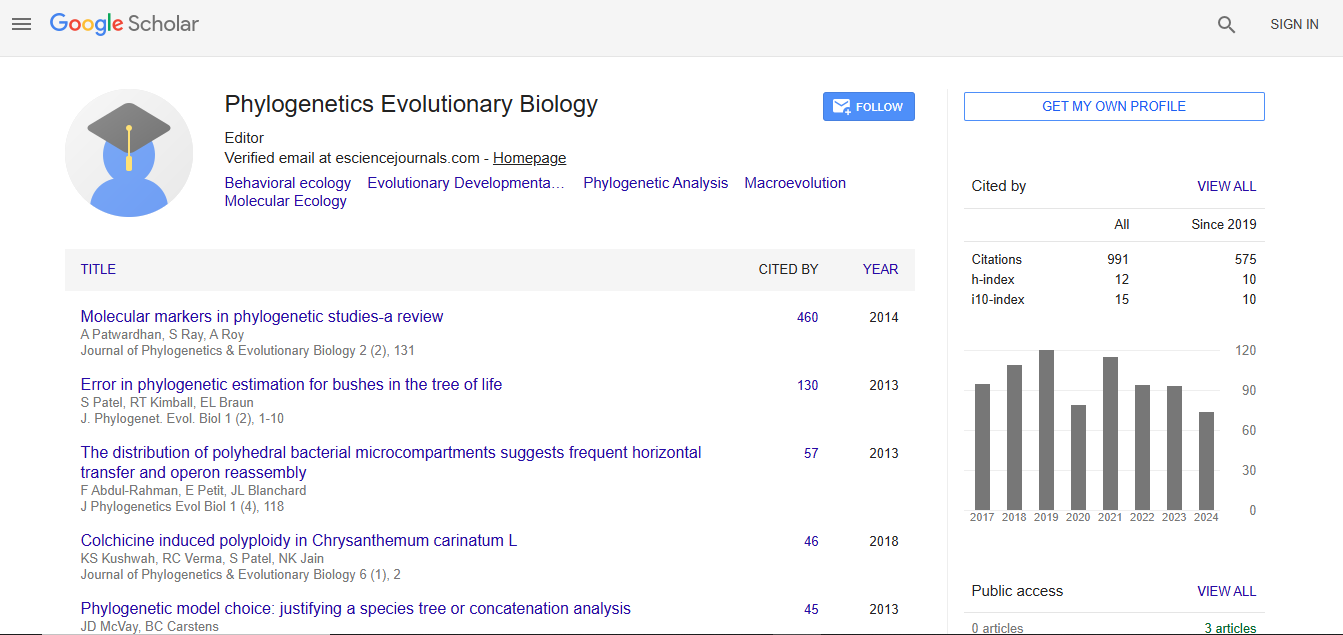
Journal of Phylogenetics & Evolutionary Biology received 911 citations as per Google Scholar report