Commentary - (2025) Volume 13, Issue 6
Received: 01-Dec-2025, Manuscript No. jpgeb-26-184333;
Editor assigned: 03-Dec-2025, Pre QC No. P-184333;
Reviewed: 17-Dec-2025, QC No. Q-184333;
Revised: 22-Dec-2025, Manuscript No. R-184333;
Published:
29-Dec-2025
, DOI: 10.37421/2329-9002.2025.13.411
Citation: Wilkins, Thomas E.. ”Phylogenetic Methods Unlocking Historical Biogeography.” J Phylogenetics Evol Biol 13 (2025):411.
Copyright: © 2025 Wilkins E. Thomas This is an open-access article distributed under the terms of the Creative Commons Attribution License, which permits unrestricted use, distribution and reproduction in any medium, provided the original author and source are credited.
The field of historical biogeography has been significantly advanced by the integration of phylogenetic frameworks. These frameworks allow for robust reconstructions of species' past distributions, diversification patterns, and dispersal histories by combining molecular phylogenies with fossil data and geological events [1].
Phylogenetic comparative methods are essential tools for testing hypotheses about macroevolutionary processes such as vicariance, dispersal, and adaptive radiations across diverse taxa and geological timescales [1].
Refining our understanding of past continental connections and their impact on species distributions is achievable through phylogenomic data. Analyzing large-scale genomic datasets can resolve deep evolutionary relationships and infer historical vicariance events with greater precision [2].
This work demonstrates the utility of phylogenomics in reconstructing ancestral areas and understanding the drivers of speciation and extinction in relation to paleogeographic changes [2].
Phylogenetic trees are instrumental in exploring the biogeographic history of specific clades. Integrating molecular clock estimates with current and past climate data allows for the inference of dispersal routes and the identification of climate-driven speciation events [3].
These findings provide insights into how major climate shifts have shaped the diversity and distribution of groups over millions of years, underscoring the importance of environmental factors in macroevolution [3].
The application of ancestral state reconstruction on phylogenetic trees offers a powerful method for inferring the geographic origins and dispersal patterns of marine organisms [4].
By mapping current distributions onto a robust phylogeny, ancestral ranges can be identified and hypotheses about long-distance dispersal versus vicariance can be tested [4].
This approach unravels the complex histories of marine biodiversity in response to changing oceanographic conditions [4].
Investigating the evolutionary history of plant communities in mountainous regions can be achieved through phylogenetic inference. Examining how factors like altitude, climate, and geological uplift influence species diversification and distribution showcases how integrating phylogenetic data with ecological and geological information illuminates the assembly and history of complex ecosystems [5].
A novel method for incorporating fossil occurrences into phylogenetic biogeographic analyses has been presented. Treating fossils as phylogenetic tips with uncertain divergence times enables more comprehensive reconstructions of evolutionary history and geographic ranges, effectively aiding in understanding dispersal dynamics of extinct faunas [6].
This approach has proven effective in understanding the dispersal dynamics of extinct faunas and their relationships to extant lineages [6].
The impact of past geological events, such as island formation and continental drift, on the diversification of island endemics can be investigated using phylogenetic trees and divergence dating [7].
Reconstructing colonization history and subsequent speciation on oceanic islands provides a clear example of how tectonic activity and isolation have shaped unique evolutionary trajectories [7].
The evolutionary origins of widespread insect groups can be explored using phylogenetic methods and molecular clock analyses to identify geographic source areas of diversification and trace subsequent dispersal routes [8].
This work demonstrates how phylogenetic frameworks infer the timing and locations of major dispersal events contributing to current distribution patterns of insect lineages [8].
Paleoclimatic oscillations and their influence on genetic structure and distribution of freshwater fish species can be examined through phylogeographic lineages correlated with past climate models [9].
This research infers refugial areas and identifies corridors for dispersal, highlighting how climate change has historically fragmented and reconnected populations, thus shaping current biodiversity patterns [9].
Phylogenetic comparative methods are crucial for testing hypotheses about the evolution of dispersal ability in plants [10].
Mapping dispersal-related traits onto a phylogenetic tree allows for the inference of whether dispersal evolved multiple times or is a conserved trait, offering a framework for understanding evolutionary drivers of plant distribution and colonization [10].
The fundamental role of phylogenetic frameworks in advancing historical biogeography is critically explored. These frameworks facilitate robust reconstructions of past species distributions, diversification patterns, and dispersal histories by integrating molecular phylogenies with fossil data and geological events [1].
The power of phylogenetic comparative methods is emphasized for testing hypotheses about macroevolutionary processes such as vicariance, dispersal, and adaptive radiations across diverse taxa and geological timescales [1].
A key area of investigation is how phylogenomic data can refine our understanding of past continental connections and their impact on species distributions. By analyzing large-scale genomic datasets, researchers can achieve greater precision in resolving deep evolutionary relationships and inferring historical vicariance events [2].
This approach proves invaluable for reconstructing ancestral areas and understanding the drivers of speciation and extinction in the context of paleogeographic changes [2].
The utilization of phylogenetic trees is central to exploring the biogeographic history of specific vertebrate clades. Researchers integrate molecular clock estimates with current and past climate data to infer dispersal routes and identify climate-driven speciation events [3].
Such investigations offer insights into how significant climate shifts have shaped the diversity and distribution of various groups over millions of years, highlighting the profound influence of environmental factors on macroevolution [3].
The application of ancestral state reconstruction on phylogenetic trees provides a potent methodology for inferring the geographic origins and dispersal patterns of marine organisms [4].
By mapping extant distributions onto a well-supported phylogeny, ancestral ranges can be elucidated, and hypotheses concerning long-distance dispersal versus vicariance can be rigorously tested [4].
This technique is instrumental in unraveling the intricate biogeographic histories of marine biodiversity in response to evolving oceanographic conditions [4].
The evolutionary history of plant communities within mountainous regions is effectively investigated through phylogenetic inference. Studies examine the influence of factors such as altitude, climate, and geological uplift on species diversification and distribution, demonstrating how the integration of phylogenetic data with ecological and geological information illuminates the assembly and history of complex ecosystems [5].
A significant methodological contribution involves a novel approach for incorporating fossil occurrences into phylogenetic biogeographic analyses. This method treats fossils as phylogenetic tips with inherent uncertainties in divergence times, enabling more comprehensive reconstructions of evolutionary history and geographic ranges [6].
This framework has shown effectiveness in clarifying the dispersal dynamics of extinct faunas and their evolutionary relationships with extant lineages [6].
The influence of past geological events, including island formation and continental drift, on the diversification of island endemics is investigated using phylogenetic trees and divergence dating methodologies [7].
The reconstruction of colonization histories and subsequent speciation events on oceanic islands offers compelling evidence of how tectonic activity and geographical isolation have fostered unique evolutionary trajectories [7].
The evolutionary origins of widely distributed insect groups are explored using phylogenetic methods combined with molecular clock analyses. The objective is to pinpoint the original geographic source areas of diversification and to meticulously trace subsequent dispersal routes [8].
This research exemplifies how phylogenetic frameworks can be employed to deduce the timing and geographical locations of pivotal dispersal events that have shaped the contemporary distributions of insect lineages [8].
The impact of paleoclimatic oscillations on the genetic structure and distribution of freshwater fish species is examined through the construction of phylogeographic lineages and their correlation with past climate models [9].
This analytical approach facilitates the inference of historical refugial areas and the identification of dispersal corridors, thereby illuminating how climate change has historically influenced population fragmentation and reconnection, ultimately shaping present-day biodiversity patterns [9].
Phylogenetic comparative methods are employed to rigorously test hypotheses concerning the evolution of dispersal ability in plants. By mapping traits associated with dispersal onto a phylogenetic tree, researchers can infer whether dispersal has evolved independently multiple times or if it represents a conserved characteristic within specific lineages [10].
This methodology provides a robust framework for elucidating the evolutionary drivers underlying plant distribution and colonization dynamics [10].
This collection of research highlights the pivotal role of phylogenetic methods in understanding historical biogeography. By integrating molecular phylogenies with fossil data, geological events, and climate data, researchers can reconstruct past species distributions, diversification, and dispersal patterns. Phylogenomics offers enhanced precision in resolving evolutionary relationships and inferring vicariance. Ancestral state reconstruction helps unravel geographic origins and dispersal routes, particularly for marine organisms. Studies on various taxa, including vertebrates, plants, insects, and freshwater fish, demonstrate how phylogenetic approaches illuminate the influence of paleogeography, climate change, and geological activity on evolutionary trajectories. Novel methods for incorporating fossils enhance these reconstructions, providing comprehensive insights into evolutionary history and biogeographic dynamics across diverse ecosystems and lineages.
None
None
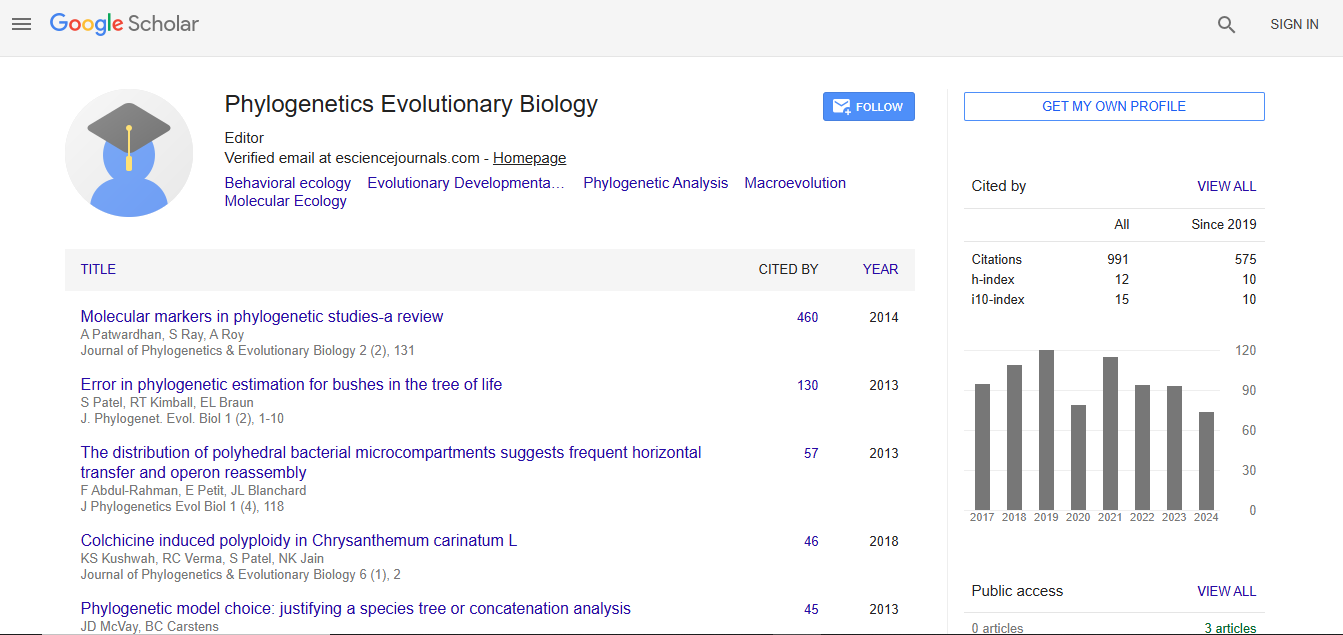
Journal of Phylogenetics & Evolutionary Biology received 911 citations as per Google Scholar report