Short Communication - (2025) Volume 13, Issue 5
Received: 01-Oct-2025, Manuscript No. jpgeb-26-184325;
Editor assigned: 03-Oct-2025, Pre QC No. P-184325;
Reviewed: 17-Oct-2025, QC No. Q-184325;
Revised: 22-Oct-2025, Manuscript No. R-184325;
Published:
29-Oct-2025
, DOI: 10.37421/2329-9002.2025.13.405
Citation: Rojas, Gabriel T.. ”Phylogenetic Diversity: Safeguarding Evolutionary Legacies For Conservation.” J Phylogenetics Evol Biol 13 (2025):405.
Copyright: © 2025 Rojas T. Gabriel This is an open-access article distributed under the terms of the Creative Commons Attribution License, which permits unrestricted use, distribution and reproduction in any medium, provided the original author and source are credited.
Phylogenetic diversity (PD) is recognized as a pivotal metric in conservation biology, serving to quantify the evolutionary history represented by a species or group of species. High PD signifies the presence of lineages with extensive and distinct evolutionary trajectories, making their loss a substantial detriment to overall biodiversity and ecosystem resilience. Understanding and applying PD enables the prioritization of conservation efforts towards regions or species that encapsulate unique evolutionary heritage, thereby preserving a broader spectrum of life's future evolutionary potential [1].
Integrating phylogenetic information into conservation planning can significantly bolster the efficacy of protected area networks. By incorporating the evolutionary distinctiveness of species, we can design reserves that capture a greater proportion of global biodiversity's evolutionary legacy, rather than solely focusing on species richness. This approach is instrumental in preventing the extinction of unique evolutionary paths [2].
The application of phylogenetic diversity metrics is indispensable for comprehending and mitigating the impacts of anthropogenic change on biodiversity. Habitat fragmentation and climate change can disproportionately affect species with restricted ecological niches and limited ranges, frequently resulting in the loss of evolutionarily distinct lineages. Phylogenetic metrics serve to quantify this evolutionary loss [3].
Assessing phylogenetic diversity hinges on the availability of robust phylogenetic trees and comprehensive species occurrence data. Progress in molecular phylogenetics and computational tools has considerably advanced our capacity to construct accurate phylogenies, which form the bedrock for reliable PD calculations. The precision of the underlying phylogeny directly dictates the conservation relevance of PD measures [4].
The concept of 'evolutionary distinctiveness' lies at the core of phylogenetic diversity. Species that are evolutionarily isolated, possessing few or no close relatives, contribute more significantly to the overall phylogenetic diversity of a community or region. Conservation strategies that afford priority to such species are crucial for the preservation of the branching patterns of life [5].
When considering conservation outcomes, an exclusive focus on maximizing species richness may prove insufficient. Phylogenetic diversity offers a complementary viewpoint, ensuring that conservation initiatives protect not only the sheer number of species but also the diversity of evolutionary histories they embody. This is particularly critical for safeguarding unique adaptations and evolutionary potential [6].
The practical implementation of phylogenetic diversity in conservation necessitates efficient computational methodologies for calculating and comparing PD across diverse datasets and scenarios. Software packages and algorithms are continually being developed to enhance the accessibility and scalability of these analyses for conservation practitioners and researchers alike [7].
Investigating the phylogenetic structure of communities provides profound insights into ecological processes and evolutionary history. Variations in PD among communities can illuminate differing levels of diversification, speciation rates, and extinction events, thereby fostering a deeper appreciation of biodiversity patterns [8].
In the context of establishing conservation priorities, particularly in regions undergoing rapid environmental transformation, phylogenetic diversity presents a prospective perspective. It aids in identifying lineages that are not only currently rare but also possess distinctive evolutionary traits that could prove vital for future ecosystem functionality and adaptation [9].
The ongoing discourse surrounding the most effective methods for calculating phylogenetic diversity metrics persists, with continuous research dedicated to exploring various weighting schemes and tree metrics. Ensuring that these metrics accurately represent evolutionary history and are responsive to conservation imperatives remains a paramount area of investigation [10].
Phylogenetic diversity (PD) is a critical metric in conservation biology, quantifying the evolutionary history encompassed by a species or group of species. A high PD value indicates the presence of lineages with long and distinct evolutionary paths, making their loss a significant blow to overall biodiversity and ecosystem resilience. The understanding and application of PD are crucial for prioritizing conservation efforts towards areas or species that possess unique evolutionary heritage, thus safeguarding a broader scope of life's future evolutionary potential [1].
Integrating phylogenetic information into conservation planning can substantially enhance the effectiveness of protected area networks. By considering the evolutionary distinctiveness of species, conservationists can design reserves that capture a larger proportion of global biodiversity's evolutionary legacy, moving beyond a sole focus on species richness. This strategic approach helps prevent the extinction of unique evolutionary trajectories [2].
The application of phylogenetic diversity metrics is vital for understanding and mitigating the impacts of anthropogenic changes on biodiversity. Processes such as habitat fragmentation and climate change can disproportionately affect species with narrow ecological niches and restricted distributions, often leading to the loss of evolutionarily distinct lineages. Phylogenetic metrics provide a quantitative measure of this evolutionary loss [3].
Accurate assessment of phylogenetic diversity relies on the availability of robust phylogenetic trees and comprehensive species occurrence data. Advancements in molecular phylogenetics and computational tools have significantly improved the ability to construct precise phylogenies, which are fundamental for reliable PD calculations. The accuracy of the underlying phylogenetic tree directly influences the conservation relevance of PD measures [4].
Central to the concept of phylogenetic diversity is 'evolutionary distinctiveness.' Species that are evolutionarily isolated, meaning they have few or no close relatives, contribute more significantly to the overall phylogenetic diversity of a community or region. Conservation strategies that prioritize these evolutionarily unique species are essential for preserving the intricate branching patterns of life [5].
When evaluating conservation outcomes, maximizing species richness alone may not be sufficient. Phylogenetic diversity offers a complementary perspective, ensuring that conservation efforts protect not only the number of species but also the variety of evolutionary histories they represent. This is particularly important for safeguarding unique adaptations and future evolutionary potential [6].
The practical utilization of phylogenetic diversity in conservation necessitates efficient computational methods for calculating and comparing PD across various datasets and conservation scenarios. Ongoing development of software packages and algorithms aims to make these analyses more accessible and scalable for conservation practitioners and researchers [7].
Studying the phylogenetic structure of ecological communities provides valuable insights into underlying ecological processes and evolutionary history. Differences in PD between communities can reflect varying levels of diversification, speciation rates, and historical extinction events, offering a deeper understanding of biodiversity patterns [8].
When establishing conservation priorities, especially in regions facing rapid environmental change, phylogenetic diversity offers a forward-looking approach. It helps identify lineages that are not only currently rare but also possess unique evolutionary traits that could be critical for future ecosystem function and adaptation [9].
The scientific community continues to debate and refine the optimal methods for calculating phylogenetic diversity metrics, with ongoing research exploring different weighting schemes and tree metrics. Ensuring that these metrics accurately reflect evolutionary history and are sensitive to conservation priorities remains a key area of investigation [10].
Phylogenetic diversity (PD) is a crucial metric in conservation biology that quantifies the evolutionary history within a species assemblage. High PD indicates the presence of lineages with unique evolutionary paths, making their loss significant for overall biodiversity and ecosystem resilience. Integrating PD into conservation planning, particularly in protected area networks, enhances the preservation of evolutionary legacies beyond mere species richness. This approach is vital for mitigating anthropogenic impacts like habitat fragmentation and climate change, which can lead to the loss of distinct lineages. Accurate PD assessment relies on robust phylogenetic trees and comprehensive species data, with computational tools facilitating its practical application. The concept of evolutionary distinctiveness, which prioritizes species with few close relatives, is central to PD. By focusing on PD, conservation efforts safeguard unique adaptations and evolutionary potential, offering a more holistic approach than solely maximizing species richness. Understanding the phylogenetic structure of communities provides insights into ecological processes and evolutionary history, aiding in conservation prioritization, especially in the face of global change. Ongoing research aims to refine PD metrics for greater accuracy and sensitivity to conservation needs.
None
None
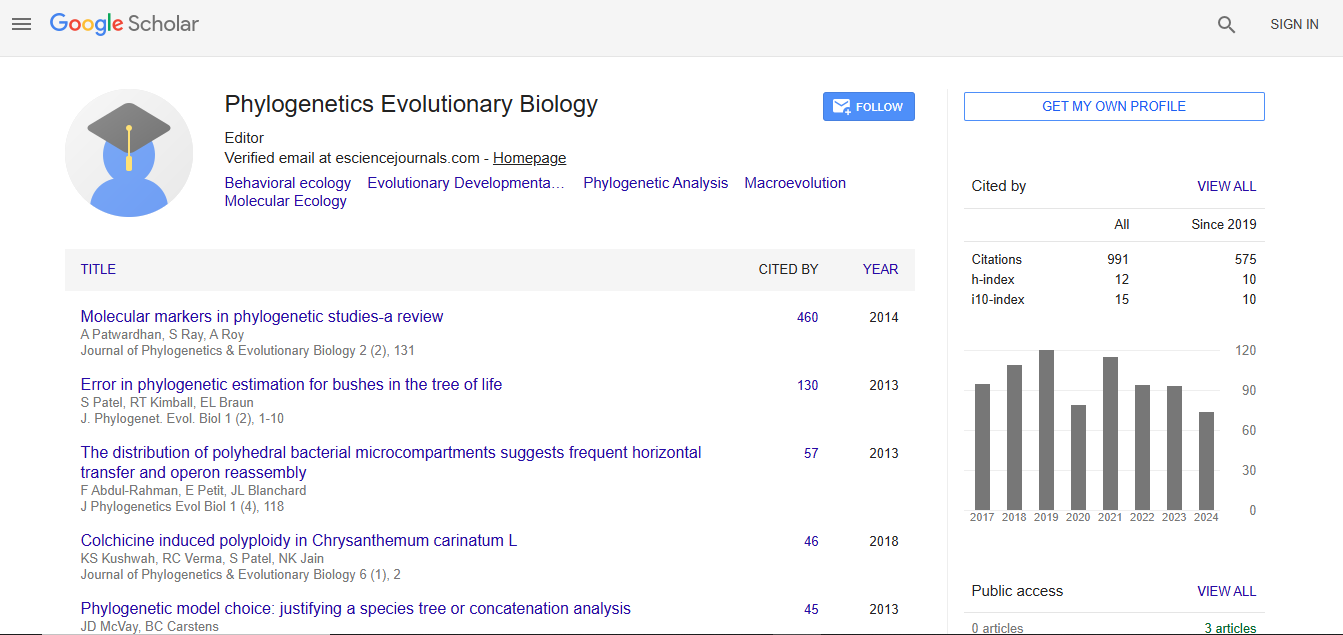
Journal of Phylogenetics & Evolutionary Biology received 911 citations as per Google Scholar report