Perspective - (2025) Volume 12, Issue 6
Received: 01-Nov-2025, Manuscript No. jlop-26-179113;
Editor assigned: 03-Nov-2025, Pre QC No. P-179113;
Reviewed: 17-Nov-2025, QC No. Q-179113;
Revised: 24-Nov-2025, Manuscript No. R-179113;
Published:
29-Nov-2025
, DOI: 10.37421/2469-410X. 2025.12.236
Citation: O’Sullivan, Claire. ”Photonics: Revolutionizing Astronomy and Space Exploration.” J Laser Opt Photonics 12 (2025):236.
Copyright: © 2025 O’Sullivan C. This is an open-access article distributed under the terms of the Creative Commons Attribution License, which permits unrestricted use, distribution and reproduction in any medium, provided the original author and source are credited.
Photonics is fundamentally transforming the field of astronomy and space science, offering novel imaging techniques that significantly expand observational capabilities. Advanced telescopes, equipped with adaptive optics, and high-precision spectrographs are now able to analyze light with unprecedented detail, providing crucial insights into distant celestial bodies and facilitating the exploration of our solar system. The development of sensitive detectors, efficient light collection systems, and interferometric methods for enhanced angular resolution are all driven by photonic principles, leading to a deeper understanding of cosmic phenomena [1].
Adaptive optics systems represent a critical advancement in astronomical imaging, with photonics playing a central role in their functionality. These systems employ deformable mirrors and wavefront sensors, often incorporating advanced photon detectors and laser guide stars, to actively compensate for atmospheric turbulence. This technological integration allows ground-based telescopes to achieve image quality that rivals that of space-based observatories, enabling the observation of finer details in planets, stars, and galaxies with remarkable precision [2].
Interferometry, particularly optical interferometry, stands as a testament to photonics' capability in achieving the highest resolutions in astronomical observation. By ingeniously combining light from multiple telescopes through photonic principles such as beam splitting and precise phase control, astronomers can effectively synthesize an aperture far larger than any individual telescope. This powerful technique is indispensable for resolving intricate surface details on exoplanets, studying binary star systems, and investigating the complex structures of active galactic nuclei, where the precise manipulation of light paths is paramount [3].
The continuous development of highly sensitive photon detectors is a primary driver behind advancements in astronomical imaging technology. Emerging generations of charge-coupled devices (CCDs) and complementary metal-oxide-semiconductor (CMOS) image sensors, alongside specialized single-photon avalanche diodes (SPADs) and superconducting nanowire single-photon detectors (SNSPDs), are continually improving quantum efficiency, reducing noise levels, and accelerating readout speeds. These improvements are essential for detecting fainter and more distant celestial objects with greater accuracy [4].
Spectroscopy, the analysis of the light spectrum emitted or absorbed by celestial objects, is a cornerstone of determining their chemical composition, temperature, and velocity. Photonics significantly contributes to the design of sophisticated spectrographs, including advanced grating-based systems and Fourier transform spectrometers, which can capture and analyze light across a broad spectrum of wavelengths with exceptional resolution. Furthermore, the efficient delivery of light from telescope foci to spectrographs is often facilitated by the strategic use of fiber optics [5].
Exoplanet characterization, a rapidly evolving area of astrophysics, benefits immensely from photonics-enabled imaging and spectroscopic techniques. Methods such as transit photometry and direct imaging rely on precise light measurements, while coronagraphs, frequently incorporating advanced photonic elements, are designed to block the intense glare of starlight, thereby revealing faint exoplanets. The detailed atmospheric analysis of exoplanets is largely dependent on spectroscopy to identify potential biosignatures and ascertain their atmospheric composition [6].
The integration of fiber optics within astronomical instrumentation is vital for achieving efficient light transport and optimizing instrument design. Fiber spectrographs, for instance, enable the consolidation of multiple telescope focal planes into a single, stable spectrograph, resulting in instruments that are both more compact and more robust. This photonic approach simplifies the construction of complex instruments and significantly enhances observing efficiency, particularly for large-scale astronomical surveys [7].
For space-based observatories, critical challenges related to miniaturization, power consumption, and radiation hardness must be addressed. Photonics provides effective solutions through the development of compact optical systems, efficient solid-state lasers for in-situ calibration, and radiation-hardened photonic components. These advancements are instrumental in creating smaller, more capable instruments that can be deployed in space, thereby extending our observational reach beyond the limitations of Earth's atmosphere [8].
Wavefront sensing and control, an essential component for both adaptive optics systems and the precise alignment of space telescopes, relies heavily on accurate photonic measurements. Shack-Hartmann sensors, which utilize microlens arrays to precisely measure wavefront aberrations, are a prime example of photonics in action. The ongoing development of faster and more accurate wavefront sensors, often incorporating advanced photon-counting techniques, is crucial for achieving real-time correction and optimizing image formation quality [9].
Future astronomical missions are increasingly oriented towards the detection of biosignatures on exoplanets and the study of the early universe. Photonics-driven advancements in areas such as high-contrast imaging, polarimetry, and ultra-stable interferometry will be instrumental in realizing these ambitious scientific objectives. The integration of novel photonic materials and emerging quantum technologies holds significant promise for further enhancing the sensitivity and overall capabilities of future space science instruments [10].
Photonics is revolutionizing astronomy and space science by providing novel imaging techniques that push the boundaries of observation. From advanced telescopes utilizing adaptive optics to sophisticated spectrographs capable of analyzing light with unprecedented precision, photonics-based instruments are key to understanding distant celestial objects and exploring our solar system. This includes the development of sensitive detectors, efficient light collection systems, and interferometric methods for enhanced angular resolution, all contributing to deeper insights into cosmic phenomena [1].
Adaptive optics systems, a cornerstone of modern astronomical imaging, are heavily reliant on photonics. These systems employ deformable mirrors and wavefront sensors, often incorporating sophisticated photon detectors and laser guide stars, to counteract atmospheric turbulence. This technological synergy allows ground-based telescopes to achieve image quality comparable to space-based observatories, revealing finer details of planets, stars, and galaxies. The precision of these photonics components is crucial for real-time correction of atmospheric distortions [2].
Interferometry, particularly optical interferometry, offers the highest angular resolution achievable in astronomy. By combining light from multiple telescopes using photonic principles like beam splitting and phase control, astronomers can synthesize an aperture far larger than any individual telescope. This technique is essential for resolving fine details on exoplanet surfaces, studying binary stars, and probing the structures of active galactic nuclei. The precise manipulation of light paths is paramount for achieving these high-resolution observations [3].
The development of highly sensitive photon detectors is a significant driving force in astronomical imaging. New generations of charge-coupled devices (CCDs) and complementary metal-oxide-semiconductor (CMOS) image sensors, alongside specialized single-photon avalanche diodes (SPADs) and superconducting nanowire single-photon detectors (SNSPDs), offer improved quantum efficiency, reduced noise, and faster readout speeds. These advancements enable the detection of fainter and more distant objects with greater accuracy and efficiency [4].
Spectroscopy, the analysis of light's spectrum, is crucial for determining the chemical composition, temperature, and velocity of celestial objects. Photonics plays a vital role in designing advanced spectrographs, including grating-based systems and Fourier transform spectrometers, that can capture and analyze light across a wide range of wavelengths with exceptional resolution. Fiber optics are also employed to deliver light from telescope foci to spectrographs efficiently, enhancing instrument performance [5].
Exoplanet characterization, a rapidly advancing field, benefits immensely from photonics-enabled imaging and spectroscopy. Techniques like transit photometry and direct imaging rely on precise light measurements, while coronagraphs, often employing advanced photonic elements, block starlight to reveal faint exoplanets. Atmospheric analysis of exoplanets uses spectroscopy to identify biosignatures and understand their atmospheric composition, furthering our understanding of potentially habitable worlds [6].
The use of fiber optics in astronomical instrumentation is crucial for efficient light transport and instrument design. Fiber spectrographs, for instance, allow for the integration of multiple telescope focal planes into a single, stable spectrograph, leading to more compact and robust instruments. This photonic approach simplifies instrument construction and enhances observing efficiency, especially for large-scale surveys aimed at cataloging numerous celestial objects [7].
For space-based observatories, the challenges of miniaturization, power consumption, and radiation hardness are paramount. Photonics offers solutions through the development of compact optical systems, efficient solid-state lasers for calibration, and radiation-hardened photonic components. These advancements enable the creation of smaller, more capable instruments that can be launched into space, expanding our observational capabilities beyond Earth's atmosphere and allowing for observations from pristine environments [8].
The field of wavefront sensing and control, essential for both adaptive optics and space telescope alignment, relies on precise photonic measurements. Shack-Hartmann sensors, which use microlens arrays to measure wavefront aberrations, are a prime example. The development of faster and more accurate wavefront sensors, often incorporating advanced photon-counting techniques, is critical for real-time correction and optimal image formation in demanding astronomical applications [9].
Future astronomical missions are increasingly focused on detecting biosignatures on exoplanets and understanding the early universe. Photonics-driven advancements in high-contrast imaging, polarimetry, and ultra-stable interferometry will be instrumental in achieving these ambitious goals. The integration of novel photonic materials and quantum technologies promises to further enhance the sensitivity and capabilities of future space science instruments, paving the way for groundbreaking discoveries [10].
Photonics is revolutionizing astronomy and space science through advanced imaging techniques, adaptive optics, and precision spectrographs. These technologies enable deeper understanding of celestial objects and solar system exploration. Key developments include sensitive photon detectors, efficient light collection systems, and interferometry for high angular resolution. Adaptive optics counteract atmospheric turbulence for ground-based telescopes, while interferometry synthesizes large apertures for detailed observations. Photonics also enhances exoplanet detection and characterization through imaging and spectroscopy, and fiber optics improve instrument efficiency. For space missions, photonics addresses miniaturization and radiation hardness. Future missions will leverage photonics for biosignature detection and early universe studies, integrating new materials and quantum technologies for enhanced capabilities.
None
None
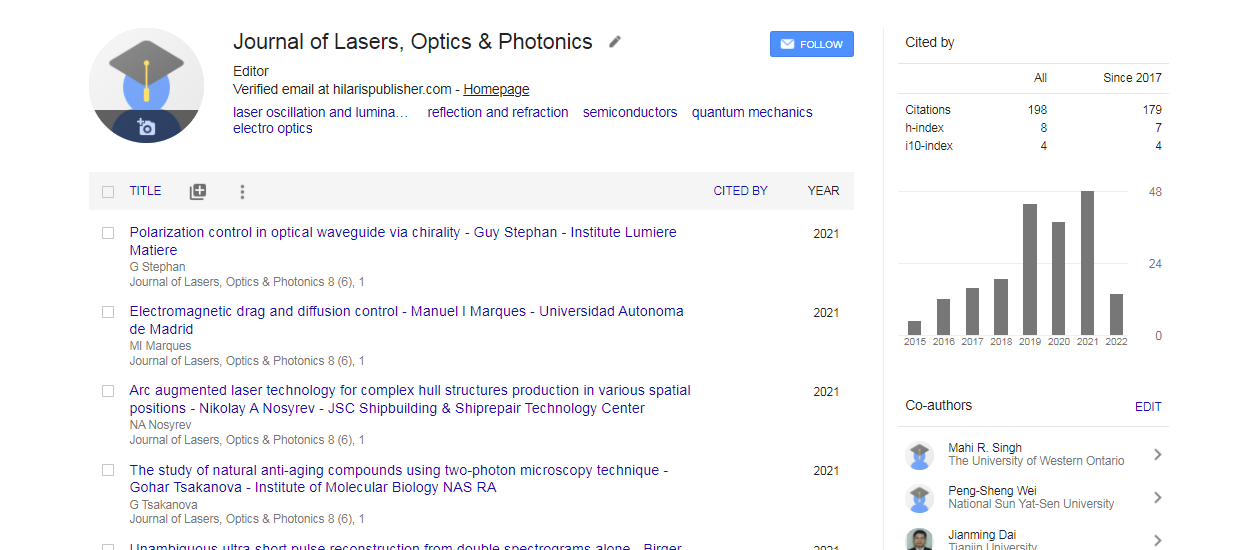
Journal of Lasers, Optics & Photonics received 279 citations as per Google Scholar report