Brief Report - (2025) Volume 12, Issue 4
Received: 01-Jul-2025, Manuscript No. jlop-26-179044;
Editor assigned: 03-Jul-2025, Pre QC No. P-179044;
Reviewed: 17-Jul-2025, QC No. Q-179044;
Revised: 22-Jul-2025, Manuscript No. R-179044;
Published:
29-Jul-2025
, DOI: 10.37421/2469-410X. 2025.12.209
Citation: Collins, Andrew. ”Optical Frequency Combs: Miniaturization and Advanced Applications.” J Laser Opt Photonics 12 (2025):209.
Copyright: © 2025 Collins A. This is an open-access article distributed under the terms of the Creative Commons Attribution License, which permits unrestricted use, distribution and reproduction in any medium, provided the original author and source are credited.
Optical frequency combs (OFCs) have emerged as transformative tools in metrology, fundamentally altering our ability to measure light with unprecedented precision. Their characteristic periodic spectrum, composed of equally spaced spectral lines, functions as a highly accurate ruler for optical frequencies. This unique property enables exceptionally precise measurements in both frequency and time domains. The applications of OFCs are remarkably diverse, spanning critical areas such as fundamental physics investigations, high-precision spectroscopy for scientific research, and the development of advanced navigation systems and secure communication technologies. A key capability of OFCs is their ability to effectively bridge the gap between microwave and optical frequencies, a feat previously challenging to achieve with such accuracy and stability. The ongoing progress in miniaturizing optical frequency comb technology, leading to the development of chip-scale devices, is a critical factor for their widespread adoption in practical metrological applications. These compact OFCs, often fabricated using silicon nitride waveguides, are instrumental in enabling high-precision measurements even within portable devices. This marks a significant departure from the traditional reliance on large, stationary laboratory setups, making advanced metrology more accessible and versatile. The research in this area is actively focused on enhancing the stability of these devices and significantly reducing their power consumption to facilitate real-world deployment. The synergistic integration of optical frequency combs with atomic clocks represents a monumental leap forward in the field of timekeeping and frequency metrology. This powerful combination allows for the direct and highly accurate transfer of the comb's precisely defined optical frequencies to microwave atomic clock standards. The result is an unprecedented level of accuracy and stability in timekeeping, pushing the boundaries of precision. Furthermore, the development and refinement of self-referenced combs have played a crucial role in simplifying this integration process, making these advanced systems more practical. Optical frequency combs have also proven to be invaluable for high-resolution spectroscopy, particularly in the challenging task of identifying and characterizing trace gases. The broad spectral bandwidth and the precisely defined line spacing offered by OFCs are instrumental in detecting even faint absorption features with remarkable sensitivity. This capability has profound implications for environmental monitoring, enabling more accurate assessments of air quality and the detection of pollutants, as well as for precise industrial process control, allowing for real-time analysis and optimization. Significant advancements in fiber-based optical frequency combs have substantially increased their accessibility for a broader range of metrological applications. Research efforts are intensely focused on enhancing the robustness of these fiber combs and reducing their overall cost. By leveraging standard telecommunication fibers, these systems are becoming more practical and cost-effective. Such developments are absolutely vital for expanding the use of frequency combs beyond highly specialized laboratory environments into diverse field applications where portability and cost are key considerations. The direct frequency comb referencing of GPS signals presents a compelling pathway towards achieving significantly enhanced navigation accuracy. By precisely locking GPS signals to the highly accurate frequency markers provided by an optical comb, it becomes possible to minimize errors that are typically introduced by atmospheric conditions and drift in satellite clocks. This innovative approach promises to revolutionize positioning systems, enabling next-generation navigation capabilities with unparalleled precision. This publication delves into the exciting application of optical frequency combs within the domain of secure communications. The inherent ability of OFCs to generate a vast number of optical carriers with extremely precise spacing opens up possibilities for sophisticated encryption schemes. These combs can enhance data security through high-dimensional encoding and advanced wavelength multiplexing techniques, offering a robust solution for protecting sensitive information. The development of tunable optical frequency combs is a critical area of research, essential for aligning the comb's spectral lines with specific atomic transitions or spectral features of interest. This research focuses on pioneering novel methods for precisely tuning both the comb's spacing and its offset frequency. Such tunability greatly expands their utility across a wide spectrum of diverse metrological tasks, allowing for greater flexibility and precision in experimental setups. This article critically investigates the impact of various environmental factors on the long-term stability of optical frequency combs, especially when deployed in metrology applications. A thorough understanding of and effective mitigation strategies for common noise sources, such as temperature fluctuations and mechanical vibrations, are paramount for maintaining the exceptionally high precision required for comb-based measurements in real-world operational conditions. The ongoing development of solid-state lasers specifically designed for optical frequency comb generation is a central theme in the advancement of metrology. This particular work explores innovative laser designs that aim to deliver improved efficiency, increased compactness, and enhanced reliability. These breakthroughs are paving the way for the realization of frequency comb systems that are not only more practical but also significantly more cost-effective for widespread adoption.
Optical frequency combs (OFCs) have revolutionized metrology by functioning as precise rulers for light, offering a periodic spectrum with equally spaced teeth that allows for unprecedented accuracy in frequency and time measurements. Their applications extend from fundamental physics tests and high-precision spectroscopy to advanced navigation and secure communication, driven by their unique ability to bridge the microwave and optical domains [1].
The progress in developing miniaturized and chip-scale optical frequency combs is crucial for their practical, widespread metrological applications. These compact combs, often utilizing silicon nitride waveguides, enable high-precision measurements in portable devices, moving beyond bulky laboratory setups. Research in this area focuses on enhancing stability and reducing power consumption [2].
The integration of optical frequency combs with atomic clocks signifies a major advancement in timekeeping and frequency metrology. This synergy enables the direct transfer of the comb's optical frequencies to microwave atomic clock standards, achieving unprecedented levels of accuracy and stability. The development of self-referenced combs further simplifies this integration [3].
Optical frequency combs are employed for high-resolution spectroscopy, particularly for identifying and characterizing trace gases. The broad bandwidth and precise line spacing of OFCs allow for the sensitive detection of faint absorption features, supporting applications in environmental monitoring and industrial process control [4].
Advances in fiber-based optical frequency combs have made them more accessible for metrological applications. Research focuses on improving robustness and reducing the cost of these combs, utilizing standard telecommunication fibers. These developments are key to expanding their use beyond specialized laboratories into field applications [5].
The direct frequency comb referencing of GPS signals offers a path to significantly enhanced navigation accuracy. By locking GPS signals to the precise frequency markers of an optical comb, errors from atmospheric conditions and satellite clock drift can be minimized, promising next-generation positioning systems [6].
This publication discusses the application of optical frequency combs in secure communications. The combs' ability to generate a large number of precisely spaced optical carriers enables sophisticated encryption schemes, enhancing data security through high-dimensional encoding and wavelength multiplexing [7].
The development of tunable optical frequency combs is essential for matching comb teeth to specific atomic transitions or spectral features. This research focuses on novel methods for tuning the comb spacing and offset frequency, expanding their utility in diverse metrological tasks [8].
This article investigates the impact of environmental factors on the stability of optical frequency combs used in metrology. Understanding and mitigating noise sources, such as temperature fluctuations and vibrations, are critical for maintaining the precision of comb-based measurements in real-world conditions [9].
The development of solid-state lasers for optical frequency comb generation is a key area of research for metrology. This work explores novel laser designs that offer improved efficiency, compactness, and reliability, paving the way for more practical and cost-effective frequency comb systems [10].
Optical frequency combs (OFCs) are essential tools in metrology, providing precise rulers for light with applications in frequency and time measurements, fundamental physics, advanced navigation, and secure communications. Miniaturization efforts are leading to chip-scale and fiber-based OFCs for practical, portable applications. Integrating OFCs with atomic clocks has advanced timekeeping accuracy, while their use in high-resolution spectroscopy enables sensitive trace gas detection. Future developments focus on tunable combs, robust solid-state laser sources, and mitigating environmental influences to enhance stability and expand their deployment in diverse scientific and technological fields.
None
None
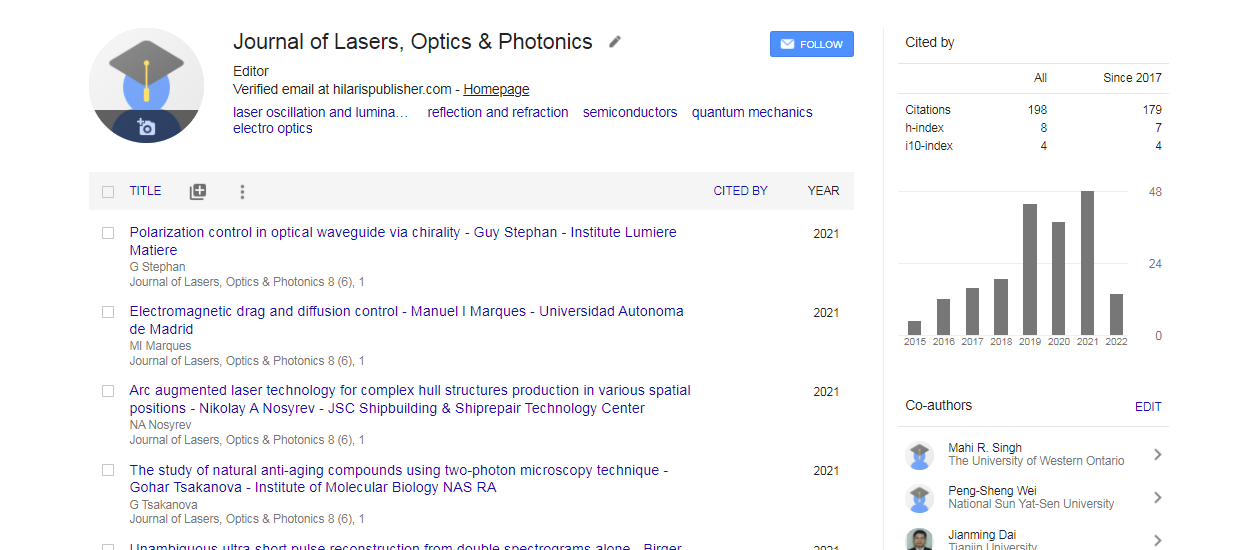
Journal of Lasers, Optics & Photonics received 279 citations as per Google Scholar report