Brief Report - (2025) Volume 12, Issue 3
Received: 01-May-2025, Manuscript No. jlop-26-179024;
Editor assigned: 05-May-2025, Pre QC No. P-179024;
Reviewed: 19-May-2025, QC No. Q-179024;
Revised: 22-May-2025, Manuscript No. R-179024;
Published:
29-May-2025
, DOI: 10.37421/2469-410X. 2025.12.200
Citation: O’Connell, David. ”Optical Coherence Tomography: A Versatile Imaging Modality.” J Laser Opt Photonics 12 (2025):200.
Copyright: © 2025 O’Connell D. This is an open-access article distributed under the terms of the Creative Commons Attribution License, which permits unrestricted use, distribution and reproduction in any medium, provided the original author and source are credited.
Optical Coherence Tomography (OCT) has emerged as a transformative non-invasive imaging modality, leveraging light waves to generate high-resolution, cross-sectional views of biological tissues. Its underlying principle is rooted in low-coherence interferometry, enabling the analysis of backscattered light to achieve depth-resolved imaging of tissue microstructures, facilitating detailed visualization of subsurface features that are inaccessible to conventional microscopy [1].
The technological evolution of OCT has led to specialized variants, such as swept-source OCT (SS-OCT), which offers distinct advantages over earlier spectral-domain OCT (SD-OCT) systems. These benefits include enhanced imaging speeds and greater penetration depths, making it particularly suitable for dynamic imaging and deeper tissue analysis [2].
Significant progress has been made in miniaturizing OCT systems, leading to the development of handheld and endoscopic probes. This miniaturization expands OCT's versatility, enabling its use in surgical guidance and for imaging internal organs directly, thereby enhancing its utility in minimally invasive procedures [3].
The integration of artificial intelligence (AI) with OCT represents a paradigm shift in diagnostic capabilities. Machine learning algorithms are being developed to automate the analysis of OCT images, aiming to improve the accuracy and efficiency of disease detection, particularly in complex datasets [4].
Beyond structural imaging, functional OCT (fOCT) techniques have been developed to assess dynamic physiological processes like tissue perfusion. Methods such as Doppler OCT and speckle variance OCT quantify blood flow, providing crucial information about tissue viability and function [9].
OCT angiography (OCTA) is another significant advancement, specifically designed for visualizing retinal vasculature. This technique allows for label-free, depth-resolved imaging of blood flow, offering a powerful tool for diagnosing and managing neovascular retinal diseases by clearly delineating abnormal vascular networks [5].
Furthermore, polarization-sensitive OCT (PS-OCT) provides an added dimension of information by assessing the birefringent properties of tissues. This capability is invaluable for differentiating between healthy and diseased tissues based on their structural and molecular composition, such as collagen organization in skin [6].
High-resolution spectral-domain OCT (SD-OCT) has seen continuous refinement, particularly for imaging superficial tissues. Advances in spectral resolution and detection sensitivity enable the detailed visualization of epidermal and dermal structures, crucial for early detection of skin pathologies [7].
The application of OCT extends to cardiovascular health, where intravascular OCT provides micrometer-resolution cross-sectional images of coronary arteries. This allows for detailed visualization of atherosclerotic plaques and assessment of stent placements, complementing other intravascular imaging methods [8].
In the realm of neuroscience, OCT is being explored for its potential in neuroimaging. While challenges exist in imaging deep brain structures, OCT shows promise for visualizing neural tissue, cerebral vasculature, and disease-related changes, opening new avenues for studying neurological conditions [10].
Optical Coherence Tomography (OCT) operates on the principle of low-coherence interferometry, utilizing light waves to produce high-resolution, cross-sectional images of biological tissues without invasive procedures. The technique analyzes the interference patterns of backscattered light from different depths within the tissue to create detailed structural maps, revealing microstructures that are otherwise difficult to visualize [1].
Swept-source OCT (SS-OCT) represents a significant advancement in OCT technology, offering improved performance characteristics compared to traditional spectral-domain OCT (SD-OCT). Its ability to rapidly sweep the light source wavelength enables faster acquisition times and deeper tissue penetration, which are critical for imaging thicker tissues or capturing dynamic processes [2].
The development of miniaturized OCT systems, including handheld devices and endoscopic probes, has dramatically expanded the clinical applicability of OCT. These compact systems facilitate in vivo imaging at the point of care and enable minimally invasive procedures, such as guiding surgical interventions or examining internal organs directly [3].
The synergistic integration of artificial intelligence (AI) with OCT is revolutionizing diagnostic interpretation. AI algorithms, particularly machine learning, are being trained to identify and classify subtle pathological features in OCT images, aiming to enhance diagnostic accuracy and reduce the workload on clinicians [4].
Functional OCT (fOCT) techniques expand the capabilities of OCT beyond structural imaging to include the assessment of physiological parameters. By employing methods like Doppler OCT, researchers can quantify blood flow velocity and distribution within tissues, providing insights into perfusion and microcirculation [9].
OCT angiography (OCTA) is a specialized OCT technique dedicated to visualizing the vascular network, particularly in the retina. It provides high-resolution, depth-resolved images of blood flow, enabling the non-invasive detection and monitoring of angiogenesis and vascular abnormalities associated with diseases like diabetic retinopathy [5].
Polarization-sensitive OCT (PS-OCT) adds another layer of diagnostic information by probing the birefringent properties of tissues. This technique is sensitive to changes in tissue microstructure, such as collagen fiber orientation, making it useful for characterizing tissue pathologies and monitoring therapeutic responses [6].
Advances in spectral-domain OCT (SD-OCT) continue to push the boundaries of high-resolution imaging, especially for superficial tissues. Enhanced spectral resolution and improved detector sensitivity allow for unprecedented detail in imaging the epidermis and dermis, crucial for dermatological applications [7].
In cardiology, intravascular OCT has become an indispensable tool for assessing cardiovascular disease. Its high resolution allows for detailed imaging of the arterial wall, enabling precise characterization of atherosclerotic plaques, evaluation of stent deployment, and monitoring of vessel wall remodeling [8].
The application of OCT in neuroimaging is an active area of research, addressing the challenges of visualizing delicate neural structures and cerebral vasculature. OCT offers the potential for high-resolution imaging of superficial brain layers and microvasculature, aiding in the study of neurological disorders [10].
Optical Coherence Tomography (OCT) is a non-invasive imaging technique using light for high-resolution cross-sectional views of biological tissues. Its principles allow for depth-resolved imaging and have led to advancements like swept-source OCT (SS-OCT) for faster and deeper imaging. Miniaturized OCT systems enhance clinical utility, while AI integration automates image analysis for improved diagnostics. Functional OCT (fOCT) assesses tissue perfusion, and OCT angiography (OCTA) visualizes vascular networks. Polarization-sensitive OCT (PS-OCT) provides tissue characterization, and high-resolution SD-OCT excels in superficial tissue imaging. OCT is applied in cardiology for intravascular imaging and in neuroscience for brain tissue analysis.
None
None
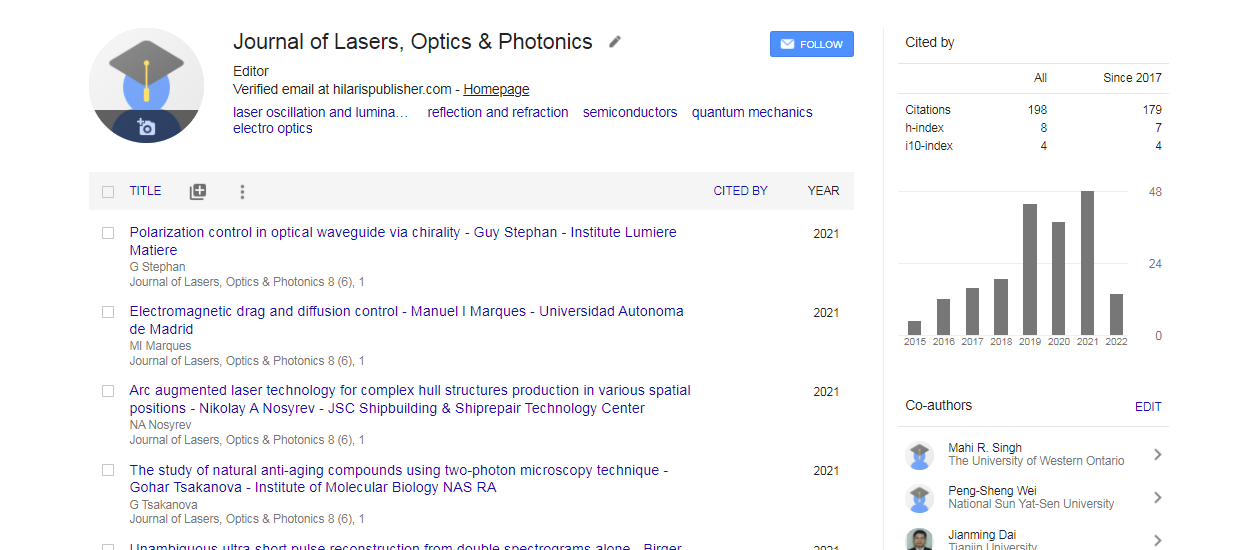
Journal of Lasers, Optics & Photonics received 279 citations as per Google Scholar report