Brief Report - (2025) Volume 9, Issue 3
Received: 01-Sep-2025, Manuscript No. rrms-25-175063;
Editor assigned: 03-Sep-2025, Pre QC No. P-175063;
Reviewed: 17-Sep-2025, QC No. Q-175063;
Revised: 22-Sep-2025, Manuscript No. R-175063;
Published:
29-Sep-2025
, DOI: 10.37421/2952-8127.2025.9.225
Citation: Novak, Katarina. "New Therapeutic Frontiers Reshaping Global Healthcare." Res Rep Med Sci 09 (2025):225.
Copyright: © 2025 Novak K. This is an open-access article distributed under the terms of the Creative Commons Attribution License, which permits unrestricted use, distribution and reproduction in any medium, provided the original author and source are credited.
Modern medicine is witnessing a transformative era, marked by significant advancements across various therapeutic domains. These developments are not only refining existing treatments but also introducing entirely new paradigms for managing complex diseases. Researchers are actively exploring innovative strategies, from highly targeted molecular interventions to comprehensive digital health solutions, aiming to enhance patient outcomes and address previously intractable conditions, ultimately fostering a new era of healthcare. For solid cancers, current immunotherapy strategies show remarkable progress, covering modalities like immune checkpoint inhibitors, adoptive cell therapies, and vaccine approaches, all emphasizing personalized combinations to improve patient outcomes [1].
The field of precision oncology, driven by personalized medicine, utilizes genomics, proteomics, and advanced diagnostics to enable tailored cancer treatments, optimizing drug selection, and improving response rates, while actively addressing cost, accessibility, and resistance mechanisms [10].
Regarding neurodegenerative diseases, current therapeutic strategies are evolving from symptomatic treatments to disease-modifying approaches, with future prospects including gene therapies, stem cell-based treatments, and novel small molecule drugs targeting underlying pathologies [2].
Therapies for autoimmune diseases are advancing through novel pathways and mechanisms, moving beyond broad immunosuppression towards more precise biological agents, small molecule inhibitors, and cell-based therapies designed for increased efficacy and fewer side effects [4].
Recent advancements in gene therapy demonstrate its evolution from a theoretical concept to clinical reality, with successful applications in monogenic disorders now expanding to cancer and infectious diseases, though challenges in delivery systems, safety, and long-term efficacy persist [5].
A powerful tool, CRISPR-Cas9-mediated gene editing, details current strategies and expanding therapeutic applications, outlining precise genome modification for genetic disorders, infectious diseases, and cancer, alongside efforts to enhance specificity, reduce off-target effects, and navigate ethical considerations for clinical translation [6].
Stem cell-based therapeutic strategies in regenerative medicine emphasize their potential to repair or replace damaged tissues and organs, covering embryonic, induced pluripotent, and adult stem cells with applications across medical fields, while addressing challenges in safety and clinical implementation [7].
Latest pharmacological interventions for cardiovascular diseases include novel drug classes and therapeutic approaches, advancing management of hypertension, dyslipidemia, heart failure, and arrhythmias, with a focus on precision medicine and combination therapies to improve outcomes and reduce disease progression [8].
Nutritional interventions are critically evaluated for managing and preventing chronic diseases like diabetes, cardiovascular disease, and obesity, discussing the roles of specific dietary patterns, micronutrients, and functional foods, providing insights into their mechanisms and future integration into therapeutic strategies [9].
Finally, digital therapeutic interventions (DTIs) for mental health conditions, including mobile apps, online platforms, and virtual reality tools, offer a viable and accessible alternative or adjunct to traditional therapies, effectively expanding mental healthcare reach and reducing barriers [3].
This comprehensive and multifaceted landscape of therapeutic advancements collectively represents a dynamic global effort dedicated to profoundly improving human health and overall well-being.
Recent advances in medical science showcase a diverse array of therapeutic interventions, targeting a wide spectrum of human diseases from chronic conditions to complex genetic disorders. A key area of focus is the evolution of treatment modalities, aiming for greater precision and efficacy.
Immunotherapy strategies for solid cancers provide a compelling example, detailing remarkable progress through immune checkpoint inhibitors, adoptive cell therapies, and vaccine approaches, which underline the importance of personalized combinations for enhancing patient outcomes [1]. This development is closely related to the advancements in personalized medicine within precision oncology, where genomics, proteomics, and advanced diagnostics facilitate tailored treatments for cancer patients, optimizing drug selection and improving response rates, all while navigating challenges of cost, accessibility, and resistance mechanisms [10].
The landscape of neurodegenerative diseases is also witnessing significant evolution in therapeutic strategies, moving from symptomatic treatments towards more impactful disease-modifying approaches [2]. This involves a critical assessment of existing interventions and a forward look at promising prospects such as gene therapies, stem cell-based treatments, and novel small molecule drugs designed to address underlying pathologies [2]. Similarly, emerging therapeutic interventions for autoimmune diseases are targeting novel pathways and mechanisms, distinguishing themselves from broad immunosuppression by employing precise biological agents, small molecule inhibitors, and cell-based therapies for improved efficacy and reduced side effects [4].
Gene therapy, once a theoretical concept, has now achieved clinical reality, demonstrating successful applications in monogenic disorders and expanding into cancer and infectious diseases [5]. However, the field continues to contend with challenges related to delivery systems, safety, and ensuring long-term efficacy, which also represent future opportunities for innovation [5]. A specific and highly impactful method is CRISPR-Cas9-mediated gene editing, which outlines current strategies and its rapidly expanding therapeutic applications [6]. This involves precise genome modification for treating genetic disorders, infectious diseases, and cancer, alongside ongoing discussions on enhancing specificity, reducing off-target effects, and addressing ethical considerations crucial for clinical translation [6].
Stem cell-based therapeutic strategies are central to regenerative medicine, emphasizing their considerable potential to repair or replace damaged tissues and organs [7]. This encompasses various stem cell types, including embryonic, induced pluripotent, and adult stem cells, with wide-ranging applications across diverse medical fields, though challenges in safety and clinical implementation remain important considerations [7].
For cardiovascular health, recent pharmacological interventions include novel drug classes and therapeutic approaches that represent significant advancements in managing hypertension, dyslipidemia, heart failure, and arrhythmias [8]. These strategies prioritize precision medicine and combination therapies with the explicit goal of improving cardiovascular outcomes and reducing disease progression [8].
Furthermore, nutritional interventions are gaining recognition for their role in managing and preventing chronic diseases such as diabetes, cardiovascular disease, and obesity [9]. Reviews critically evaluate current evidence, discussing the roles of specific dietary patterns, micronutrients, and functional foods, thereby providing insights into their mechanisms and future integration into broader therapeutic strategies [9].
Finally, digital therapeutic interventions (DTIs) for mental health conditions, encompassing mobile apps, online platforms, and virtual reality tools, are proving to be viable and accessible alternatives or adjuncts to traditional therapies [3]. These DTIs are instrumental in expanding mental healthcare reach and significantly reducing barriers to access, offering new pathways to support mental well-being [3].
The collective effort across these diverse therapeutic areas reflects a concerted push towards more effective, personalized, and accessible healthcare solutions globally.
This collection of articles highlights a broad spectrum of cutting-edge therapeutic advancements across various medical fields. Key developments include significant progress in immunotherapy and personalized medicine for solid cancers, leveraging immune checkpoint inhibitors and advanced diagnostics to optimize patient outcomes. For neurodegenerative diseases, therapies are shifting towards disease-modifying approaches, incorporating gene therapies, stem cell treatments, and novel small molecules to target underlying pathologies. Autoimmune disease treatments are evolving to more precise biological and cell-based interventions, moving beyond broad immunosuppression. Gene therapy and CRISPR-Cas9-mediated gene editing are revolutionizing treatments for monogenic disorders, cancer, and infectious diseases through precise genome modification, while simultaneously addressing challenges in delivery, safety, and ethics. Stem cell-based therapies continue to advance regenerative medicine, offering potential for tissue and organ repair across various medical applications. Pharmacological interventions for cardiovascular diseases are seeing new drug classes and precision medicine approaches to manage conditions like hypertension and heart failure, aiming to improve outcomes. Nutritional interventions are gaining importance for preventing and managing chronic diseases such as diabetes and obesity. Furthermore, digital therapeutic interventions, including mobile apps and virtual reality tools, are expanding mental healthcare accessibility and effectiveness. Together, these diverse strategies underscore a dynamic push towards more targeted, effective, and accessible healthcare solutions globally.
None
None
Robert LF, Kevin JH, Christophe LT. "Immunotherapy for solid cancers: current status and future directions".Cancer Treat Rev 118 (2023):102581.
Indexed at, Google Scholar, Crossref
Jianjun C, Zhenyu S, Xiaodong L. "Therapeutic strategies for neurodegenerative diseases: current state and future prospects".Aging (Albany NY) 14 (2022):8632-8646.
Indexed at, Google Scholar, Crossref
Jun-Hyuk K, Bo-Ram K, Seong-Joo K. "Digital therapeutic interventions for mental health conditions: A systematic review and meta-analysis".J Psychiatr Res 168 (2023):269-281.
Indexed at, Google Scholar, Crossref
Giuseppe E, Maria GF, Stefania C. "Emerging therapeutic interventions for autoimmune diseases: targeting novel pathways and mechanisms".Front Immunol 12 (2021):724806.
Indexed at, Google Scholar, Crossref
Xiaohua X, Xiaoming Z, Jiankang L. "Recent advances in gene therapy: current status and future perspectives".J Cell Mol Med 27 (2023):1478-1490.
Indexed at, Google Scholar, Crossref
Guangwen L, Yunzhi L, Wenyan Z. "CRISPR-Cas9-mediated gene editing in human cells: current strategies and therapeutic applications".Mol Ther Methods Clin Dev 25 (2022):233-242.
Indexed at, Google Scholar, Crossref
Haishan Y, Xiaohong S, Bo L. "Stem cell-based therapeutic strategies for regenerative medicine: an overview".Cell Death Dis 11 (2020):674.
Indexed at, Google Scholar, Crossref
Xinsheng Z, Wenwen F, Jinbao W. "Recent advances in pharmacological therapeutic interventions for cardiovascular diseases".Front Pharmacol 14 (2023):1256059.
Indexed at, Google Scholar, Crossref
Shweta S, Shalini S, Pradeep K. "Nutritional interventions in chronic diseases: A review of current evidence and future directions".J Clin Med 10 (2021):3161.
Indexed at, Google Scholar, Crossref
Giannis M, Vasileios NT, Konstantinos AT. "Personalized medicine in precision oncology: challenges and opportunities".Cancer Treat Rev 121 (2023):102640.
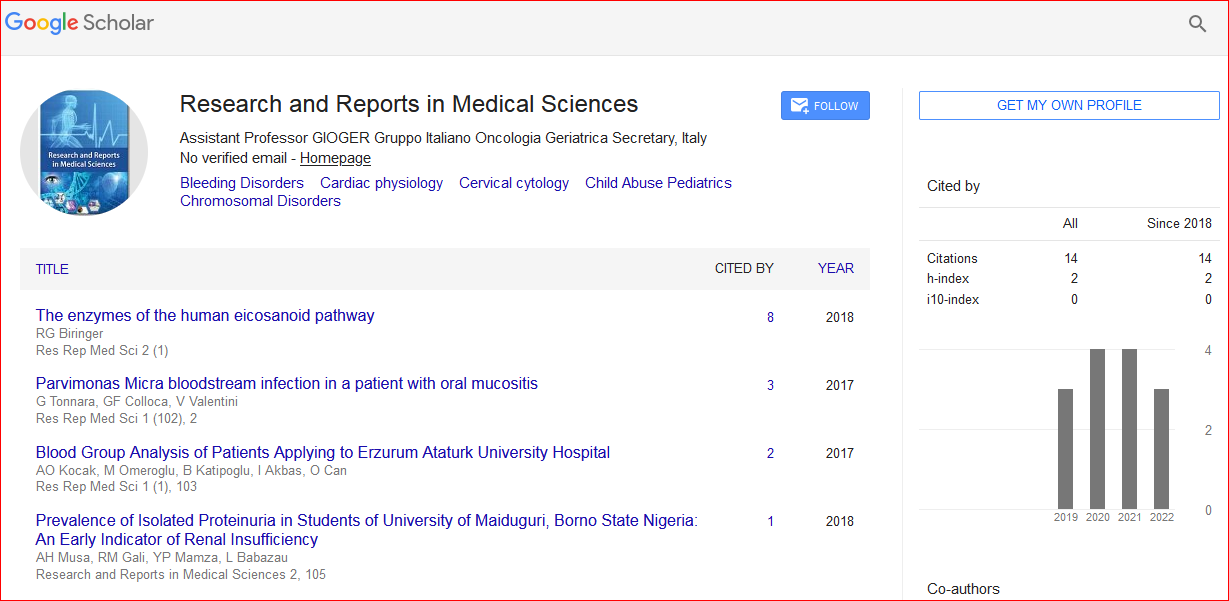
Research and Reports in Medical Sciences received 13 citations as per Google Scholar report