Opinion - (2025) Volume 12, Issue 6
Received: 01-Dec-2025, Manuscript No. ijn-26-184023;
Editor assigned: 03-Dec-2025, Pre QC No. P-184023;
Reviewed: 17-Dec-2025, QC No. Q-184023;
Revised: 22-Dec-2025, Manuscript No. R-184023;
Published:
29-Dec-2025
, DOI: 10.37421/2376-0281.2025.12.662
Citation: Chen, Olivia. ”Neurorehabilitation for Stroke Aphasia: Personalized, Tech-Driven Recovery.” Int J Neurorehabilitation Eng 12 (2025):662.
Copyright: © 2025 Chen O. This is an open-access article distributed under the terms of the Creative Commons Attribution License, which permits unrestricted use, distribution and reproduction in any medium, provided the original author and source are credited.
The field of neurorehabilitation for stroke patients experiencing aphasia is a complex and evolving area of study, requiring a comprehensive and individualized approach to maximize functional communication recovery. Early and personalized interventions are recognized as critical factors in optimizing outcomes, integrating various therapeutic modalities to address the multifaceted nature of language impairments following stroke [1].
The efficacy of technology-assisted interventions, such as virtual reality and serious games, is being explored as a means to enhance engagement and provide novel practice opportunities, potentially accelerating recovery by mimicking real-world communication scenarios [2].
Furthermore, the impact of intensity and dosage in therapy is a significant consideration, with evidence suggesting that higher intensity and longer durations of rehabilitation lead to better outcomes, necessitating carefully calibrated treatment plans [3].
Tailoring speech and language therapy to specific aphasia profiles, distinguishing between expressive, receptive, and global aphasia, is crucial for maximizing patient recovery by applying the most beneficial therapeutic strategies based on accurate diagnosis [4].
The neurobiological underpinnings of aphasia recovery, including neuroplasticity and synaptic reorganization, are increasingly being leveraged in rehabilitation strategies to stimulate these neural processes, providing a scientific basis for evidence-based practices [5].
Beyond the linguistic and cognitive aspects, the psychological impact of aphasia on stroke survivors and their families is substantial, highlighting the importance of integrated psychological support to improve overall well-being and facilitate successful reintegration [6].
Advancements in the assessment of post-stroke aphasia are ongoing, with a focus on developing more sensitive and ecologically valid measures that capture real-world communication abilities to guide rehabilitation planning effectively [7].
The role of caregiver involvement is also paramount, as educating and empowering caregivers to support therapy goals and facilitate communication in daily life positively impacts patient outcomes and family adjustment [8].
An interdisciplinary team approach, involving a collaborative model of various healthcare professionals, is argued to lead to more holistic and effective patient care by addressing the complex needs of stroke survivors comprehensively [9].
Looking towards the future, personalized and precision neurorehabilitation strategies, informed by biomarkers, neuroimaging, and computational modeling, are being developed to optimize individualized treatment plans for each patient's unique profile of brain injury and recovery potential [10].
This comprehensive review examines the multifaceted landscape of neurorehabilitation for stroke patients experiencing aphasia, highlighting the critical role of early and personalized interventions in optimizing functional communication recovery. It underscores the integration of diverse therapeutic approaches, from traditional speech therapy to technological aids and community reintegration programs, emphasizing a patient-centered approach that considers individual needs and co-occurring impairments [1].
The efficacy of technology-assisted interventions, specifically virtual reality and serious games, is explored as a complementary tool to enhance language therapy. These technologies aim to increase engagement and offer novel practice opportunities by providing immersive and interactive experiences that mimic real-world communication scenarios [2].
A significant focus is placed on the impact of intensity and dosage in stroke aphasia rehabilitation, with evidence supporting the notion that higher intensity and longer durations of therapy yield better outcomes. Various models of intensive rehabilitation, such as massed practice and constraint-induced language therapy, are reviewed for their effectiveness, stressing the need for balanced treatment plans [3].
The research further investigates the tailored application of speech and language therapy for different aphasia profiles following stroke, comparing treatments for expressive versus receptive and global aphasia. This comparative analysis provides insights into the most beneficial therapeutic strategies for particular aphasia types, reinforcing the importance of accurate diagnosis and individualized interventions [4].
Delving into the underlying mechanisms, this article explores the neurobiological basis of aphasia recovery, examining neuroplasticity and synaptic reorganization. It discusses how different therapeutic interventions can stimulate these neural processes, providing a scientific foundation for evidence-based rehabilitation practices [5].
The profound psychological impact of aphasia on stroke survivors and their families is addressed, including the emotional and social challenges such as depression, anxiety, and social isolation. The necessity of integrated psychological support within neurorehabilitation programs is emphasized to enhance overall well-being and facilitate successful reintegration into daily life [6].
Advancements in the assessment of post-stroke aphasia are reviewed, covering both traditional and novel methods. The limitations of current assessment tools are discussed alongside the development of more sensitive and ecologically valid measures designed to capture real-world communication abilities, crucial for effective rehabilitation planning and progress monitoring [7].
The vital role of caregiver involvement in the neurorehabilitation of stroke patients with aphasia is examined, highlighting the importance of educating and empowering caregivers to support therapy goals and facilitate communication in everyday life. Strategies for effective caregiver training and the positive impact of their participation on patient outcomes are discussed [8].
The effectiveness of interdisciplinary team approaches in stroke aphasia rehabilitation is investigated, advocating for a collaborative model involving various specialists. This coordinated effort is argued to lead to more holistic and effective patient care by addressing the complex and multifaceted needs of stroke survivors from acute care through long-term recovery [9].
Finally, the concept of personalized and precision neurorehabilitation for stroke-related aphasia is explored, envisioning a future where advancements in biomarkers, neuroimaging, and computational modeling inform individualized treatment plans optimized for each patient's unique profile of brain injury and recovery potential, advocating for a shift towards targeted and adaptive strategies [10].
This collection of research explores various facets of neurorehabilitation for stroke patients with aphasia. Key themes include the importance of early and personalized interventions, the integration of diverse therapeutic approaches, and the efficacy of technology-assisted methods like virtual reality. The impact of therapy intensity and dosage, as well as tailoring treatments to specific aphasia profiles, are crucial considerations for optimizing recovery. The neurobiological underpinnings of recovery, particularly neuroplasticity, inform evidence-based practices. Furthermore, the significant psychological and psychosocial impacts of aphasia are addressed, emphasizing the need for integrated support. Advancements in assessment tools and the critical role of interdisciplinary teams and caregiver involvement are highlighted. The future of rehabilitation points towards personalized and precision approaches, leveraging advanced technologies and data to tailor treatments to individual patient needs and recovery potential.
None
None
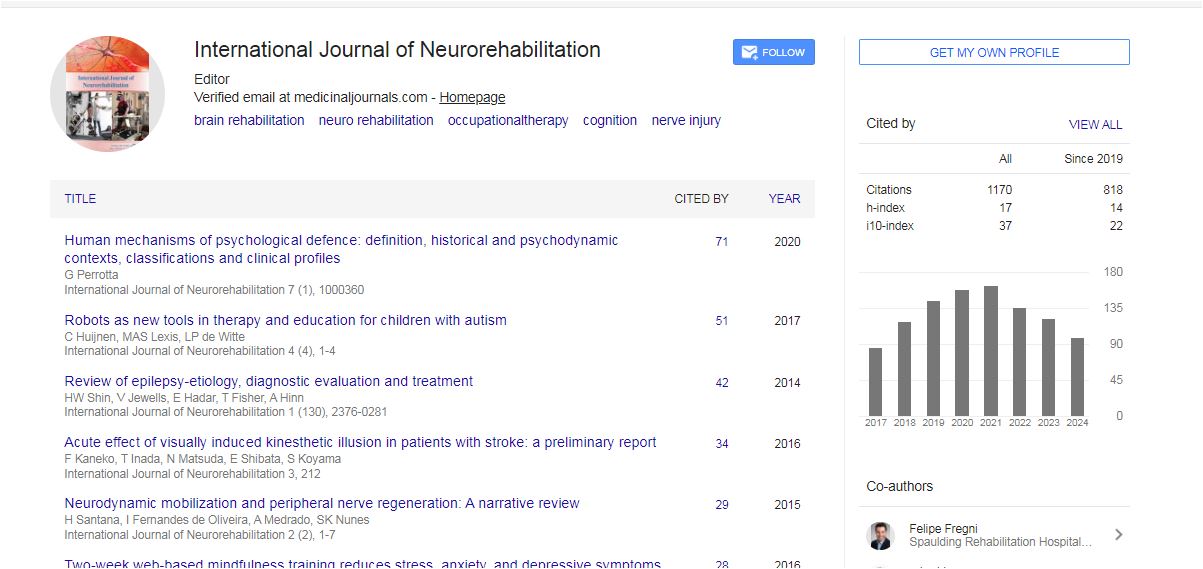
International Journal of Neurorehabilitation received 1078 citations as per Google Scholar report