Brief Report - (2025) Volume 13, Issue 3
Received: 02-Jun-2025, Manuscript No. jpgeb-26-184294;
Editor assigned: 04-Jun-2025, Pre QC No. P-184294;
Reviewed: 18-Jun-2025, QC No. Q-184294;
Revised: 23-Jun-2025, Manuscript No. R-184294;
Published:
30-Jun-2025
, DOI: 10.37421/2329-9002.2025.13.377
Citation: Verma, Alisha K.. ”Multigene Phylogenetics: Resolving Evolutionary History.” J Phylogenetics Evol Biol 13 (2025):377.
Copyright: © 2025 Verma K. Alisha This is an open-access article distributed under the terms of the Creative Commons Attribution License, which permits unrestricted use, distribution and reproduction in any medium, provided the original author and source are credited.
Multigene phylogenetics has emerged as a powerful paradigm for unraveling the intricate tapestry of evolutionary history, offering a more robust and reliable framework compared to traditional single-gene analyses. By integrating data from numerous unlinked genetic loci, this approach effectively mitigates the challenges posed by phenomena such as incomplete lineage sorting, horizontal gene transfer, and variations in evolutionary rates. This comprehensive utilization of genetic information provides a significantly clearer and more nuanced understanding of species divergence patterns, gene duplication events, and the multifaceted evolutionary trajectory of life, ultimately leading to the construction of more dependable phylogenetic trees [1].
The selection of appropriate analytical methodologies is of paramount importance for achieving accurate phylogenetic inference when dealing with complex multigene datasets. A variety of sophisticated techniques, including concatenation, coalescent-based methods, and gene tree parsimony, have been developed to effectively address the inherent complexities introduced by analyzing multiple independent loci. A thorough comprehension of the underlying assumptions and inherent limitations associated with each analytical method is essential for making informed decisions and selecting the most suitable approach, thereby enhancing both the resolution and the overall accuracy of the resulting phylogenetic reconstructions [2].
Next-generation sequencing (NGS) technologies have been instrumental in driving a revolution in the generation of extensive multigene datasets. Reduced-representation genomic methods, such as Restriction site Associated DNA sequencing (RAD-seq) and Genotyping by Sequencing (GBS), have made it feasible to cost-effectively sequence thousands of genetic loci across a large number of individuals. This technological advancement has democratized phylogenomic analyses, making them accessible to a broader spectrum of taxa and enabling the investigation of a wider array of research questions that were previously intractable [3].
Gene duplication and loss events represent fundamental evolutionary processes that can profoundly influence the outcomes of phylogenetic reconstruction. By systematically analyzing the presence or absence of specific genes and their copy numbers across different taxa within a multigene dataset, researchers can gain valuable insights into the history of these events. This detailed analysis can subsequently aid in resolving deeper evolutionary relationships that might otherwise be obscured or rendered ambiguous by analyses relying solely on single genes [4].
Incomplete lineage sorting (ILS) stands as a significant challenge in the field of phylogenomics, where the evolutionary history of individual genes may not accurately reflect the true species tree due to the stochastic sorting of ancestral genetic variations. Multigene analyses, particularly those that employ sophisticated coalescent-based methodologies, are considerably better equipped to effectively address and account for the complexities introduced by ILS. This enables them to recover more accurate species-level phylogenies, even in the presence of this common evolutionary complication [5].
The resolution of evolutionary histories characterized by rapid radiations and complex divergence events can be substantially improved through the utilization of multigene datasets. By providing a larger and more diverse pool of phylogenetic signal, these comprehensive datasets empower researchers to more effectively disentangle the evolutionary relationships among closely related taxa. This improved signal allows for a more precise pinpointing of the timing of divergence events, offering greater accuracy than is typically achievable with single-gene approaches [6].
Homology assessment, the process of identifying corresponding genetic loci across different taxa, is a critical and foundational step in the practice of multigene phylogenetics. Ensuring that homologous loci are accurately identified and correctly aligned is absolutely paramount for obtaining reliable and meaningful evolutionary inferences. Fortunately, significant advancements in bioinformatics tools have greatly facilitated the automation and enhancement of the accuracy of homology assessment, particularly when dealing with the vast datasets characteristic of modern phylogenomic studies [7].
The evolutionary history encoded within non-coding DNA, such as introns and intergenic regions, can also serve as a valuable source of phylogenetic signal when incorporated into multigene analyses. These non-coding regions often exhibit distinct evolutionary rates and patterns compared to their coding counterparts. Consequently, they provide complementary genetic information that can enrich and strengthen the overall phylogenetic reconstruction, leading to more robust conclusions [8].
Horizontal gene transfer (HGT), the movement of genetic material between unrelated organisms, can introduce discordant phylogenetic signals within multigene datasets. The accurate identification and appropriate handling of genes that have been subjected to HGT are crucial steps for achieving a reliable species phylogeny. Fortunately, the ongoing development of advanced phylogenetic methods is continuously improving our ability to detect and effectively mitigate the potentially disruptive impact of HGT on evolutionary analyses [9].
The integration of diverse types of molecular data, encompassing nuclear genes, mitochondrial DNA, and even morphological characters, within a unified multigene framework can significantly bolster phylogenetic resolution. The combination of these complementary datasets provides independent lines of evidence, thereby reducing the inherent reliance on any single source of evolutionary information and leading to more robust and well-supported phylogenetic inferences [10].
Multigene phylogenetics represents a significant advancement over single-gene analyses by employing data from multiple unlinked loci to reconstruct evolutionary relationships. This approach enhances robustness by mitigating issues such as incomplete lineage sorting, horizontal gene transfer, and variations in evolutionary rates, offering a more comprehensive view of species divergence and evolutionary history [1].
The accuracy of phylogenetic inference from multigene datasets is heavily reliant on the choice of analytical methods. Techniques like concatenation, coalescent-based methods, and gene tree parsimony are designed to handle the complexities arising from multiple loci. Understanding the assumptions and limitations of each method is vital for selecting the most appropriate one, thereby improving the precision of the resulting phylogenies [2].
Next-generation sequencing (NGS) technologies have transformed the generation of large multigene datasets. Methods such as RAD-seq and GBS enable cost-effective sequencing of numerous loci across many individuals, making phylogenomic analyses more accessible for a wider range of organisms and research questions [3].
Gene duplication and loss events are common evolutionary processes that can influence phylogenetic reconstruction. Analyzing the presence, absence, and copy number of genes across taxa in multigene datasets provides insights into these events and can help resolve deeper evolutionary relationships that might be obscured by single-gene analyses [4].
Incomplete lineage sorting (ILS) poses a significant challenge in phylogenomics, as gene trees may not align with the species tree due to stochastic sorting of ancestral polymorphisms. Multigene analyses, especially those using coalescent-based methods, are better suited to handle ILS and recover accurate species-level phylogenies [5].
Multigene datasets are crucial for improving the resolution of rapid radiations and complex evolutionary histories. By offering a larger pool of phylogenetic signal, these datasets aid in disentangling closely related taxa and more accurately pinpointing divergence times compared to single-gene approaches [6].
Accurate homology assessment is a critical prerequisite for reliable multigene phylogenetics. Ensuring the correct identification and alignment of homologous loci across taxa is paramount for obtaining accurate evolutionary inferences. Modern bioinformatics tools have significantly improved the automation and accuracy of this process for large datasets [7].
Non-coding DNA, including introns and intergenic regions, can contribute valuable phylogenetic signal when analyzed within a multigene framework. These regions often evolve differently from coding sequences, providing complementary information that enhances phylogenetic reconstruction [8].
Horizontal gene transfer (HGT) can introduce conflicting phylogenetic signals in multigene datasets. Identifying and appropriately managing genes affected by HGT is essential for obtaining an accurate species phylogeny. Advanced phylogenetic methods are being developed to detect and mitigate the impact of HGT [9].
The integration of diverse data types, such as nuclear genes, mitochondrial DNA, and morphological characters, within a multigene framework can improve phylogenetic resolution. Complementary datasets provide independent evidence, reducing reliance on any single source of evolutionary information [10].
Multigene phylogenetics offers a more robust approach to understanding evolutionary history than single-gene analyses. It overcomes challenges like incomplete lineage sorting and horizontal gene transfer by using data from multiple genetic loci. Next-generation sequencing technologies have made generating large multigene datasets more accessible. Analytical methods and accurate homology assessment are crucial for reliable results. Gene duplication, loss, and non-coding DNA also contribute valuable phylogenetic information. Advanced methods are being developed to handle complexities like horizontal gene transfer and to integrate diverse data types for enhanced phylogenetic resolution.
None
None
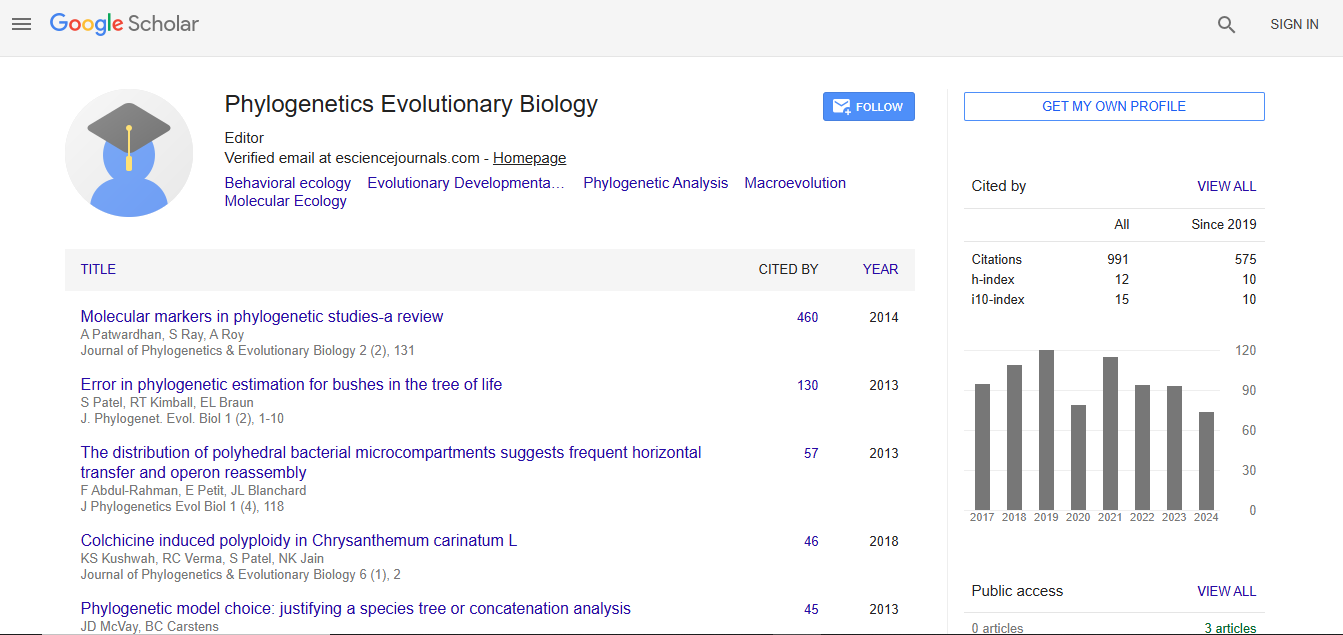
Journal of Phylogenetics & Evolutionary Biology received 911 citations as per Google Scholar report