Brief Report - (2025) Volume 13, Issue 3
Received: 02-Jun-2025, Manuscript No. jpgeb-26-184295;
Editor assigned: 04-Jun-2025, Pre QC No. P-184295;
Reviewed: 18-Jun-2025, QC No. Q-184295;
Revised: 23-Jun-2025, Manuscript No. R-184295;
Published:
30-Jun-2025
, DOI: 10.37421/2329-9002.2025.13.378
Citation: Feldmann, Markus I.. ”Multigene Data: Unlocking Complex Evolutionary Histories.” J Phylogenetics Evol Biol 13 (2025):378.
Copyright: © 2025 Feldmann I. Markus This is an open-access article distributed under the terms of the Creative Commons Attribution License, which permits unrestricted use, distribution and reproduction in any medium, provided the original author and source are credited.
The field of molecular phylogenetics has undergone a significant transformation with the widespread adoption of multigene datasets, offering a more robust resolution of evolutionary relationships than was previously achievable with single-locus analyses. This advanced approach effectively mitigates critical issues such as gene tree-species tree discordance, which can arise from phenomena like incomplete lineage sorting, horizontal gene transfer, or varying selective pressures. By examining numerous independent genetic loci, phylogenomic methods are capable of more accurately inferring deep divergences and unraveling complex evolutionary histories, thereby providing a clearer understanding of speciation events and evolutionary rates across a broad spectrum of taxa. Reconciling gene trees with species trees presents a common and significant complication in phylogenetic analyses, particularly when dealing with multigene datasets. Species tree inference methods are specifically designed to address these gene tree discrepancies, aiming to accurately estimate the underlying species phylogeny. The utilization of techniques such as coalescent-based methods is fundamental for adequately accounting for incomplete lineage sorting, which is recognized as a primary driver of gene tree variation. The selection of an appropriate phylogenetic method is a critical determinant of the outcome in analyses employing multigene datasets. While concatenation methods involve pooling all gene data into a single, large supermatrix, species tree methods opt for analyzing individual gene trees before combining their topologies. Each of these approaches possesses distinct advantages and disadvantages, with species tree methods generally being considered more resilient to diverse evolutionary processes. The advent of high-throughput sequencing technologies has profoundly revolutionized the generation of multigene datasets, thereby enabling the reconstruction of evolutionary histories for previously challenging groups of organisms. The increasing availability of genomic and transcriptomic data for a wide array of species facilitates an unprecedented level of phylogenetic resolution. This surge in data necessitates concurrent advancements in computational power and the development of standardized protocols for data acquisition, curation, and analysis to guarantee reproducible and reliable phylogenetic inferences. Interpreting phylogenetic trees derived from multigene datasets demands meticulous consideration of potential biases that could influence the results. Factors such as saturation in sequence evolution, variations in evolutionary rates across different genes, and the presence of paralogs can all potentially confound the phylogenetic signals. The deployment of advanced statistical models and rigorous diagnostic checks is paramount for identifying and effectively mitigating these biases, thereby ensuring that the inferred relationships accurately represent the true evolutionary history of the organisms under study. Phylogenomic studies are increasingly being leveraged to address fundamental questions within evolutionary biology. These include investigations into the timing of major evolutionary radiations, the reconstruction of ancestral genomes, and the precise identification of genes that have been subjected to selective pressures. The comprehensive nature of multigene datasets provides the essential resolution and statistical power required to tackle these intricate problems, ultimately leading to novel insights into the processes that have shaped global biodiversity. The development of robust phylogenetic methods specifically tailored for multigene datasets is indispensable for advancing our comprehension of evolutionary history. Sophisticated techniques such as Bayesian inference and maximum likelihood methods, when applied to extensive datasets, offer powerful analytical tools for inferring complex evolutionary patterns. The ongoing enhancement of algorithms and computational resources continues to expand our capacity to analyze increasingly large and diverse genomic datasets. Comparative genomics, significantly empowered by the availability of multigene datasets, plays an instrumental role in identifying genes that have undergone substantial evolutionary modification. Through the systematic comparison of gene content and evolutionary rates across different species, researchers can accurately pinpoint genes that are involved in crucial processes such as adaptation, speciation, and the emergence of novel traits. The precision of phylogenetic reconstructions derived from multigene datasets is profoundly dependent on both the quality and the sheer quantity of the data employed. Consequently, concerted efforts focused on standardizing data collection, annotation procedures, and the overall phylogenetic analysis pipelines are essential for ensuring comparability and reproducibility across diverse research studies. Careful curation of sequence data and the judicious selection of informative genetic loci represent critical preliminary steps in the generation of reliable phylogenetic hypotheses. Multigene datasets have proven to be transformative in resolving particularly challenging phylogenetic relationships, especially within rapidly diversifying lineages or among groups characterized by complex evolutionary histories. These comprehensive datasets confer the necessary statistical power to surmount obstacles such as short divergence times and the prevalence of homoplasy, thereby facilitating more confident reconstructions of evolutionary trees and a more profound understanding of biodiversity patterns.
Molecular phylogenetics has seen remarkable advancements, largely driven by the integration of multigene datasets, which provide a more robust framework for resolving evolutionary relationships compared to analyses based on single genes. This approach is crucial for mitigating issues like gene tree-species tree discordance that can arise from factors such as incomplete lineage sorting, horizontal gene transfer, or differential selection pressures. By analyzing a multitude of independent genetic loci, phylogenomic methods can achieve greater accuracy in inferring deep evolutionary divergences and complex evolutionary histories, ultimately illuminating speciation events and evolutionary rates across diverse taxa. Gene tree heterogeneity poses a common challenge in phylogenetics, especially when working with multigene datasets. Species tree inference methodologies are designed to reconcile these observed gene tree discrepancies to provide a reliable estimate of the underlying species phylogeny. Techniques such as coalescent-based methods are vital for accounting for incomplete lineage sorting, a primary contributor to gene tree variation, underscoring the importance of understanding the patterns and causes of gene tree discordance for accurate phylogenetic signal interpretation. The selection of the appropriate phylogenetic method profoundly influences the outcomes of analyses that utilize multigene datasets. Concatenation methods, which involve combining all gene data into a single large matrix, offer one approach, while species tree methods analyze individual gene trees before aggregating their topologies. Both methodologies have their respective strengths and limitations, with species tree methods generally demonstrating greater robustness when faced with diverse evolutionary processes. High-throughput sequencing technologies have revolutionized the generation of multigene datasets, thereby enabling the reconstruction of evolutionary histories for groups that were previously intractable. The widespread availability of genomes and transcriptomes for a broad range of organisms facilitates an unprecedented level of phylogenetic resolution. This data explosion necessitates parallel advancements in computational capabilities and the establishment of standardized protocols for data acquisition, curation, and analysis to ensure the reproducibility and reliability of phylogenetic inferences. The interpretation of phylogenetic trees derived from multigene datasets requires careful attention to potential biases. Factors such as saturation in sequence evolution, variations in evolutionary rates among genes, and the presence of paralogs can distort phylogenetic signals. The application of advanced statistical models and rigorous diagnostic checks is essential for identifying and mitigating these biases, thereby ensuring that the inferred relationships accurately reflect the true evolutionary history of the organisms. Phylogenomic studies are increasingly employed to tackle fundamental questions in evolutionary biology, including the precise timing of major evolutionary radiations, the reconstruction of ancestral genomes, and the identification of genes subjected to selection. Multigene datasets provide the necessary resolution and statistical power to address these complex issues, leading to novel insights into the processes that have shaped biodiversity. The development of effective phylogenetic methods for multigene datasets is critical for advancing our understanding of evolutionary history. Bayesian inference and maximum likelihood methods, particularly when applied to large datasets, provide powerful tools for inferring complex evolutionary patterns. Continuous improvements in algorithmic approaches and computational resources enable the analysis of increasingly vast and diverse genomic datasets. Comparative genomics, significantly enhanced by multigene datasets, is a powerful tool for identifying genes that have undergone substantial evolutionary changes. By comparing gene content and evolutionary rates across different species, researchers can pinpoint genes involved in adaptation, speciation, and the development of novel traits, offering a comprehensive view of molecular evolution. The accuracy of phylogenetic reconstructions from multigene datasets is highly dependent on the quality and quantity of the data. Standardizing data collection, annotation, and phylogenetic analysis pipelines is crucial for ensuring comparability and reproducibility across studies. Careful data curation and the selection of informative loci are paramount for generating reliable phylogenetic hypotheses. The application of multigene datasets has profoundly impacted the resolution of challenging phylogenetic relationships, especially in rapidly diversifying groups or those with complex evolutionary histories. These datasets provide the statistical power to overcome issues like short divergence times and homoplasy, leading to more confident tree reconstructions and a better understanding of biodiversity patterns.
Multigene datasets have significantly advanced molecular phylogenetics by providing more robust evolutionary relationship resolutions than single-locus analyses. They help overcome issues like gene tree-species tree discordance caused by incomplete lineage sorting and horizontal gene transfer. Phylogenomic methods use numerous genetic loci to infer deep divergences and complex histories, offering clearer insights into speciation and evolutionary rates. Challenges include selecting appropriate loci, concatenation strategies, and analytical models. Reconciling gene trees with species trees is crucial, with coalescent-based methods aiding in understanding incomplete lineage sorting. Methodological choices like concatenation versus species tree methods impact outcomes, with the latter often considered more robust. High-throughput sequencing has enabled unprecedented phylogenetic resolution, necessitating computational advancements and standardized protocols. Interpreting phylogenetic trees requires careful consideration of biases such as sequence saturation and varying evolutionary rates, addressed by advanced statistical models. Phylogenomics addresses fundamental evolutionary questions by providing resolution and statistical power for complex problems. Modern phylogenetic inference utilizes Bayesian and maximum likelihood methods on large datasets, with ongoing algorithmic and computational improvements. Comparative genomics with multigene datasets helps identify genes under selection or involved in adaptation. Data quality and standardization in collection, annotation, and analysis pipelines are vital for reliable phylogenetic hypotheses. Ultimately, multigene datasets are transformative for resolving complex evolutionary histories and understanding biodiversity.
None
None
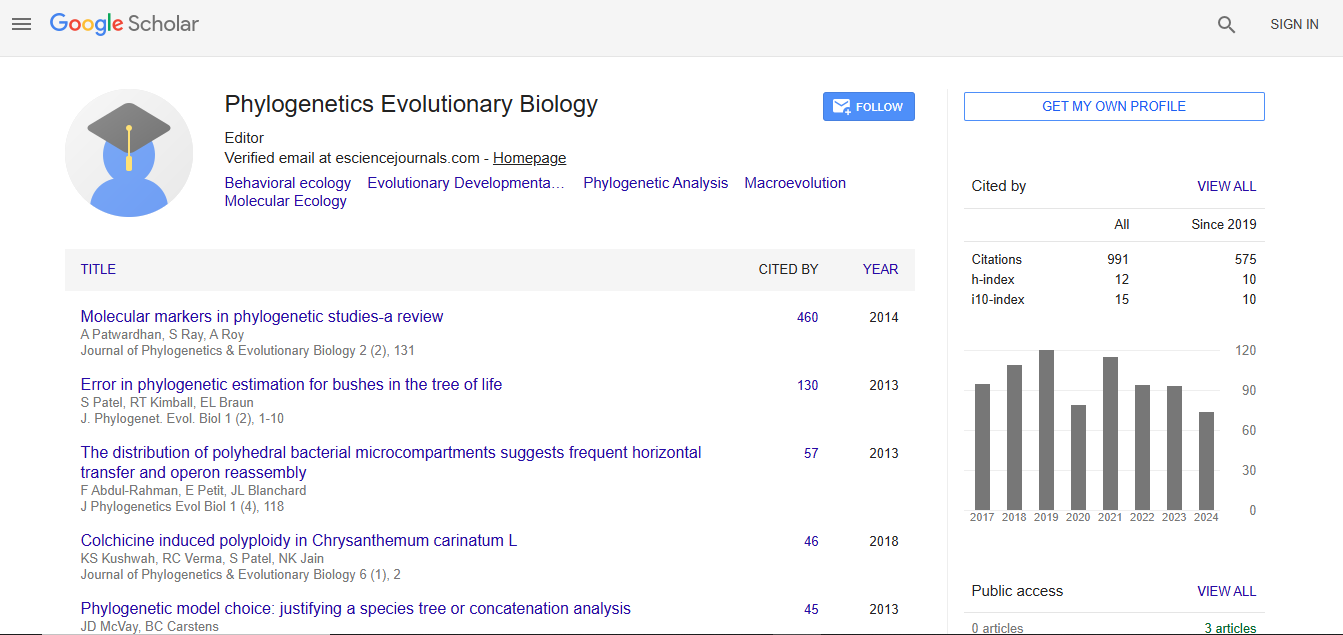
Journal of Phylogenetics & Evolutionary Biology received 911 citations as per Google Scholar report