Commentary - (2025) Volume 13, Issue 5
Received: 01-Oct-2025, Manuscript No. jpgeb-26-184321;
Editor assigned: 03-Oct-2025, Pre QC No. P-184321;
Reviewed: 17-Oct-2025, QC No. Q-184321;
Revised: 22-Oct-2025, Manuscript No. R-184321;
Published:
29-Oct-2025
, DOI: 10.37421/2329-9002.2025.13.402
Citation: Thompson, Zoe E.. ”Integrative Taxonomy: Uniting Data for Evolutionary Insight.” J Phylogenetics Evol Biol 13 (2025):402.
Copyright: © 2025 Thompson E. Zoe This is an open-access article distributed under the terms of the Creative Commons Attribution License, which permits unrestricted use, distribution and reproduction in any medium, provided the original author and source are credited.
The field of taxonomy is undergoing a significant transformation, moving towards more comprehensive and robust methodologies for species delimitation and evolutionary understanding. Integrative taxonomy, by merging molecular and morphological data, offers precisely this advanced approach, addressing the inherent limitations of relying on single data sources to achieve more accurate phylogenetic reconstructions and a clearer depiction of biodiversity [1].
DNA barcoding has emerged as a pivotal molecular tool. When synergistically integrated with morphological characteristics, it markedly elevates the accuracy of identifying cryptic species. This combined strategy is of paramount importance for conservation initiatives, enabling precise biodiversity mapping, particularly in regions that are currently under-researched [2].
Phylogenomic analyses, which leverage extensive molecular datasets, provide an unprecedented resolution for unraveling complex evolutionary relationships. Nevertheless, the integration of these molecular insights with fossil data and studies on trait evolution, drawing from morphological evidence, is crucial for constructing a more complete evolutionary narrative [3].
Morphological variation, though informative, can sometimes be subtle and potentially misleading, especially when distinguishing between closely related species. In such scenarios, molecular data, particularly mitochondrial DNA sequences, serve as a powerful complement, revealing genetic divergences that might not be readily apparent through morphological examination alone [4].
The amalgamation of morphological and molecular datasets empowers researchers to rigorously test hypotheses concerning evolutionary processes. For example, this integrated approach allows for the investigation of whether observed morphological differences are indeed correlated with genetic divergence, thereby signifying distinct evolutionary trajectories [5].
Despite the significant advantages of integrative taxonomy, certain challenges persist, primarily concerning data quality and standardization. Ensuring uniformity and consistency in both molecular sequencing protocols and morphological measurement techniques is absolutely vital for conducting robust comparative analyses and drawing accurate taxonomic conclusions [6].
The application of sophisticated imaging techniques, such as micro-CT scanning, has revolutionized the acquisition of detailed morphological data. This data can be digitized and seamlessly integrated with molecular phylogenies, thereby illuminating intricate anatomical structures and their profound evolutionary significance [7].
Metabarcoding, a high-throughput molecular technique, offers an efficient means to assess biodiversity within environmental samples. Its integration with targeted morphological identification of key taxa is essential for achieving comprehensive and reliable biodiversity assessments, especially when dealing with complex ecosystems [8].
Conservation genomics, fundamentally grounded in integrative taxonomic principles, provides critical insights for identifying distinct management units and evaluating genetic diversity within populations. This crucial information directly informs the design and implementation of effective conservation strategies [9].
The ongoing advancement and development of novel computational tools are indispensable for effectively managing and integrating the diverse datasets characteristic of integrative taxonomy. These tools are instrumental in visualizing and analyzing the intricate relationships that exist between molecular and morphological features [10].
Integrative taxonomy represents a paradigm shift in species discovery and understanding, moving beyond the limitations of single-source data to a more holistic approach. By combining molecular data, such as DNA sequences, with traditional morphological characteristics, researchers can achieve a more comprehensive and robust assessment of species boundaries and evolutionary histories. This synergy is essential for overcoming the challenges posed by cryptic species and for building more accurate phylogenetic trees [1].
DNA barcoding, a cornerstone of molecular identification, demonstrates its enhanced utility when employed in conjunction with morphological assessments. This integrated strategy significantly improves the accuracy of species identification, particularly for cryptic taxa that are morphologically similar. Such precision is vital for effective biodiversity conservation, especially in poorly studied regions where accurate species inventories are crucial for informed management decisions [2].
Phylogenomic studies, utilizing vast molecular datasets, offer unparalleled resolution in reconstructing evolutionary relationships. However, the full potential of these analyses is realized when they are complemented by other lines of evidence, including fossil data and detailed studies of morphological trait evolution. This multi-faceted approach provides a more complete and nuanced evolutionary narrative [3].
Morphological characteristics, while valuable, can sometimes be ambiguous, especially in closely related species. Molecular data, particularly mitochondrial DNA sequences, act as a critical counterpoint, allowing for the detection of genetic divergence that may not be discernible through morphology alone. This capability is indispensable for resolving taxonomic uncertainties [4].
The power of integrative taxonomy lies in its ability to facilitate rigorous hypothesis testing regarding evolutionary processes. By correlating morphological differences with genetic divergence, researchers can ascertain whether observed phenotypic variations are indicative of distinct evolutionary pathways. This allows for a more nuanced understanding of adaptation and speciation [5].
While integrative taxonomy offers substantial benefits, practical implementation faces challenges related to data quality and standardization. Ensuring consistency in molecular sequencing protocols and precision in morphological measurements are critical prerequisites for robust comparative analyses and reliable taxonomic conclusions. Addressing these issues is paramount for the advancement of the field [6].
Modern advancements in imaging technologies, such as micro-CT scanning, are providing unprecedented levels of detail in morphological data. The digitization of these high-resolution morphological datasets enables their seamless integration with molecular phylogenies, offering profound insights into anatomical structures and their evolutionary significance, particularly in comparative studies [7].
Metabarcoding technologies are revolutionizing biodiversity assessment by enabling rapid analysis of environmental samples. The accurate interpretation of these molecular datasets is significantly enhanced when combined with targeted morphological identification of key taxa. This integrated approach ensures more comprehensive and reliable biodiversity assessments, especially in diverse and complex ecosystems [8].
Conservation genomics draws heavily on the principles of integrative taxonomy to inform conservation practices. By identifying genetically distinct management units and assessing population-level genetic diversity, this approach provides essential data for developing targeted and effective conservation strategies, ultimately contributing to biodiversity preservation [9].
The integration of diverse datasets in integrative taxonomy necessitates the development and application of sophisticated computational tools. These tools are crucial for handling the complexity of molecular and morphological data, enabling researchers to visualize, analyze, and interpret the intricate relationships between different data types, thus driving new discoveries [10].
Integrative taxonomy enhances species delimitation and evolutionary understanding by combining molecular and morphological data, overcoming the limitations of single-source approaches. DNA barcoding, coupled with morphology, improves cryptic species identification, crucial for conservation. Phylogenomics, when integrated with fossil and morphological data, provides a more complete evolutionary picture. Molecular data complements subtle morphological variations, revealing genetic divergences. The integration of these datasets allows for hypothesis testing on evolutionary processes. Challenges in integrative taxonomy include data quality and standardization. Advanced imaging techniques like micro-CT scanning offer detailed morphological data for integration with molecular phylogenies. Metabarcoding, combined with morphological identification, provides comprehensive biodiversity assessments. Conservation genomics, based on integrative taxonomy, aids in identifying management units and assessing genetic diversity for effective conservation. Novel computational tools are essential for handling and integrating diverse datasets in this field.
None
None
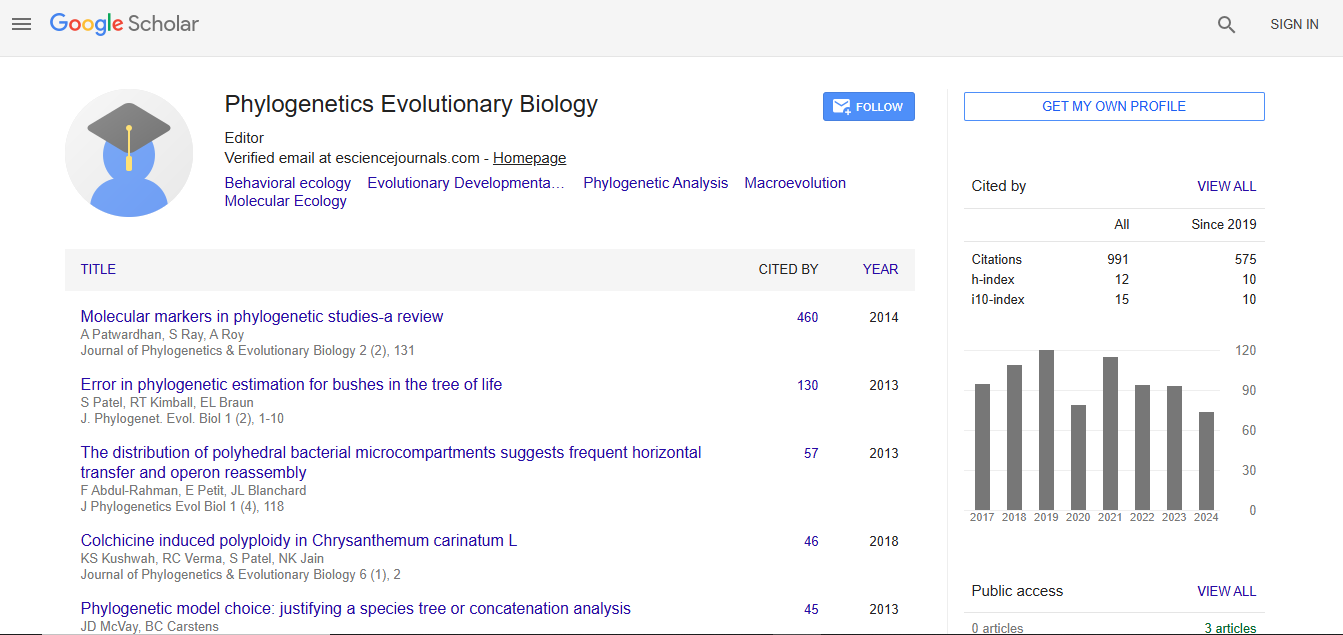
Journal of Phylogenetics & Evolutionary Biology received 911 citations as per Google Scholar report