Opinion - (2025) Volume 13, Issue 2
Received: 01-Apr-2025, Manuscript No. jpgeb-25-157465;
Editor assigned: 03-Apr-2025, Pre QC No. P-157465;
Reviewed: 17-Apr-2025, QC No. Q-157465;
Revised: 22-Apr-2025, Manuscript No. R-157465;
Published:
29-Apr-2025
, DOI: 10.37421/2329-9002.2025.13.368
Citation: Meyer, Lucas. ”Genomic Underpinnings and Mechanisms of Speciation.” J Phylogenetics Evol Biol 13 (2025):368.
Copyright: © 2025 Meyer L. This is an open-access article distributed under the terms of the Creative Commons Attribution License, which permits unrestricted use, distribution
and reproduction in any medium, provided the original author and source are credited.
The process of speciation, fundamentally the formation of new and distinct species, is a cornerstone of evolutionary biology. Modern research, greatly augmented by genomic technologies, provides profound insights into the complex mechanisms driving this divergence. One significant area of focus involves understanding the genomic underpinnings of speciation, exemplified by studies using model organisms like stickleback fish. These investigations reveal how specific genomic regions contribute to reproductive isolation, highlighting the dynamic interplay between adaptive divergence and persistent gene flow across the genome, ultimately defining the architecture of speciation where differentiation occurs despite ongoing genetic exchange[1].
Furthering this genomic perspective, the intricate relationship between gene flow and natural selection is now seen as a primary sculptor of the genomic landscape during speciation. Theoretical and empirical models integrate these powerful evolutionary forces to explain observed patterns of genomic divergence between populations on their path to becoming distinct species. A critical aspect of this understanding emphasizes the varying roles of recombination rates and effective population sizes in shaping this genomic landscape[2].
Speciation, however, isn't solely confined to scenarios with geographic barriers. Sympatric speciation, which involves the evolution of reproductive isolation within the same geographic area, presents a compelling alternative. Research indicates that resource competition can be a potent driver in such contexts. Through divergent selection pressures on resource use, mechanisms like assortative mating can lead to the formation of new species, providing robust theoretical and empirical evidence for this less intuitive pathway[3].
To clarify the genetic basis of these isolating barriers, the genetic architecture of reproductive isolation has been extensively explored, often through quantitative trait locus (QTL) mapping. This powerful technique helps identify specific genomic regions responsible for preventing gene flow, encompassing both pre-zygotic and post-zygotic isolation mechanisms. Such studies offer a much clearer and detailed picture of the underlying genetic components essential for species formation[4].
Moreover, the role of hybridization in speciation is undergoing a re-evaluation, moving beyond its traditional perception as purely disruptive. Contemporary understanding acknowledges that hybridization can, in fact, contribute significantly to the formation of new species. This includes diverse mechanisms where it introduces novel genetic variation, potentially fueling adaptive radiation, or by forming hybrid lineages that themselves become reproductively isolated from their parental species[5].
While sympatric speciation offers one pathway, allopatric speciation, characterized by geographic isolation, remains a crucial mode. Even with some limited gene flow, geographic separation can lead to the accumulation of genomic incompatibilities over time, resulting in the formation of distinct species. Genomic data in complex ring species illustrates the fine-scale genomic patterns intricately linked with this process, showcasing divergence even under conditions of partial genetic exchange[6].
Ecological speciation, another key mechanism, underscores how adaptation to divergent environments can drive the evolution of new species. Using model systems like freshwater fish, researchers have detailed the genetic and phenotypic changes arising from adaptations to distinct ecological niches. These adaptations ultimately lead to the reproductive isolation necessary for species formation, highlighting the profound impact of environmental pressures on evolutionary trajectories[7].
A genomic perspective also provides vital insights into the timing and dynamics of speciation. By analyzing molecular clocks and patterns of genomic divergence, scientists can estimate precisely when species diverged. This approach helps to understand the variable rates at which reproductive isolation accumulates across the genome and over evolutionary time, offering a chronological framework to the speciation process[8].
In the contemporary genomic era, our understanding of speciation continues to evolve, tracing the process from initial divergence through to complete reproductive isolation. Genomics integrates various insights to elucidate how different mechanisms contribute to the progressive build-up of reproductive barriers and how these barriers are spatially distributed across the genome, providing a holistic view of species divergence[9].
Finally, studying the genetic basis of adaptation and speciation through the lens of parallel evolution offers compelling lessons. It demonstrates how similar environmental pressures can independently drive the evolution of analogous adaptations in different lineages. Critically, these parallel changes often play a significant role in the development of reproductive isolation between populations as they diverge, reinforcing the adaptive nature of speciation[10].
Understanding speciation involves deciphering the complex genetic and ecological processes that lead to reproductive isolation and the formation of distinct species. Genomic studies are at the forefront of this effort, providing detailed insights into the architecture of speciation. For instance, research on model organisms like stickleback fish reveals how specific genomic regions, often termed 'speciation islands', become highly differentiated even in the presence of ongoing gene flow, underscoring the interplay between adaptive divergence and genetic exchange across the genome [1]. The broader genomic landscape of speciation is further shaped by the integration of gene flow and natural selection, where factors such as varying recombination rates and effective population sizes significantly influence patterns of genomic divergence between populations [2].
Speciation can occur through various geographical contexts. Sympatric speciation, for example, illustrates how species can diverge without physical barriers. Here, resource competition emerges as a key driver, initiating divergent selection pressures on resource use. This can lead to mechanisms like assortative mating, where individuals prefer mates with similar traits, thereby reinforcing reproductive isolation and enabling the formation of new species within the same geographic area [3]. In contrast, allopatric speciation, traditionally associated with geographic isolation, still involves complex genomic dynamics. Studies show that even with limited gene flow, geographic separation can facilitate the accumulation of genomic incompatibilities, leading to the formation of distinct species. Genomic analysis of complex ring species helps elucidate the fine-scale patterns of divergence associated with this mode of speciation [6].
The genetic basis of reproductive isolation, regardless of the geographical context, is a critical area of study. Quantitative trait locus (QTL) mapping has been instrumental in identifying the specific genomic regions responsible for barriers to gene flow. These barriers can be pre-zygotic, preventing mating or fertilization, or post-zygotic, affecting hybrid viability or fertility. Such mapping efforts offer a high-resolution view of the genetic underpinnings of speciation [4]. Beyond direct genetic barriers, ecological speciation emphasizes the role of adaptation to divergent environments. Using systems like freshwater fish, researchers observe how adaptations to distinct ecological niches drive genetic and phenotypic changes, ultimately leading to reproductive isolation and species formation [7]. Furthermore, the genetic basis of adaptation and speciation is often illuminated through parallel evolution, where similar environmental pressures independently drive analogous adaptations that contribute to reproductive isolation between diverging populations [10].
Hybridization, historically viewed as a detrimental process, is increasingly recognized for its constructive role in evolution and speciation. It can introduce novel genetic variation, which may fuel adaptive radiation, and can even lead to the formation of entirely new, reproductively isolated hybrid lineages. This challenges simplistic views and highlights the diverse mechanisms through which hybridization influences the evolution of new species [5]. The modern genomic era provides an updated and comprehensive view of speciation, tracking the entire process from initial population divergence to complete reproductive isolation. It leverages genomic insights to illustrate precisely how different mechanisms contribute to the accumulation of reproductive barriers and how these barriers are distributed across the genome [9].
Finally, understanding the tempo and mode of speciation is crucial. Genomic analyses, incorporating tools like molecular clocks, allow scientists to estimate the timing of species divergence. This genomic perspective also clarifies the dynamics of speciation by identifying the varying rates at which reproductive isolation accumulates across different parts of the genome and over vast evolutionary timescales [8]. Together, these studies paint a nuanced picture of speciation as a dynamic and multifaceted process, driven by interactions between genetics, ecology, and environmental pressures, all increasingly understood through the powerful lens of genomics.
The diverse mechanisms and genomic underpinnings of speciation are central to understanding how new species arise. Research highlights the intricate interplay between adaptive divergence, gene flow, and reproductive isolation across the genome. For instance, studies on stickleback fish reveal how specific genomic regions differentiate even with ongoing gene exchange, shaping the architecture of speciation. Gene flow and natural selection are crucial forces sculpting the genomic landscape during this process, with varying recombination rates and effective population sizes playing significant roles. Speciation can occur in sympatry, where resource competition drives reproductive isolation through divergent selection pressures and assortative mating, leading to new species without geographic barriers. Quantitative trait locus mapping further clarifies the genetic architecture of reproductive isolation, identifying genomic regions responsible for pre- and post-zygotic isolation mechanisms. Hybridization, traditionally seen as disruptive, is now recognized for its constructive role in forming new species by introducing novel genetic variation and creating reproductively isolated hybrid lineages. Allopatric speciation, often involving geographic isolation, can accumulate genomic incompatibilities even with limited gene flow, revealing fine-scale genomic patterns. Ecological speciation, driven by adaptation to divergent environments, especially in model systems like freshwater fish, results in genetic and phenotypic changes that foster reproductive isolation. The genomic era provides a contemporary view, tracking speciation from initial divergence to complete reproductive isolation by integrating genomic insights to understand how reproductive barriers accumulate and distribute across the genome. Moreover, genomic analyses, including molecular clocks, help estimate the timing and dynamics of speciation, revealing the rates at which isolation builds over evolutionary time. Parallel evolution offers further lessons, showing how similar environmental pressures can independently drive analogous adaptations and contribute to reproductive isolation.
None
None
Indexed at, Google Scholar, Crossref
Indexed at, Google Scholar, Crossref
Indexed at, Google Scholar, Crossref
Indexed at, Google Scholar, Crossref
Indexed at, Google Scholar, Crossref
Indexed at, Google Scholar, Crossref
Indexed at, Google Scholar, Crossref
Indexed at, Google Scholar, Crossref
Indexed at, Google Scholar, Crossref
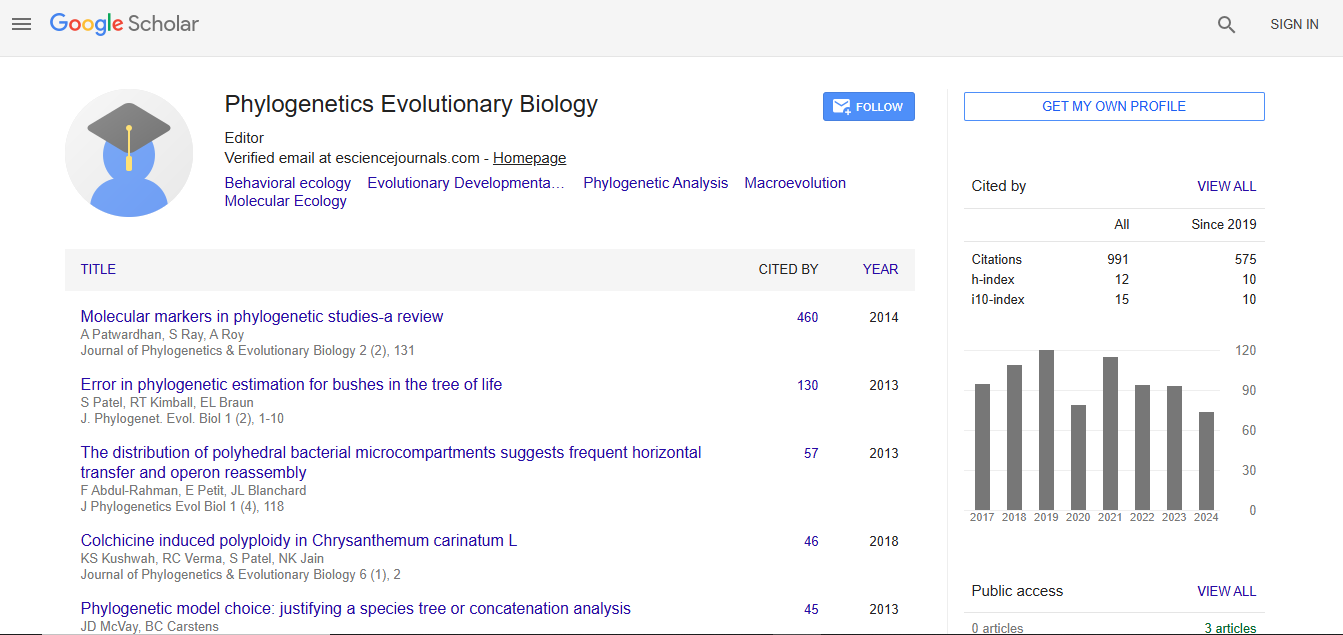
Journal of Phylogenetics & Evolutionary Biology received 911 citations as per Google Scholar report