Opinion - (2025) Volume 13, Issue 1
Received: 03-Feb-2025, Manuscript No. jpgeb-25-741568;
Editor assigned: 05-Feb-2025, Pre QC No. P-741568;
Reviewed: 19-Feb-2025, QC No. Q-741568;
Revised: 24-Feb-2025, Manuscript No. R-741568;
Published:
28-Feb-2025
, DOI: 10.37421/2329-9002.2025.13.356
Citation: Lopez, Maria. ”Genomic and Ecological Drivers of Speciatio.”
J Phylogenetics Evol Biol 13 (2025):356.
Copyright: © 2025 Lopez M. This is an open-access article distributed under the terms of the Creative Commons Attribution License, which permits unrestricted use, distribution
and reproduction in any medium, provided the original author and source are credited.
A foundational study in speciation research delves into how differences in salinity tolerance drive rapid ecological divergence within a midge radiation. Utilizing comprehensive genomic data, researchers pinpointed specific genomic regions crucial for adaptation to varying salinity levels. This work profoundly highlights the potent role of ecological pressures in fostering rapid divergence, even across remarkably short evolutionary timescales. It further establishes that distinct environmental gradients can quickly lead to the emergence of new, discrete species. [1] Further insights into species boundary formation come from an investigation into alpine cushion plants, where both environmental factors and mechanisms preventing interbreeding contribute to species distinctions. The evidence suggests that while initial divergence stems from differences in ecological niches, robust reproductive isolation mechanisms subsequently reinforce these boundaries. This crucial interplay effectively prevents gene flow, ensuring the maintenance of distinct species despite potential for physical contact and interaction. [2] Habitat fragmentation presents another compelling factor in genetic divergence and local adaptation, as observed in an endangered bird species, the San Clemente Island Loggerhead Shrike. This research identified significant genomic divergence within fragmented populations. This finding strongly implies that habitat loss, by creating isolated conditions, can dramatically accelerate the process of species differentiation, favoring the evolution of distinct adaptations tailored to specific, isolated environments. [3] The complexity of avian speciation is further illuminated by a study exploring genomic introgression, or gene flow, even amidst widespread hybridization. Despite frequent interbreeding instances across a continuum of speciation stages, the findings reveal that the distinct genomic identities of diverging species are largely preserved. This resilience suggests powerful selective pressures actively work against introgression in critical genomic regions, maintaining species integrity. [4] Genomic methodologies also offer profound insights into sympatric ecological divergence, particularly within an adaptive radiation of European whitefish. This work meticulously uncovers the genetic underpinnings for how new species can emerge and flourish within the same geographic area. By adapting to distinct ecological niches, these populations demonstrate the immense power of genomics in unraveling intricate speciation mechanisms and understanding diversification. [5] A compelling example of parallel ecological divergence comes from a cichlid fish radiation, where genomic analysis sheds light on the repeatable nature of evolution. The study reveals how similar environmental pressures can independently drive the evolution of similar adaptations and species forms across disparate lineages. This phenomenon underscores the consistent patterns that can emerge at the genomic level when similar selective forces are at play. [6] A comprehensive review synthesizes recent genomic advancements in understanding plant speciation. This significant work encompasses key genetic mechanisms, explores the critical role of chromosomal changes, and assesses the profound impact of polyploidy on divergence. It ultimately offers a holistic and detailed perspective on the multifaceted genomic landscape that underpins the formation of new plant species. [7] The role of sex-biased gene expression in genomic divergence has been investigated in two closely related Anopheles mosquito species. Researchers discovered that genes exhibiting differential expression between sexes contribute significantly to overall genomic divergence. This observation strongly implies that sexual conflict or specific selection pressures tied to reproduction are pivotal in driving the separation and eventual speciation of these species. [8] Intriguing evidence for rapid phenotypic and genomic divergence emerges from hybridizing sympatric pupfishes. This research powerfully demonstrates that even in the presence of ongoing gene flow between species coexisting in the same geographic area, intense selective pressures can swiftly lead to distinct genetic and physical differentiation. This rapid divergence ultimately contributes to the successful establishment of new species, defying the homogenizing effects of hybridization. [9] Finally, the concept of ecological opportunity as a driver of species divergence is explored through a high-altitude insect radiation. The findings strongly indicate that novel or underutilized ecological niches, particularly in challenging environments, can create the necessary conditions for populations to adapt and differentiate at an accelerated pace. This dynamic process, driven by available ecological space, frequently culminates in the formation of new species. [10]
Understanding how new species arise is a core question in evolutionary biology, and recent genomic studies highlight the profound influence of ecological factors. For example, differences in salinity tolerance have been shown to drive rapid ecological speciation within a midge radiation, where specific genomic regions are associated with adaptation to varying saline environments [1]. This demonstrates how swiftly environmental gradients can foster distinct species, often across remarkably short evolutionary timescales [1]. Similarly, in alpine cushion plants, species boundaries are intricately shaped by a combination of environmental factors and mechanisms that prevent interbreeding. Ecological niche differences appear to initiate the divergence process, while robust reproductive isolation mechanisms subsequently reinforce these boundaries, effectively preventing gene flow and ensuring the maintenance of species distinctiveness despite opportunities for physical contact [2]. The concept of ecological opportunity also plays a critical role, particularly in challenging environments like high-altitude insect radiations. Here, new or underutilized niches provide the essential 'space' for populations to adapt and differentiate rapidly, leading directly to the formation of novel species through this selective pressure [10].
Genomic research has significantly advanced our comprehension of speciation mechanisms, providing detailed insights into the genetic underpinnings of how new species emerge. Studies on European whitefish, for instance, offer profound genomic insights into sympatric ecological divergence, a process where species arise and coexist in the same geographic area by adapting to different ecological niches [5]. This specific research powerfully underscores the utility of genomics in unraveling the intricate processes of speciation and adaptive radiation. The genomic basis of parallel ecological divergence and speciation is also strikingly evident in cichlid fish radiations. This work beautifully illustrates how similar environmental pressures can independently lead to the evolution of similar adaptations and species forms across different evolutionary lineages, thereby emphasizing the remarkably repeatable nature of evolutionary processes at a fine-grained genomic level [6]. A broader review of plant speciation further synthesizes these genomic advancements, covering key genetic mechanisms, the critical role of chromosomal changes, and the significant impact of polyploidy on divergence, ultimately offering a comprehensive and detailed view of the complex genomic landscape that underpins the formation of new plant species [7].
Beyond broad ecological forces, specific challenges and intrinsic biological processes contribute significantly to genetic divergence and the ultimate formation of species. Habitat fragmentation, for example, is shown to dramatically impact genetic divergence and local adaptation in endangered species, such as the San Clemente Island Loggerhead Shrike. Researchers found substantial genomic divergence within fragmented populations, strongly suggesting that habitat loss can accelerate the speciation process by creating isolated conditions that selectively favor distinct adaptations [3]. Another intriguing biological factor is sex-biased gene expression. In studies involving two closely related Anopheles mosquito species, researchers discovered that genes exhibiting differential expression between sexes contribute considerably to overall genomic divergence. This compelling finding strongly implies that sexual conflict or specific selection pressures intrinsically tied to reproduction are pivotal in driving species separation and maintaining distinct species identities [8].
The complex relationship between hybridization and speciation is a dynamic area of study, often involving the extent of gene flow, or introgression, between diverging lineages. While hybridization has the potential to blur species boundaries and homogenize genomes, evidence suggests that strong selective pressures can actively maintain distinct genomic identities. A detailed study on avian speciation, for example, found limited genomic introgression despite widespread hybridization across an avian speciation continuum. This indicates that even with frequent interbreeding, strong selection acts against introgression in critical genomic regions, thereby preserving the genetic distinctness of diverging species [4]. Conversely, rapid phenotypic and genomic divergence has been compellingly observed in hybridizing sympatric pupfishes. This work powerfully demonstrates that even in the presence of ongoing gene flow between species coexisting in the same geographic area, powerful selective pressures can lead to quick genetic and physical differentiation, which actively contributes to the successful establishment and maintenance of new species [9].
Recent genomic studies significantly advance our understanding of speciation, revealing how ecological pressures, reproductive isolation, and genetic mechanisms drive the formation of new species. Environmental factors like salinity tolerance and ecological opportunities in diverse habitats rapidly foster divergence, as seen in midge radiations and high-altitude insects. In alpine plants, both ecological niche differences and reproductive isolation shape species boundaries, preventing gene flow. Habitat fragmentation also accelerates genomic divergence and local adaptation in endangered populations. Genomics provides crucial insights into sympatric divergence, where species arise in the same area by adapting to different niches, exemplified by European whitefish. It also elucidates parallel evolution, showing how similar environmental pressures lead to independent yet similar adaptations in groups like cichlid fish. The intricate genomic landscape of plant speciation involves various genetic mechanisms, chromosomal changes, and polyploidy. Furthermore, sex-biased gene expression in mosquitoes contributes significantly to genomic divergence, suggesting reproductive pressures play a key role. Despite widespread hybridization, studies on avian speciation show limited genomic introgression, indicating strong selection maintains species integrity. However, rapid divergence can still occur in hybridizing sympatric pupfishes under intense selective pressures. These findings collectively underscore the multifaceted genomic and ecological drivers of speciation across diverse taxa.
None
None
1. Julia KH, David SB, Paul HB. "Ecological Speciation in a Rapidly Diverging Midge Radiation is Driven by Differences in Salinity Tolerance".Mol Biol Evol 40 (2023):msad001.
Indexed at, Google Scholar, Crossref
2. Simon AM, Michael FP, Sarah ED. "Ecological and reproductive isolation shape species boundaries in a radiation of alpine cushion plants".New Phytol 237 (2023):2038-2053.
Indexed at, Google Scholar, Crossref
3. Jennifer EB, Scott RA, Susan KS. "Genomic Divergence and Local Adaptation in Response to Habitat Fragmentation in the Endangered San Clemente Island Loggerhead Shrike".Conserv Genet 21 (2020):1113-1126.
Indexed at, Google Scholar, Crossref
4. Jonathan MNS, David AHB, Rebecca BLT. "Limited genomic introgression despite widespread hybridization across an avian speciation continuum".Evol Lett 7 (2023):569-583.
Indexed at, Google Scholar, Crossref
5. Simon KAL, Ole KAV, Craig RJP. "Genomic insights into sympatric ecological divergence in an adaptive radiation of European whitefish (Coregonus spp.)".Mol Ecol 33 (2024):e13251.
Indexed at, Google Scholar, Crossref
6. Richard MDW, Sebastian AM, Martina ASW. "Genomic basis of parallel ecological divergence and speciation in a cichlid fish radiation".Nat Ecol Evol 6 (2022):1533-1546.
Indexed at, Google Scholar, Crossref
7. Qiao-Ling W, Fei Z, Yu-Hua W. "Genomic insights into the mechanisms of speciation in plants".Curr Opin Plant Biol 65 (2022):102148.
Indexed at, Google Scholar, Crossref
8. Jennifer MA, Kevin RS, L. T. "Sex-biased gene expression and genomic divergence in two closely related species of Anopheles mosquito".Evolution 75 (2021):417-432.
Indexed at, Google Scholar, Crossref
9. Jennifer AZA, Vicente G, Thomas O. "Rapid phenotypic and genomic divergence in hybridizing sympatric pupfishes (Cyprinodon)".Mol Ecol 30 (2021):3141-3155.
Indexed at, Google Scholar, Crossref
10. Yong-Jian H, Shu-Shan L, Bo-Ping T. "Ecological opportunity and species divergence: evidence from a high-altitude insect radiation".Mol Ecol 32 (2023):6622-6638.
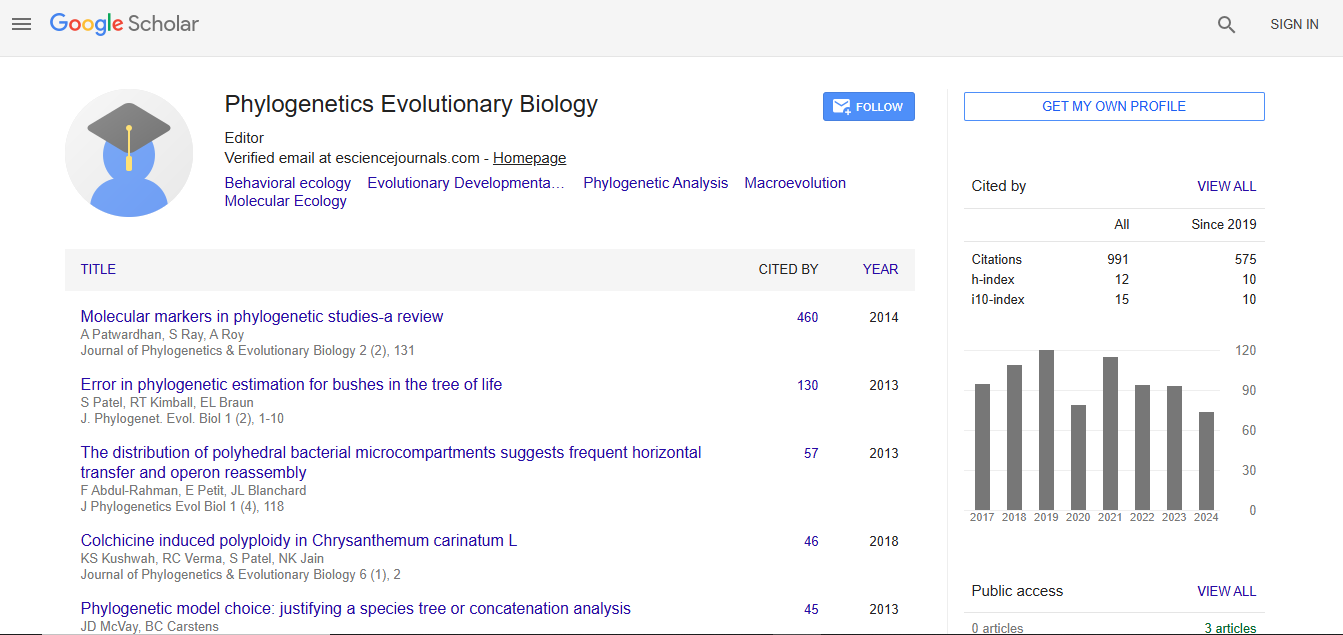
Journal of Phylogenetics & Evolutionary Biology received 911 citations as per Google Scholar report