Short Communication - (2025) Volume 12, Issue 2
Received: 01-Apr-2025, Manuscript No. ijn-26-183973;
Editor assigned: 03-Apr-2025, Pre QC No. P-183973;
Reviewed: 17-Apr-2025, QC No. Q-183973;
Revised: 22-Apr-2025, Manuscript No. R-183973;
Published:
29-Apr-2025
, DOI: 10.37421/2376-0281.2025.12.628
Citation: Schneider, Felix. "FES: Advancing Neurorehabilitation For Motor Recovery." Int J Neurorehabilitation Eng 12 (2025):628.
Copyright: © 2025 Schneider F. This is an open-access article distributed under the terms of the Creative Commons Attribution License, which permits unrestricted use, distribution and reproduction in any medium, provided the original author and source are credited.
Functional Electrical Stimulation (FES) stands as a cornerstone in neurorehabilitation, employing electrical currents to elicit muscle contractions and facilitate the recovery of lost motor function following neurological injuries. This technique is particularly vital for individuals recovering from conditions such as stroke and spinal cord injury, where disruptions to the nervous system impair voluntary movement. Recent advancements have significantly refined FES protocols, moving towards personalized approaches that better cater to individual patient needs and recovery trajectories. The integration of FES with robotic systems represents a major leap forward, creating hybrid systems designed to offer more comprehensive and intensive therapeutic interventions. These hybrid systems aim to leverage the strengths of both robotic assistance and FES-induced muscle activation to optimize motor relearning and functional restoration. Furthermore, the incorporation of sophisticated feedback mechanisms into FES systems is a critical area of development. These mechanisms allow for more dynamic and responsive stimulation, adapting to the patient's progress and volitional efforts. This adaptive capability is crucial for promoting genuine motor relearning rather than simply substituting for lost function. The synergy between FES and virtual reality (VR) environments is also showing considerable promise, enhancing patient engagement and providing immersive therapeutic experiences. By combining FES with VR, clinicians can create more motivating and effective rehabilitation programs that can lead to improved outcomes. The application of FES extends to various neurological conditions, including post-stroke motor deficits and challenges faced by individuals with spinal cord injuries, demonstrating its versatility. Studies have explored the effects of FES on motor function and spasticity in post-stroke patients, highlighting its potential to improve both aspects of motor control. The effectiveness of FES in restoring upper-extremity motor function in stroke survivors has been a subject of systematic review, underscoring its therapeutic value. Research into closed-loop FES systems, which adapt stimulation based on biofeedback, signifies a move towards more intelligent and personalized rehabilitation tools. These adaptive systems are crucial for maximizing motor learning and ensuring sustained functional gains. The efficacy of FES in improving gait in individuals with incomplete spinal cord injury has been systematically examined, with findings pointing to positive impacts on gait speed and stability. The application of FES for improving gait in individuals with incomplete spinal cord injury has been a focus of research, with studies demonstrating its benefits. The role of FES in enhancing motor control and reducing spasticity in children with cerebral palsy is being investigated, showcasing its potential across different age groups and conditions. The application of FES in pediatric neurological conditions like cerebral palsy highlights its broad therapeutic scope. Combined interventions, such as FES with transcranial direct current stimulation (tDCS), are being explored for their synergistic effects on neuroplasticity and motor recovery in stroke rehabilitation. The combination of FES with other neuromodulation techniques is an exciting frontier in stroke rehabilitation. Wearable FES systems are emerging as a convenient and effective option for assisting individuals with spinal cord injuries, offering improved independence and quality of life. The development of portable and user-friendly FES devices is expanding access to rehabilitation. The use of FES for foot drop correction in individuals with neurological disorders is well-established, aiming to improve walking biomechanics and reduce the risk of falls. FES for correcting foot drop is a significant application that enhances mobility and safety. Finally, advancements in FES technology, including novel electrode designs and stimulation algorithms, are continuously being pursued to enhance patient outcomes and create more responsive systems. The ongoing technological evolution of FES is paving the way for even more effective rehabilitation strategies. [1] [2] [3] [4] [5] [6] [7] [8] [9] [10]
Functional Electrical Stimulation (FES) is a critical neurorehabilitation technique that utilizes electrical currents to induce muscle contractions, thereby aiding in the restoration of lost motor function after neurological injury. Recent advancements in the field are notably focusing on the development of personalized FES protocols, the integration of FES with robotic systems to create hybrid FES-robotics platforms, and the implementation of advanced feedback mechanisms. These innovations are aimed at significantly enhancing motor relearning and promoting functional recovery in individuals affected by conditions such as stroke and spinal cord injury. The incorporation of FES with emerging technologies like virtual reality (VR) and biofeedback is showing substantial promise in boosting patient engagement and improving overall therapeutic outcomes. The effectiveness of FES in improving motor function and managing spasticity in post-stroke patients has been investigated, revealing positive impacts on these key areas of recovery. Systematic reviews have explored the broader effect of FES on upper-extremity motor function in stroke survivors, confirming its therapeutic utility. Research into closed-loop FES systems, which dynamically adjust stimulation intensity based on a patient's volitional effort and biofeedback, highlights a significant step towards adaptive and individualized rehabilitation. These adaptive systems are crucial for fostering motor learning and achieving lasting functional gains. The efficacy of FES in enhancing gait parameters for individuals with incomplete spinal cord injury has been thoroughly reviewed, indicating improvements in gait speed, endurance, and symmetry. Studies on FES for foot drop correction in individuals with neurological disorders underscore its ability to refine walking biomechanics and improve gait stability. The application of FES for hand grasp recovery in individuals with hemiplegia is also a notable area, with findings suggesting improvements in grip strength and reduced effort for object manipulation, thereby contributing to greater functional independence. Furthermore, the combination of FES with other neuromodulatory techniques, such as transcranial direct current stimulation (tDCS), is being explored for its potential synergistic effects in enhancing neuroplasticity and motor recovery after stroke. The development of wearable FES systems is addressing the need for convenient and portable rehabilitation solutions, particularly for individuals with cervical spinal cord injuries, demonstrating improved adherence and functional assistance. Finally, ongoing advancements in FES technology, encompassing novel electrode designs and sophisticated stimulation algorithms, are continuously being pursued to optimize patient outcomes and create more responsive and intuitive rehabilitation systems. The development of wearable FES systems for individuals with cervical spinal cord injury has demonstrated good adherence and provided significant functional assistance, enhancing independence and quality of life. The use of FES for foot drop correction in individuals with neurological disorders has been examined, with findings highlighting its ability to improve walking biomechanics, reduce tripping, and enhance gait stability. The potential of FES to facilitate hand grasp recovery in individuals with hemiplegia has been investigated, suggesting improvements in grip strength and reduced effort for object manipulation. The advancement of FES technology, including new electrode designs and stimulation algorithms, is focused on improving patient outcomes and creating more intuitive and responsive systems. [1] [2] [3] [4] [5] [6] [7] [8] [9] [10]
Functional Electrical Stimulation (FES) is a key neurorehabilitation technique that uses electrical currents to stimulate muscle contractions, aiding in motor function recovery after neurological injury. Current advancements focus on personalized FES protocols, hybrid FES-robotics systems, and integrated feedback mechanisms to enhance motor relearning and functional recovery in individuals with conditions like stroke and spinal cord injury. The integration of FES with virtual reality and biofeedback is showing promise in improving engagement and therapeutic outcomes. Studies have demonstrated FES's effectiveness in improving motor function, reducing spasticity, enhancing gait, and facilitating hand grasp recovery. Emerging technologies like closed-loop FES systems and wearable FES devices are further personalizing and improving accessibility. Combined FES interventions with other modalities like tDCS are also being explored for synergistic effects. Continued technological advancements in electrode design and stimulation algorithms are aimed at optimizing patient outcomes and creating more responsive FES systems.
None
None
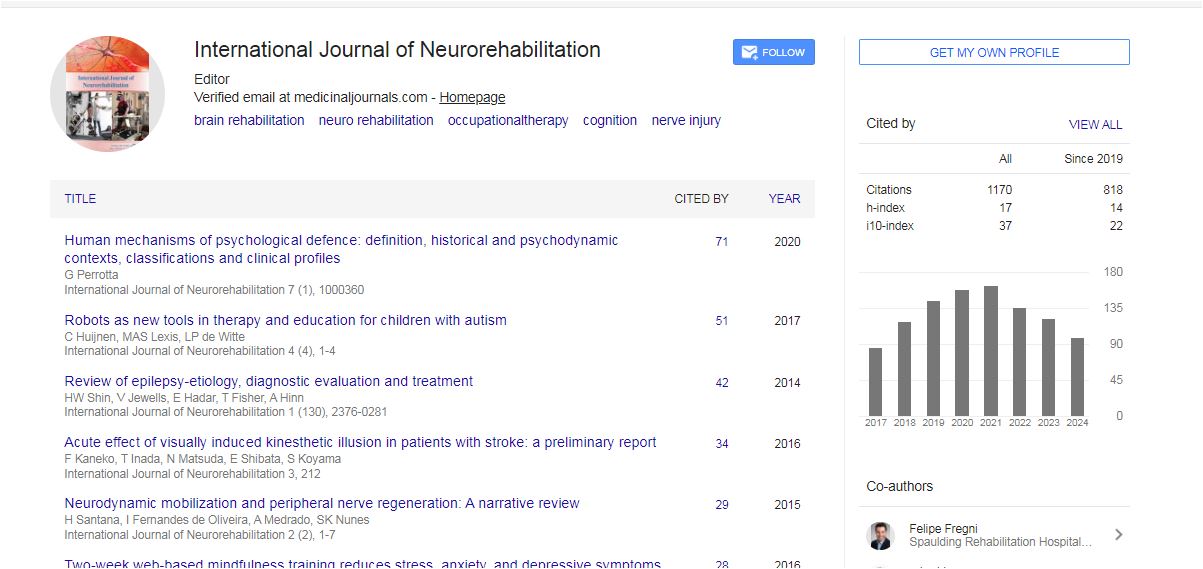
International Journal of Neurorehabilitation received 1078 citations as per Google Scholar report