Commentary - (2025) Volume 13, Issue 2
Received: 01-Apr-2025, Manuscript No. jpgeb-25-157465;
Editor assigned: 03-Apr-2025, Pre QC No. P-157465;
Reviewed: 17-Apr-2025, QC No. Q-157465;
Revised: 22-Apr-2025, Manuscript No. R-157465;
Published:
29-Apr-2025
, DOI: 10.37421/2329-9002.2025.13.370
Citation: Duarte, Isabella. ”Evolution’s Grand Patterns: Genes, Traits, Adaptation.” J Phylogenetics Evol Biol 13 (2025):370.
Copyright: © 2025 Duarte I. This is an open-access article distributed under the terms of the Creative Commons Attribution License, which permits unrestricted use, distribution
and reproduction in any medium, provided the original author and source are credited.
This paper reviews how fast traits evolve and how this links to species diversification across all life. It highlights recent advances in methods for studying evolutionary rates, especially using large phylogenetic trees. What this really means is that we're getting better at understanding the interplay of how fast features change and how new species form, giving us a clearer picture of evolution's grand patterns [1].
Here's the thing, phenotypic plasticity, meaning an organism's ability to change its traits in response to environmental cues, is a major player in trait evolution. This review dives into the complex evolutionary dynamics of plasticity, looking at how it evolves and how it influences other traits. What this really means is that understanding plasticity is key to predicting how organisms will adapt to changing environments [2].
Gene duplication is a fundamental mechanism driving the evolution of new traits and functions. This article explores how gene duplication provides raw material for evolutionary novelty, focusing on recent insights into the molecular processes and selective pressures involved. It means that by making extra copies of genes, evolution gets more chances to experiment, leading to diverse and sometimes entirely new biological features [3].
The field of evolutionary developmental biology, or evo-devo, provides critical insights into how traits evolve by studying their developmental origins. This piece discusses how developmental processes constrain and enable the evolution of complex traits in diverse environments. It really means understanding how an organism builds itself from a single cell gives us clues about why traits are the way they are and how they can change over evolutionary time [4].
Convergent evolution, where different species evolve similar traits independently, offers a powerful lens into the predictability of trait evolution. This review synthesizes current knowledge on the genetic mechanisms underlying convergence, highlighting both shared and distinct pathways. What this means is that by studying how different organisms arrive at similar solutions, we can uncover fundamental principles governing how traits change at the genetic level [5].
Beyond changes in DNA sequence, epigenetic mechanisms are emerging as crucial contributors to trait evolution and adaptation. This paper delves into how heritable epigenetic modifications can influence phenotypes and drive evolutionary trajectories, sometimes even rapidly. It's about recognizing that not all inherited traits are solely written in the DNA code; the way that code is read and regulated also plays a significant, evolving role [6].
Ecological speciation, where adaptation to different environments drives the formation of new species, fundamentally involves the evolution of key traits. This article examines the genomic underpinnings of this process, exploring how genes contributing to adaptation also contribute to reproductive isolation. Let's break it down: it shows that when populations evolve distinct traits to thrive in different niches, those trait changes often become the very barriers that stop them from interbreeding, leading to new species [7].
Adaptive radiation, a burst of rapid diversification where a single lineage produces many species adapted to different ecological niches, is a powerful driver of trait evolution at macroevolutionary scales. This review discusses the interplay between ecological opportunity, phenotypic innovation, and speciation during these events. What this really means is that when new environments open up, species can rapidly evolve a wide array of specialized traits, leading to significant evolutionary change [8].
Understanding the genomic architecture of complex traits â?? how genes interact to produce a phenotype â?? is crucial for grasping trait evolution. This article reviews insights gained from studying natural populations, emphasizing the distributed and often polygenic nature of these traits. It's about recognizing that many important traits aren't controlled by a single gene; instead, they're shaped by countless small genetic variations spread across the genome, and studying this complexity in nature gives us better evolutionary models [9].
Climate change is a powerful selective force, driving rapid trait evolution in many species. This synthesis reviews empirical evidence of evolutionary responses to climate change, highlighting examples of genetic adaptation in various organisms. What this means is that as environments shift due to climate change, organisms are forced to adapt their traits, and we're increasingly seeing these changes happen within observable timescales, demonstrating evolution in action [10].
Understanding how fast traits evolve and how this links to species diversification across all life is a key focus, with recent advances in methods, especially using large phylogenetic trees, providing a clearer picture of evolution's grand patterns [1]. Here's the thing, phenotypic plasticity, an organism's ability to change its traits in response to environmental cues, is a major player in trait evolution. This review dives into the complex evolutionary dynamics of plasticity, looking at how it evolves and how it influences other traits. What this really means is that understanding plasticity is key to predicting how organisms will adapt to changing environments [2].
Gene duplication is a fundamental mechanism driving the evolution of new traits and functions. This article explores how gene duplication provides raw material for evolutionary novelty, focusing on recent insights into the molecular processes and selective pressures involved. It means that by making extra copies of genes, evolution gets more chances to experiment, leading to diverse and sometimes entirely new biological features [3]. The field of evolutionary developmental biology, or evo-devo, provides critical insights into how traits evolve by studying their developmental origins. This piece discusses how developmental processes constrain and enable the evolution of complex traits in diverse environments. It really means understanding how an organism builds itself from a single cell gives us clues about why traits are the way they are and how they can change over evolutionary time [4].
Convergent evolution, where different species evolve similar traits independently, offers a powerful lens into the predictability of trait evolution. This review synthesizes current knowledge on the genetic mechanisms underlying convergence, highlighting both shared and distinct pathways. What this means is that by studying how different organisms arrive at similar solutions, we can uncover fundamental principles governing how traits change at the genetic level [5]. Beyond changes in DNA sequence, epigenetic mechanisms are emerging as crucial contributors to trait evolution and adaptation. This paper delves into how heritable epigenetic modifications can influence phenotypes and drive evolutionary trajectories, sometimes even rapidly. It's about recognizing that not all inherited traits are solely written in the DNA code; the way that code is read and regulated also plays a significant, evolving role [6].
Ecological speciation, where adaptation to different environments drives the formation of new species, fundamentally involves the evolution of key traits. This article examines the genomic underpinnings of this process, exploring how genes contributing to adaptation also contribute to reproductive isolation. Let's break it down: it shows that when populations evolve distinct traits to thrive in different niches, those trait changes often become the very barriers that stop them from interbreeding, leading to new species [7]. Adaptive radiation, a burst of rapid diversification where a single lineage produces many species adapted to different ecological niches, is a powerful driver of trait evolution at macroevolutionary scales. This review discusses the interplay between ecological opportunity, phenotypic innovation, and speciation during these events. What this really means is that when new environments open up, species can rapidly evolve a wide array of specialized traits, leading to significant evolutionary change [8].
Understanding the genomic architecture of complex traits â?? how genes interact to produce a phenotype â?? is crucial for grasping trait evolution. This article reviews insights gained from studying natural populations, emphasizing the distributed and often polygenic nature of these traits. It's about recognizing that many important traits aren't controlled by a single gene; instead, they're shaped by countless small genetic variations spread across the genome, and studying this complexity in nature gives us better evolutionary models [9]. Climate change is a powerful selective force, driving rapid trait evolution in many species. This synthesis reviews empirical evidence of evolutionary responses to climate change, highlighting examples of genetic adaptation in various organisms. What this means is that as environments shift due to climate change, organisms are forced to adapt their traits, and we're increasingly seeing these changes happen within observable timescales, demonstrating evolution in action [10].
We're getting better at understanding the interplay of how fast features change and how new species form, giving us a clearer picture of evolution's grand patterns. Understanding plasticity is key to predicting how organisms will adapt to changing environments. By making extra copies of genes, evolution gets more chances to experiment, leading to diverse and sometimes entirely new biological features. Understanding how an organism builds itself from a single cell gives us clues about why traits are the way they are and how they can change over evolutionary time. By studying how different organisms arrive at similar solutions, we can uncover fundamental principles governing how traits change at the genetic level. Not all inherited traits are solely written in the DNA code; the way that code is read and regulated also plays a significant, evolving role. When populations evolve distinct traits to thrive in different niches, those trait changes often become the very barriers that stop them from interbreeding, leading to new species. When new environments open up, species can rapidly evolve a wide array of specialized traits, leading to significant evolutionary change. Many important traits aren't controlled by a single gene; instead, they're shaped by countless small genetic variations spread across the genome, and studying this complexity in nature gives us better evolutionary models. As environments shift due to climate change, organisms are forced to adapt their traits, and we're increasingly seeing these changes happen within observable timescales, demonstrating evolution in action.
None
None
1. Brian CO, Luke JH, Michael EA. "Rates of trait evolution and diversification across the Tree of Life".Annu Rev Ecol Evol Syst 55 (2024):1-18.
Indexed at, Google Scholar, Crossref
2. Tobias UF, Mark ARB, Jessica LAK. "The evolutionary dynamics of phenotypic plasticity".Trends Ecol Evol 36 (2021):8-16.
Indexed at, Google Scholar, Crossref
3. Anthony GC, Kenji KK, David LS. "Gene duplication and the evolution of novelty".Nat Rev Genet 25 (2024):187-204.
Indexed at, Google Scholar, Crossref
4. Armin PM, Pamela AP, John ME. "Evo-devo of trait evolution in a complex world".Ecol Evol 12 (2022):e9009.
Indexed at, Google Scholar, Crossref
5. Andrew EW, Sarah RWD, Michael JM. "The genetic basis of convergent evolution".Annu Rev Ecol Evol Syst 54 (2023):191-210.
Indexed at, Google Scholar, Crossref
6. Tobias U, Qiongshi L, Russell B. "Epigenetic mechanisms in adaptation and evolution".Trends Genet 38 (2022):50-63.
Indexed at, Google Scholar, Crossref
7. Andrew PH, Daniel IB, Sean MR. "Ecological speciation and its genomic architecture".Evolution 75 (2021):2459-2475.
Indexed at, Google Scholar, Crossref
8. Jonathan BL, Rosemary GG, Joel GK. "Macroevolutionary dynamics of adaptive radiation".Trends Ecol Evol 35 (2020):45-57.
Indexed at, Google Scholar, Crossref
9. Alison MLVE, John AT, William EE. "The genomic architecture of complex traits: lessons from natural populations".Front Genet 12 (2021):644170.
Indexed at, Google Scholar, Crossref
10. Sarah RS, Christine EM, John JW. "Evolutionary responses to climate change: a synthesis of empirical data".Annu Rev Ecol Evol Syst 51 (2020):191-211.
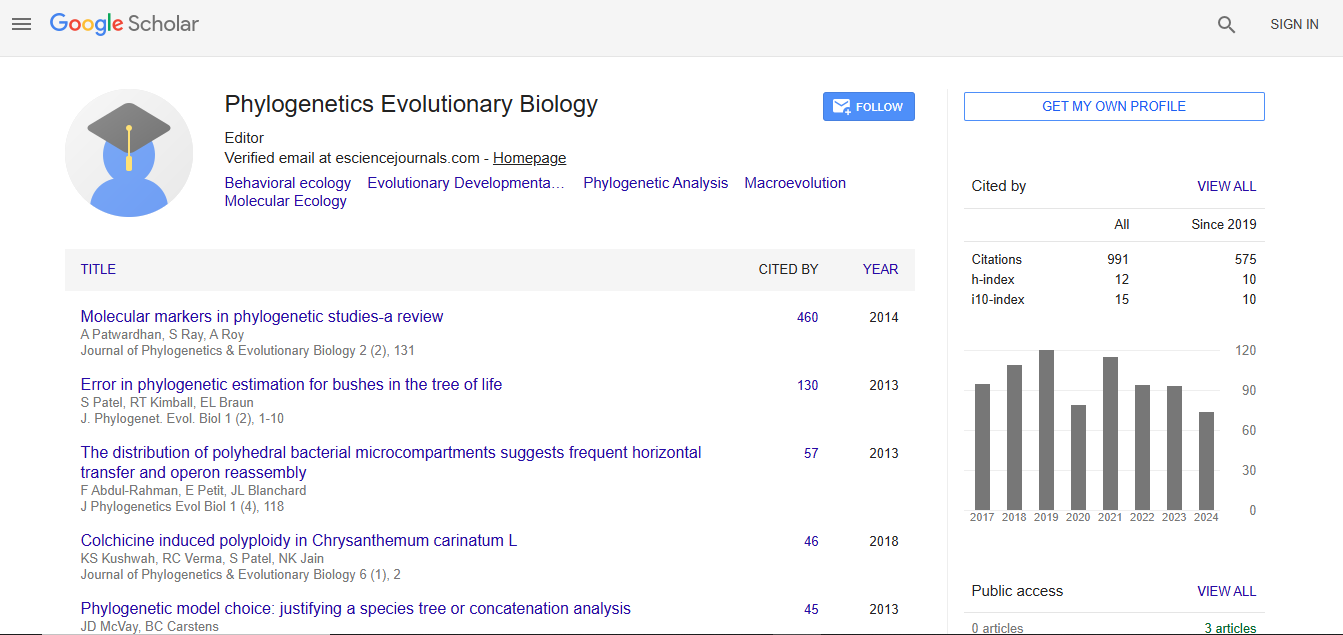
Journal of Phylogenetics & Evolutionary Biology received 911 citations as per Google Scholar report