Opinion - (2025) Volume 13, Issue 4
Received: 01-Aug-2025, Manuscript No. jpgeb-26-184306;
Editor assigned: 03-Aug-2025, Pre QC No. P-184306;
Reviewed: 18-Aug-2025, QC No. Q-184306;
Revised: 22-Aug-2025, Manuscript No. R-184306;
Published:
29-Aug-2025
, DOI: 10.37421/2329-9002.2025.13.389
Citation: Zhao, Xiaoling. ”Evolutionary Forces: Drift and Selection Driving Divergence.” J Phylogenetics Evol Biol 13 (2025):389.
Copyright: © 2025 Zhao X. This is an open-access article distributed under the terms of the Creative Commons Attribution License, which permits unrestricted use, distribution and reproduction in any medium, provided the original author and source are credited.
Genetic drift and natural selection are recognized as fundamental evolutionary forces that significantly shape population divergence and speciation processes. Genetic drift, characterized by its random nature, can lead to the fixation or loss of alleles, particularly pronounced in populations of smaller sizes. In contrast, natural selection operates on adaptive genetic variation, favoring alleles that enhance an organism's fitness within specific environmental contexts. The dynamic interplay between these two forces is critical in evolutionary trajectories: drift can sometimes supersede selection, allowing neutral or even mildly deleterious alleles to propagate, or it can preserve genetic diversity that selection may later act upon. In populations separated geographically (allopatric), differing selective pressures or unique patterns of drift can accelerate the development of reproductive isolation. Even in populations that share the same geographic area (sympatric), strong divergent selection can overcome gene flow, fostering ecological speciation, while the inherent stochasticity of drift can either aid or impede this process. A comprehensive understanding of their relative strengths and complex interactions is thus paramount for deciphering the evolutionary history and the observable patterns of biodiversity [1].
Investigating the mechanisms by which fluctuating selection and genetic drift influence the evolution of reproductive isolation is crucial for understanding speciation. Experimental studies have observed that while pronounced directional selection can expedite divergence, periods of fluctuating selection, when combined with the stochastic effects of genetic drift, also contribute substantially to the erosion of gene flow, especially when populations encounter diverse environmental conditions. These findings collectively underscore that the combined action of these evolutionary forces, rather than any single force in isolation, often governs the pathway of speciation [2].
Studies examining genetic divergence in island populations provide compelling evidence that even subtle divergent selection can precipitate significant genetic differentiation when accompanied by robust genetic drift. The process of colonization on new islands frequently results in the establishment of small founding populations, rendering them highly susceptible to the effects of genetic drift. The research demonstrates how drift can lead to the fixation of alleles that might be under weak directional selection, thereby contributing to rapid, though occasionally suboptimal, adaptation and divergence between distinct island lineages [3].
The role of background selection, which refers to the process of purifying selection against deleterious mutations, is also explored in the context of population divergence. Arguments suggest that background selection can indirectly modulate the effectiveness of both genetic drift and positive selection by influencing the effective population size and the availability of linked genetic variation. In situations where background selection is particularly strong, it has the potential to amplify the effects of genetic drift, potentially accelerating divergence or leading to the fixation of specific alleles [4].
Research focusing on the impact of geographic structure on divergence driven by drift and selection reveals important insights. Using a metapopulation model, it has been demonstrated that while potent divergent selection can foster rapid divergence within interconnected subpopulations, genetic drift plays a vital role in homogenizing genetic variation across the entire metapopulation. The ultimate extent and speed of divergence are determined by a delicate balance involving migration rates, selective pressures, and the inherent stochasticity of genetic drift [5].
Studies exploring the evolutionary dynamics of sexually selected traits reveal their significant contribution to reproductive isolation. It is highlighted that intense sexual selection can function as a potent force for divergence, even when gene flow is ongoing. Furthermore, the influence of genetic drift on the persistence or fixation of these sexually selected alleles is also taken into account, suggesting that drift can facilitate the initial stages of divergence by increasing the probability of fixation for alleles that are under relatively weak sexual selection [6].
The impact of varying mutation rates on the relative contributions of drift and selection to population divergence is a key area of investigation. Findings indicate that at higher mutation rates, selection can more efficiently act on new genetic variation, potentially accelerating adaptive divergence. Conversely, lower mutation rates tend to increase the influence of genetic drift, rendering allele fixation more stochastic and potentially slowing the pace of adaptive change, especially for mutations conferring only slight advantages [7].
Research exploring how environmental heterogeneity influences the balance between genetic drift and selection in driving population divergence offers significant insights. Within heterogeneous environments, populations are exposed to a variety of selective pressures, which promotes local adaptation. The study emphasizes that genetic drift can play a critical role in either maintaining or eliminating the genetic variation upon which selection acts, particularly in smaller, fragmented populations within a mosaic landscape. The precise interplay between these factors dictates the tempo and pattern of divergence [8].
The impact of gene flow on population divergence, when driven by drift and selection, is a crucial consideration. Studies demonstrate that while robust divergent selection can advance speciation, even minimal levels of gene flow can counteract these evolutionary forces, leading to the homogenization of allele frequencies and a deceleration of divergence. In such scenarios, genetic drift can sometimes facilitate divergence by promoting the random fixation of alleles that are advantageous in one population but not the other, particularly when gene flow is restricted [9].
Investigations into the role of demographic history, specifically fluctuations in population size, shed light on the relative importance of drift and selection in shaping divergence. Evidence indicates that periods of severe population bottlenecks can markedly amplify the influence of genetic drift, leading to rapid divergence and the potential fixation of alleles that may not be strongly selected for. In contrast, large population sizes allow selection to operate more effectively, potentially leading to more predictable and adaptive patterns of divergence [10].
Genetic drift and natural selection represent foundational forces driving the divergence of populations, a key process in evolutionary biology. Drift, a random process, can lead to the fixation or loss of alleles, especially in small populations, while selection acts on adaptive variation, favoring alleles that increase fitness in specific environments. Their interaction is crucial: drift can sometimes override selection, allowing neutral or slightly deleterious alleles to spread, or it can maintain genetic variation upon which selection can later act. In allopatric populations, differing selective pressures or unique drift trajectories can rapidly result in reproductive isolation. Even in sympatry, strong divergent selection can overcome gene flow, promoting ecological speciation, while the stochasticity of drift can facilitate or hinder this process. Understanding their relative strengths and interactions is key to deciphering evolutionary history and observed biodiversity patterns [1].
This study investigates how fluctuating selection and genetic drift influence the evolution of reproductive isolation in experimental populations. Researchers observed that while strong directional selection can accelerate divergence, periods of fluctuating selection, combined with the random effects of drift, also contribute significantly to the breakdown of gene flow, particularly when populations experience varied environmental conditions. The findings highlight that the combined action of these forces, rather than a single one, often dictates the trajectory of speciation [2].
Examining divergence in island populations, this paper demonstrates that even weak divergent selection can lead to significant genetic differentiation when coupled with strong genetic drift. Colonization events on new islands often result in small founding populations, making them highly susceptible to drift. The study shows how drift can fix alleles that might be under weak directional selection, thereby contributing to rapid, albeit sometimes suboptimal, adaptation and divergence between island lineages [3].
The role of background selection, a form of purifying selection against deleterious mutations, is explored in the context of population divergence. The authors argue that background selection can indirectly influence the efficacy of both drift and positive selection by affecting effective population size and the availability of linked variation. In scenarios where background selection is strong, it can exacerbate the effects of genetic drift, potentially leading to faster divergence or fixation of certain alleles [4].
This research focuses on the impact of geographic structure on divergence driven by drift and selection. Using a metapopulation model, the study demonstrates that while strong selection can lead to rapid divergence within connected subpopulations, genetic drift plays a critical role in homogenizing genetic variation across the metapopulation. The balance between migration rates, selective pressures, and the stochasticity of drift determines the extent and speed of divergence [5].
The study explores the evolutionary dynamics of sexually selected traits and their contribution to reproductive isolation. It highlights how strong sexual selection can act as a powerful divergent force, even in the presence of ongoing gene flow. However, the influence of genetic drift on the maintenance or fixation of these sexually selected alleles is also considered, suggesting that drift can facilitate the initial stages of divergence by increasing the chance of fixation for alleles under weak sexual selection [6].
This paper investigates the impact of varying mutation rates on the relative roles of drift and selection in population divergence. The authors find that at higher mutation rates, selection can act more effectively on new variation, potentially leading to faster adaptive divergence. Conversely, lower mutation rates increase the influence of genetic drift, making the fixation of alleles more stochastic and potentially slower for adaptive change, particularly for slightly advantageous mutations [7].
This research explores how environmental heterogeneity influences the balance between drift and selection in driving divergence. In heterogeneous environments, populations are subjected to diverse selective pressures, promoting local adaptation. The study highlights that genetic drift can play a crucial role in maintaining or eliminating the variation upon which selection acts, especially in smaller, fragmented populations within a heterogeneous landscape. The interplay dictates the speed and pattern of divergence [8].
This study examines the impact of gene flow on population divergence driven by drift and selection. The authors demonstrate that while strong divergent selection can promote speciation, even low levels of gene flow can counteract these forces, homogenizing allele frequencies and slowing divergence. Genetic drift, in this context, can sometimes facilitate divergence by leading to the random fixation of alleles that are beneficial in one population but not the other, especially when gene flow is limited [9].
The paper investigates the role of demographic history, specifically population size fluctuations, on the relative importance of drift and selection in shaping divergence. The authors show that periods of strong population bottlenecks can dramatically increase the influence of genetic drift, leading to rapid divergence and potential fixation of alleles that might not be strongly selected for. Conversely, large population sizes allow selection to act more effectively, potentially leading to more deterministic adaptive divergence [10].
Evolutionary forces like genetic drift and natural selection are fundamental to population divergence and speciation. Drift, a random process, particularly impacts small populations, potentially fixing or losing alleles. Selection favors alleles that enhance fitness in specific environments. Their interplay is complex: drift can sometimes overpower selection, or preserve variation for later selection. Allopatric populations may diverge rapidly due to different selective pressures or drift patterns. Even in sympatric populations, strong divergent selection can overcome gene flow, promoting speciation, with drift playing a facilitating or hindering role. Fluctuating selection combined with drift also significantly contributes to the breakdown of gene flow. Island populations with small founding sizes are highly susceptible to drift, which can fix weakly selected alleles, leading to rapid divergence. Background selection against deleterious mutations can indirectly affect drift and positive selection by altering effective population size. Geographic structure influences divergence, with drift homogenizing variation across metapopulations despite strong selection within subpopulations. Sexual selection can drive divergence, with drift influencing the fixation of sexually selected alleles. Mutation rates affect the balance: higher rates favor selection, while lower rates enhance drift. Environmental heterogeneity promotes local adaptation, with drift playing a role in maintaining or eliminating variation in fragmented populations. Gene flow can counteract divergence driven by drift and selection, though drift may sometimes facilitate divergence by fixing beneficial alleles in specific populations. Demographic history, particularly population bottlenecks, can increase drift's influence, leading to rapid divergence, while large populations allow selection to act more effectively.
None
None
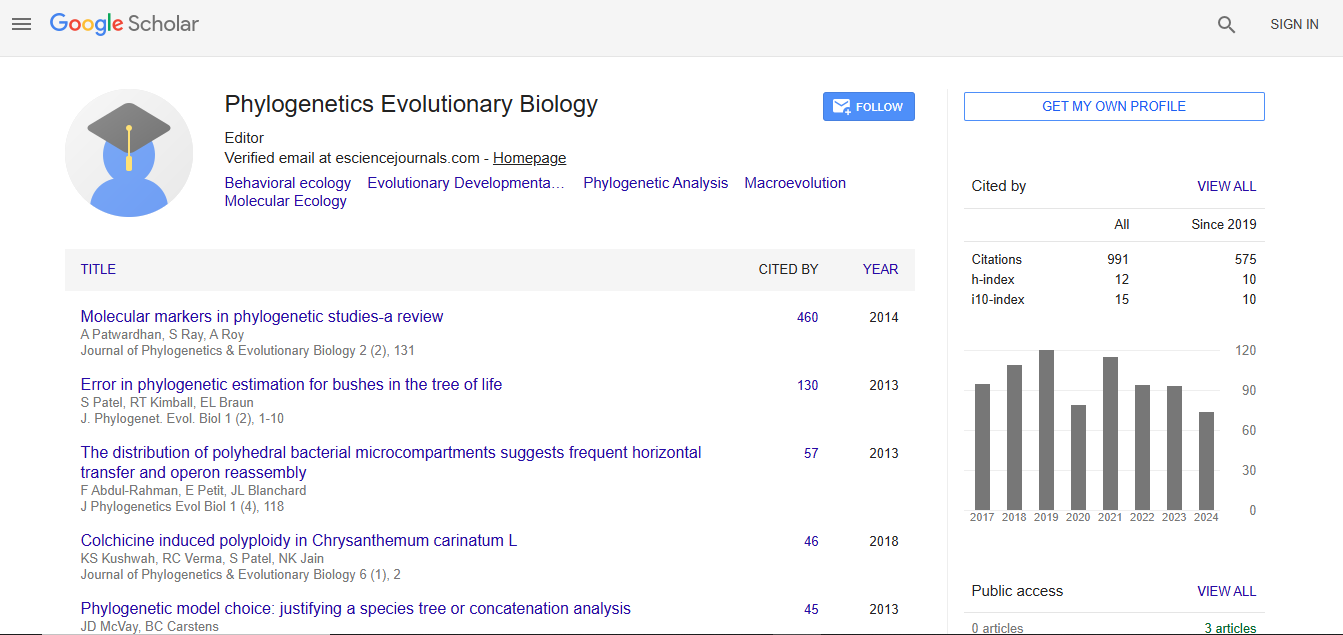
Journal of Phylogenetics & Evolutionary Biology received 911 citations as per Google Scholar report