Perspective - (2025) Volume 13, Issue 6
Received: 01-Dec-2025, Manuscript No. jpgeb-26-184337;
Editor assigned: 03-Dec-2025, Pre QC No. P-184337;
Reviewed: 17-Dec-2025, QC No. Q-184337;
Revised: 22-Dec-2025, Manuscript No. R-184337;
Published:
29-Dec-2025
, DOI: 10.37421/2329-9002.2025.13.414
Citation: Holm, Katarina J.. ”Advancing Phylogenetics: Omics, AI, and Evolutionary Dynamics.” J Phylogenetics Evol Biol 13 (2025):414.
Copyright: © 2025 Holm J. Katarina This is an open-access article distributed under the terms of the Creative Commons Attribution License, which permits unrestricted use, distribution and reproduction in any medium, provided the original author and source are credited.
The field of phylogenetics is currently experiencing a period of rapid advancement, largely propelled by significant breakthroughs in high-throughput sequencing technologies, the sophistication of bioinformatics tools, and the increasing application of machine learning algorithms. These developments are not only refining existing methodologies but also opening new avenues for inquiry into the intricate tapestry of life's evolutionary history. Future endeavors are expected to focus on the integration of multi-omics data, a strategy aimed at generating more holistic and comprehensive evolutionary reconstructions that span multiple biological scales. The development of robust and scalable analytical frameworks is paramount to effectively manage and interpret the massive genomic datasets now becoming commonplace. Furthermore, the deployment of artificial intelligence holds immense potential for inferring complex evolutionary histories and predicting the functional implications of genetic variations. A persistent challenge lies in bridging the conceptual and methodological divide between molecular phylogenetics and the study of phenotypic evolution. Simultaneously, enhancing our foundational understanding of evolutionary processes across all recognized levels of biological organization, from the molecular dynamics of genes to the intricate interactions within ecosystems, remains a critical objective. The integration of phylogenomic datasets, which encompass thousands of genes, is providing unprecedented power to resolve deep evolutionary relationships and uncover macroevolutionary patterns that were previously obscured. However, significant challenges persist in developing scalable analytical frameworks that can effectively address the inherent systematic biases present in such large datasets. These biases include phenomena such as gene tree discordance, where different genes yield conflicting evolutionary histories, and incomplete lineage sorting, where ancestral genetic variations persist in descendant lineages for extended periods. Future research in this domain will concentrate on the development of more sophisticated methods for phylogenetic inference that can accurately model and account for these inherent complexities, thereby improving the reliability of evolutionary reconstructions. Machine learning algorithms are increasingly being integrated into the phylogenetic workflow, demonstrating considerable utility in accelerating tree inference, enhancing accuracy, and facilitating the exploration of complex evolutionary scenarios. This integration spans diverse applications, including the use of deep learning techniques for optimizing sequence alignment and for the reconstruction of phylogenetic trees. Additionally, machine learning shows promise in identifying subtle phylogenetic signals within vast datasets, which can be crucial for uncovering hidden evolutionary relationships. The overarching potential for artificial intelligence to automate and significantly enhance various facets of phylogenetic analysis is substantial, although it necessitates rigorous validation and careful interpretation of the results to ensure their biological relevance and accuracy. The study of macroevolutionary dynamics, encompassing critical processes such as speciation and extinction rates, is profoundly benefiting from the application of phylogenetic frameworks. Future research efforts are slated to emphasize the sophisticated application of birth-death models and other stochastic models operating on phylogenetic trees. These models are essential for inferring speciation and extinction rates with greater precision and for understanding the multifaceted drivers that influence these rates. Such drivers include environmental changes, complex biotic interactions among species, and intrinsic biological traits of organisms themselves. The incorporation of fossil data continues to be of crucial importance in this field, serving as a vital component for calibrating molecular clocks and for extending the temporal reach of evolutionary histories beyond the limits of extant molecular data. The direct incorporation of phenotypic data into phylogenetic analyses is recognized as an essential step toward achieving a comprehensive understanding of the co-evolutionary interplay between genotype and phenotype. Significant progress is being made in the development of novel statistical methods designed for the joint analysis of both molecular and morphological data. These advanced methods enable the reconstruction of trait evolution along established phylogenetic trees and facilitate the identification of adaptive radiations, periods of rapid diversification driven by ecological opportunity. This interdisciplinary approach, which seamlessly blends molecular genetics, evolutionary biology, and morphology, is vital for effectively linking the underlying molecular mechanisms of evolution to the observable, macroscopic biological diversity we see today. The exploration of microbial evolution is currently undergoing a profound transformation, primarily driven by rapid advancements in metagenomics and single-cell genomics. Phylogenetics is emerging as a pivotal tool in this revolution, enabling researchers to reconstruct the evolutionary trajectories of entire microbial communities and to investigate the evolution of microbial functions and metabolic capabilities. Future research endeavors will be directed toward developing robust and reliable methods specifically tailored for the analysis of highly fragmented and inherently complex metagenomic data. Such advancements are critical for uncovering the nuanced evolutionary processes that govern microbial life. The necessity of understanding the evolutionary genomics of adaptation is driving the development of advanced phylogenetic methods capable of discerning the signatures of selection and meticulously tracing its historical trajectory across diverse lineages. Future research directions are focused on refining methodologies to effectively disentangle the effects of natural selection from those of genetic drift, particularly when dealing with large-scale genomic data. Concurrently, there is a growing emphasis on integrating ecological data to provide essential context for understanding the environmental pressures that shape adaptive processes. This integrated approach will significantly enhance our capacity to predict how various organisms might respond to projected future environmental changes, offering crucial insights for conservation and ecological forecasting. The application of phylogenetics to the critical field of conservation biology is gaining increasing importance, providing essential tools for prioritizing species for conservation efforts and for managing biodiversity at various scales. Future research will place a strong emphasis on the development of more sophisticated phylogenetic diversity metrics. These advanced metrics aim to incorporate considerations of evolutionary distinctiveness and ecological roles, thereby providing a more nuanced assessment of biodiversity. This will aid significantly in the identification of evolutionarily significant units and in the strategic design of more effective and targeted conservation strategies. The evolutionary history of complex traits, encompassing intricate developmental pathways and sophisticated social behaviors, continues to present a significant scientific challenge. Future research in this area will leverage the power of comparative genomics and advanced phylogenetic methodologies to meticulously infer the origins and evolutionary trajectories of these complex traits. Such investigations are poised to provide deeper and more comprehensive insights into the underlying mechanisms that drive biological innovation and the generation of biodiversity across the tree of life. The resolution of phylogenetic relationships within rapidly diversifying clades, often referred to as rapid radiations, poses a considerable analytical challenge. This challenge necessitates the development and application of highly sophisticated analytical approaches capable of handling exceptionally large datasets and inferring accurate evolutionary histories amidst considerable evolutionary speed. Future research in this domain will concentrate on the development of phylogenetic inference methods that are not only statistically robust but also computationally efficient. This is particularly crucial for the analysis of hyperdiverse groups, where the sheer volume of data can be overwhelming. Enabling deeper insights into speciation processes and diversification patterns is a key outcome expected from these methodological advancements.
The field of phylogenetics is undergoing a transformative evolution, driven by rapid advancements in high-throughput sequencing, sophisticated bioinformatics, and powerful machine learning techniques. These innovations are reshaping our ability to reconstruct the evolutionary past. Future research trajectories are strongly oriented towards integrating diverse multi-omics datasets, which promises more comprehensive and accurate evolutionary reconstructions. The development of robust methodologies for analyzing immense genomic datasets is a critical need, as is the application of artificial intelligence to infer complex evolutionary histories and predict functional traits. A significant ongoing challenge is to effectively bridge the gap between molecular phylogenetics and the study of phenotypic evolution, while simultaneously deepening our understanding of evolutionary processes across all biological organizational levels, from genes to entire ecosystems [1].
The integration of phylogenomic datasets, which often contain thousands of genes, offers unparalleled power in resolving deep evolutionary relationships and revealing macroevolutionary patterns. However, considerable hurdles remain in developing analytical frameworks that are both scalable and capable of addressing systematic biases inherent in these large datasets. Such biases include gene tree discordance and incomplete lineage sorting, where different gene histories conflict or ancestral genetic variation persists across lineages. Future efforts will be dedicated to creating more sophisticated phylogenetic inference methods that can accurately model these complexities [2].
Machine learning algorithms are increasingly being applied to phylogenetics, demonstrating their utility in accelerating tree inference, enhancing accuracy, and exploring intricate evolutionary scenarios. Applications range from using deep learning for sequence alignment and phylogenetic tree reconstruction to identifying phylogenetic signals within large datasets. The potential for AI to automate and improve various aspects of phylogenetic analysis is substantial, but it requires careful validation and interpretation to ensure biological relevance [3].
The study of macroevolutionary dynamics, including speciation and extinction rates, benefits significantly from phylogenetic frameworks. Future research will focus on employing birth-death models and other stochastic models on phylogenetic trees to infer these rates and their underlying drivers, such as environmental change, biotic interactions, and intrinsic biological traits. The inclusion of fossil data remains crucial for calibrating molecular clocks and extending evolutionary histories backwards in time [4].
The direct integration of phenotypic data into phylogenetic analyses is essential for understanding the co-evolution of genotype and phenotype. New statistical methods are under development to jointly analyze molecular and morphological data, enabling the reconstruction of trait evolution along phylogenetic trees and the identification of adaptive radiations. This interdisciplinary approach is vital for connecting molecular evolution to observable biological diversity [5].
The exploration of microbial evolution is being revolutionized by advances in metagenomics and single-cell genomics. Phylogenetics is now instrumental in reconstructing the evolutionary history of entire microbial communities and investigating the evolution of microbial functions. Future work will concentrate on developing robust methods for analyzing highly fragmented and complex metagenomic data to uncover microbial evolutionary processes [6].
Understanding the evolutionary genomics of adaptation necessitates advanced phylogenetic methods capable of detecting selection and tracing its history across lineages. Future directions include developing methods to disentangle selection from drift in large-scale genomic data and integrating ecological data to understand the environmental contexts of adaptation. This will improve our ability to predict how organisms might respond to future environmental changes [7].
The application of phylogenetics to conservation biology is becoming increasingly critical for prioritizing species and managing biodiversity. Future work will focus on developing more sophisticated phylogenetic diversity metrics that account for evolutionary distinctiveness and ecological roles, aiding in the identification of evolutionary significant units and the design of effective conservation strategies [8].
The evolutionary history of complex traits, such as developmental pathways and social behaviors, presents a significant challenge. Future research will leverage comparative genomics and advanced phylogenetic methods to infer the origins and evolution of these traits, providing deeper insights into the mechanisms driving biological innovation and diversity [9].
Resolving phylogenetic relationships within rapidly diversifying clades requires sophisticated analytical approaches to handle large datasets and infer accurate evolutionary histories. Future research will focus on developing more computationally efficient and statistically robust methods for phylogenetic inference, particularly for hyperdiverse groups, to deepen our understanding of speciation processes and diversification patterns [10].
The field of phylogenetics is rapidly advancing due to breakthroughs in sequencing, bioinformatics, and machine learning. Future research aims to integrate multi-omics data, develop robust methods for large genomic datasets, and use AI for evolutionary reconstructions. Challenges include bridging molecular and phenotypic evolution and understanding evolutionary processes across all biological levels. Phylogenomics offers power for deep evolutionary relationships but requires scalable frameworks to handle biases like gene tree discordance. Machine learning is accelerating tree inference and improving accuracy, with AI having substantial automation potential requiring validation. Macroevolutionary dynamics are studied using phylogenetic frameworks and birth-death models, with fossil data crucial for calibration. Integrating phenotypic data with molecular data is key for understanding genotype-phenotype co-evolution. Microbial evolution is being explored through metagenomics and single-cell genomics using phylogenetics. Understanding adaptation genomics requires phylogenetic methods to detect selection and integrate ecological data. Phylogenetics is vital for conservation biology, aiding in species prioritization and biodiversity management through advanced diversity metrics. The evolution of complex traits is being investigated using comparative genomics and advanced phylogenetic methods. Resolving rapid radiations necessitates efficient and robust phylogenetic inference methods for large datasets.
None
None
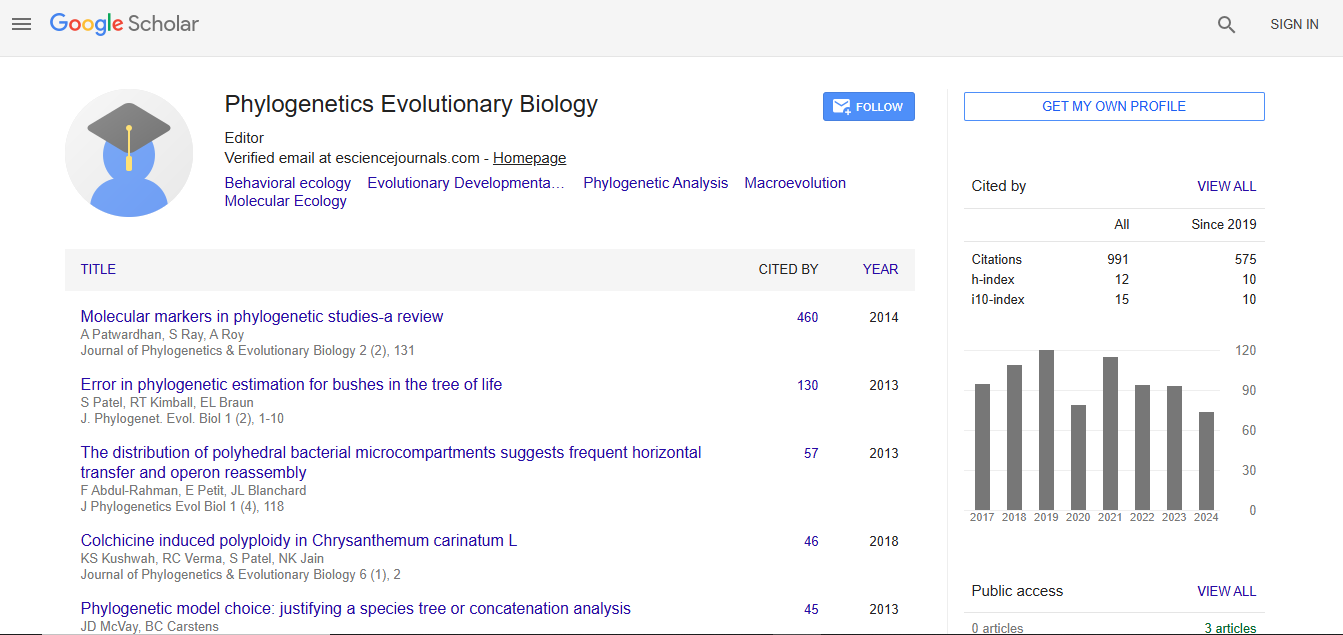
Journal of Phylogenetics & Evolutionary Biology received 911 citations as per Google Scholar report