Short Communication - (2025) Volume 13, Issue 1
Received: 03-Feb-2025, Manuscript No. jpgeb-25-157465;
Editor assigned: 05-Feb-2025, Pre QC No. P-157465;
Reviewed: 19-Feb-2025, QC No. Q-157465;
Revised: 24-Feb-2025, Manuscript No. R-157465;
Published:
28-Feb-2025
, DOI: 10.37421/2329-9002.2025.13.360
Citation: Martínez, Ana. ”Advancing Coalescent Theory: Models and Inference.” J Phylogenetics Evol Biol 13 (2025):360.
Copyright: © 2025 Martínez A. This is an open-access article distributed under the terms of the Creative Commons Attribution License, which permits unrestricted use,
distribution and reproduction in any medium, provided the original author and source are credited.
Coalescent modeling has seen substantial development, particularly with the introduction of a novel model that incorporates linked selection alongside varying population sizes. This framework offers a more realistic perspective for understanding genomic evolution, addressing the significant challenge of modeling how selective sweeps and background selection interact with demographic fluctuations. Such advancements are crucial for accurately inferring evolutionary histories from genetic data[1].
Extending this foundational theory, another notable paper models spatially structured populations under selection. This work provides a robust framework for understanding how geographic distance and local selection pressures interact to shape genetic variation, proving particularly useful for analyzing patterns of genetic differentiation and adaptation in populations with restricted dispersal. These insights are critical for the interplay of space, demography, and evolutionary forces[2].
In computational methodology, a novel algorithm has been introduced for rapidly simulating coalescent trees in populations with intricate demographic histories. This method significantly improves computational efficiency, making it feasible to analyze large datasets and complex population models that were previously intractable. This advancement allows researchers to test more sophisticated hypotheses about population dynamics, migration, and range expansions, thereby enhancing our ability to understand evolutionary processes[3].
Further theoretical work includes developing a coalescent framework specifically designed for populations experiencing strong selection, moving beyond approximations that often fail under such intense conditions. This offers a more accurate theoretical foundation for understanding how beneficial mutations sweep through a population and how standing genetic variation is affected. The insights from this theory are critical for interpreting patterns of adaptation in natural populations and for designing effective selection experiments[4].
Addressing another computational challenge, efficient methods have been presented for approximating coalescent likelihoods, especially useful when population sizes change over time. This tackles a key computational bottleneck in demographic inference by providing faster and more accurate ways to estimate population parameters from genetic data. Such advancements enable more extensive and sophisticated analyses of past population dynamics, including bottlenecks, expansions, and ancient migrations, which are essential for understanding evolutionary history[5].
The coalescent theory of sequence divergence and its utility in genetic inference has also been explored. This provides a theoretical framework for relating observed genetic differences between individuals or populations to underlying evolutionary processes like mutation, recombination, and drift. This work is crucial for developing statistical methods that accurately estimate evolutionary parameters and reconstruct demographic histories from DNA sequence data, offering a foundation for robust phylogenetic and population genetic analyses[6].
Research has also developed a coalescent model that incorporates selection acting on a quantitative trait within an equilibrium population. This provides a theoretical basis for understanding how polygenic adaptation influences genealogical patterns, helping to predict and interpret the effects of selection on quantitative traits. These insights offer understanding into the genetic architecture of complex traits and their evolutionary dynamics, which is fundamental for both evolutionary biology and breeding programs[7].
A critical comparison of different theoretical and computational approaches to the coalescent with recombination has also been undertaken. This work evaluates the strengths and limitations of various methods for handling recombination, which is crucial for accurately reconstructing genealogies and inferring demographic parameters from genetic data. It clarifies the landscape of coalescent methodologies, guiding researchers in choosing appropriate tools for specific genomic analyses[8].
Furthermore, a coalescent-based method has been developed for inferring selection coefficients directly from ancient DNA data. This approach addresses the challenges of low-coverage and fragmented ancient genomes by developing a robust framework to detect and quantify natural selection in past populations. This provides crucial insights into the historical dynamics of adaptation and disease resistance, enabling a deeper understanding of human and other species' evolutionary trajectories over time[9].
Finally, coalescent theory has been extended to effectively model time series genetic data, a resource increasingly available through ancient DNA sequencing and longitudinal studies. This offers a framework for inferring demographic and evolutionary parameters by explicitly accounting for sampling across different time points. This approach is vital for reconstructing dynamic population histories, tracking allele frequency changes, and understanding the temporal scale of evolutionary events[10].
Coalescent theory remains a cornerstone in population genetics, continually evolving to provide deeper insights into the complex processes shaping genetic variation. Recent research has significantly expanded its capabilities, addressing challenges posed by realistic biological scenarios and computational limitations. These advancements collectively refine our capacity to infer evolutionary histories and understand the interplay of various forces on genomic landscapes, moving beyond simplistic models to capture the intricacies of natural populations. This body of work underscores the theory's central role in modern genetic analysis.
A key area of development involves incorporating natural selection more comprehensively into coalescent frameworks. For instance, novel models now integrate linked selection alongside varying population sizes, offering a more realistic understanding of genomic evolution by disentangling selection and demography [1]. Similarly, specific frameworks have been developed for populations under strong selection, providing accurate theoretical foundations for understanding how beneficial mutations sweep through a population and affect standing genetic variation. This is critical for interpreting adaptation patterns in natural populations and for designing effective selection experiments [4].
Beyond single-locus selection, coalescent models have also been designed to incorporate selection acting on quantitative traits within equilibrium populations. This provides a theoretical basis for understanding polygenic adaptation and the genetic architecture of complex traits, relevant for both evolutionary biology and breeding programs [7]. The ability to infer selection coefficients directly from ancient DNA data using coalescent-based methods marks another substantial leap. This approach addresses challenges of low-coverage and fragmented ancient genomes, developing a framework to detect and quantify natural selection in past populations. This yields crucial insights into historical adaptation dynamics, illuminating evolutionary trajectories over time [9].
Understanding population demography is another major theme in these advancements. Coalescent theory has been extended to effectively model spatially structured populations undergoing selection, offering a robust framework to understand how geographic distance and local selective pressures interact to shape genetic variation [2]. These models are especially useful for analyzing genetic differentiation and adaptation in populations with restricted dispersal. Furthermore, efficient methods for approximating coalescent likelihoods are particularly valuable when population sizes change over time, tackling a critical computational bottleneck in demographic inference [5]. This enables more sophisticated analyses of past population dynamics, including bottlenecks, expansions, and ancient migrations, which are essential for reconstructing evolutionary history. The capacity to model complex demographic histories has also been vastly improved through novel algorithms for rapidly simulating coalescent trees, making previously intractable analyses feasible [3]. This allows researchers to test sophisticated hypotheses about population dynamics, migration, and range expansions.
Methodological refinements and extensions to new data types are also prominent. The coalescent theory of sequence divergence provides a theoretical framework for relating observed genetic differences to underlying evolutionary processes like mutation, recombination, and drift, forming a foundation for robust phylogenetic and population genetic analyses [6]. Moreover, a critical comparison of different theoretical and computational approaches to the coalescent with recombination has clarified the landscape of methodologies, guiding researchers in choosing appropriate tools for specific genomic analyses and accurately reconstructing genealogies [8]. Perhaps most notably, coalescent theory has been extended to effectively model time series genetic data, a growing resource from ancient DNA sequencing and longitudinal studies. This framework allows for inferring demographic and evolutionary parameters by explicitly accounting for sampling across different time points, vital for reconstructing dynamic population histories and tracking allele frequency changes [10]. These developments collectively enhance our toolkit for genetic inference and understanding evolutionary processes across various scales and complexities.
This research collectively advances coalescent theory, a foundational concept in population genetics, by addressing complex evolutionary and demographic scenarios. These studies introduce models that integrate factors like linked selection and varying population sizes, offering a more nuanced understanding of genomic evolution. Work also extends coalescent theory to spatially structured populations, explaining how geographic distance and local selection shape genetic variation. Computational efficiency is a recurring theme, with new algorithms designed for rapidly simulating coalescent trees in populations with complex demographic histories. Efforts are made to develop frameworks for populations under strong selection, moving beyond prior approximations, which provides a more accurate theoretical foundation for understanding beneficial mutations and their impact on genetic diversity. Methods for approximating coalescent likelihoods for time-varying population sizes improve demographic inference, enabling sophisticated analyses of past population dynamics. Other significant contributions include exploring the coalescent theory of sequence divergence for genetic inference, and developing models for selection on quantitative traits in equilibrium populations. Comparisons of theoretical and computational approaches to coalescent with recombination clarify existing methodologies. Furthermore, recent advancements include coalescent-based inference of selection coefficients from ancient DNA, tackling challenges of fragmented genomes, and extending models to analyze time series genetic data, vital for reconstructing dynamic population histories and tracking allele frequency changes. This body of work significantly refines our tools for population genetic analyses, adaptation studies, and understanding deep evolutionary trajectories.
None
None
1. Jonas WO, Hamish JGM, Jeffrey NJ. "Coalescent modeling of linked selection with varying population sizes".Genetics 224 (2023):iyad076.
Indexed at, Google Scholar, Crossref
2. Andrew RRMS, Michael KT, Jeffrey KJ. "A coalescent theory of spatially structured populations under selection".Genetics 222 (2022):iyac148.
Indexed at, Google Scholar, Crossref
3. Yaniv S, Mikael I, David AH. "Fast coalescent simulation of populations with complex demographic histories".Mol Ecol Resour 21 (2021):2038-2051.
Indexed at, Google Scholar, Crossref
4. Michael KT, Jeffrey KJ, Montgomery S. "A coalescent theory for populations under strong selection".Genetics 216 (2020):1085-1100.
Indexed at, Google Scholar, Crossref
5. Trevor CDG, Graham GS, Andrew LL. "Approximating coalescent likelihoods for time-varying population sizes".Mol Ecol Resour 21 (2021):2636-2647.
Indexed at, Google Scholar, Crossref
6. Michael WS, Martin JK, Seon WM. "Coalescent theory of sequence divergence and its application to genetic inference".Stat Appl Genet Mol Biol 18 (2019):20180017.
Indexed at, Google Scholar, Crossref
7. Andrew RRMS, Michael KT, Jeffrey KJ. "The coalescent with selection on a quantitative trait in an equilibrium population".Genetics 217 (2021):iyaa011.
Indexed at, Google Scholar, Crossref
8. Florian HM, Joachim L, Christian GH. "The Coalescent with Recombination: A Comparison of Approaches".J Math Biol 81 (2020):227-251.
Indexed at, Google Scholar, Crossref
9. Florian WV, Eleftheria A, Andrea W. "Coalescent-based inference of selection coefficients from ancient DNA".Mol Ecol 31 (2022):3169-3183.
Indexed at, Google Scholar, Crossref
10. Jeffrey KJ, Andrew RMS, Michael KT. "Coalescent models for time series data".Theor Popul Biol 147 (2022):30-38.
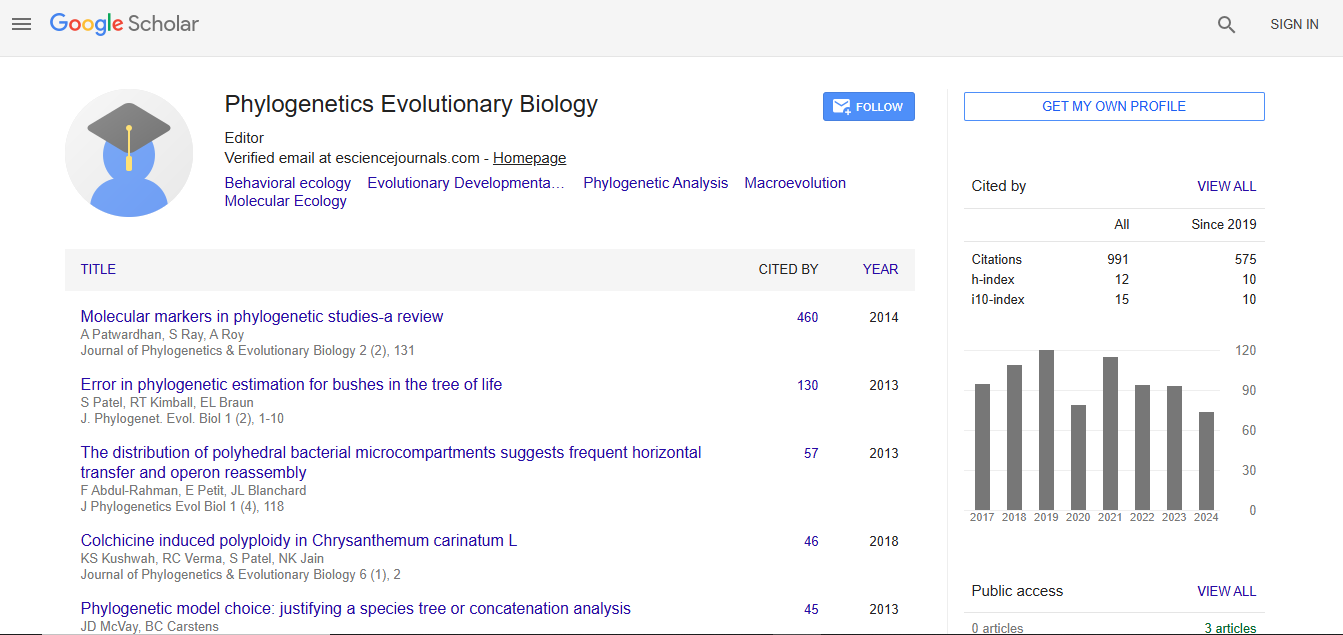
Journal of Phylogenetics & Evolutionary Biology received 911 citations as per Google Scholar report