Commentary - (2025) Volume 12, Issue 6
Received: 01-Nov-2025, Manuscript No. jlop-26-179111;
Editor assigned: 03-Nov-2025, Pre QC No. P-179111;
Reviewed: 17-Nov-2025, QC No. Q-179111;
Revised: 24-Nov-2025, Manuscript No. R-179111;
Published:
29-Nov-2025
, DOI: 10.37421/2469-410X. 2025.12.235
Citation: Jun, Wei. ”Advancements in Laser Stabilization for High-Precision Applications.” J Laser Opt Photonics 12 (2025):235.
Copyright: © 2025 Jun W. This is an open-access article distributed under the terms of the Creative Commons Attribution License, which permits unrestricted use, distribution and reproduction in any medium, provided the original author and source are credited.
The pursuit of highly stable laser sources underpins a multitude of advanced scientific and technological endeavors, ranging from fundamental physics experiments to cutting-edge industrial applications. Achieving precise control over laser output parameters such as intensity, frequency, wavefront, and pointing stability is paramount for pushing the boundaries of measurement accuracy and system performance. This critical need has spurred significant research into sophisticated stabilization techniques, aiming to mitigate inherent noise and external environmental influences. This introduction will delve into the various facets of laser stabilization as explored in recent literature, highlighting the challenges and the innovative solutions proposed to achieve unprecedented levels of laser performance. We will examine the diverse methodologies employed to enhance laser output characteristics and their implications for demanding applications. Advanced laser stabilization techniques are crucial for achieving high precision in optical systems, addressing challenges related to noise and drift in parameters like intensity, frequency, and wavefront. The integration of active feedback loops, environmental controls, and stable cavity designs facilitates sub-femtosecond jitter and picometer-level pointing stability, with specific methods including acousto-optic modulators, piezoelectric actuators, and beam steering optics, demonstrated through experimental results for interferometry and microscopy [1].
The development of lasers with ultra-low frequency noise is an essential requirement for next-generation gravitational wave detectors and atomic clocks. A robust feedback control system utilizing a reference cavity to lock laser frequency, incorporating vibration isolation and thermal drift compensation, has been detailed. This scheme achieves frequency stability in the 10â»Â¹âµ range, opening new avenues for precision measurements [2].
Laser beam pointing stability is a critical factor for applications requiring precise alignment over extended distances. Methods to minimize beam wander and angular jitter, such as active beam steering with tip-tilt mirrors controlled by quadrant photodetectors and passive optical isolation, have been investigated. Experimental setups demonstrate significant reduction in pointing fluctuations, achieving angular stability better than 100 nrad/â??Hz, a substantial improvement for free-space optical communication and remote sensing [3].
Maintaining stable output power is paramount for many laser-based experiments. A feedback control system employing a photodiode to monitor output power and an electronic loop controlling the laser's driving current has been presented for stabilizing diode laser intensity. Analysis of the feedback loopâ??s frequency response demonstrates intensity stability better than 0.01% over several hours, crucial for sensitive photometric measurements [4].
The spectral purity of a laser is vital for spectroscopy and quantum information processing. Techniques for reducing phase noise and increasing the coherence length of fiber lasers, including external cavity feedback and fiber Bragg gratings, have been examined. Results show significant phase noise reduction, leading to coherence lengths on the order of kilometers, enhancing applications requiring long optical path lengths [5].
Environmental factors, such as temperature fluctuations and vibrations, exert a considerable influence on laser stability. The design and implementation of vibration-isolated optical platforms and temperature-controlled laser housings address these concerns. Quantifying the reduction in environmental noise and its effect on laser frequency and intensity stability, the integrated system achieves notable long-term operational stability, suitable for sensitive metrology experiments [6].
Laser beam wavefront quality is critical for focusing and imaging applications. Active wavefront shaping techniques employing deformable mirrors controlled by Shack-Hartmann wavefront sensors are used to compensate for aberrations in real-time. Experimental results demonstrate effective restoration of a near-diffraction-limited wavefront, improving imaging resolution in microscopy [7].
Optical feedback offers a promising avenue for stabilizing the output characteristics of semiconductor lasers. By incorporating an external cavity, spectral linewidth reduction and improved frequency stability can be achieved. Theoretical analysis and experimental validation of different feedback configurations demonstrate a factor of 100 reduction in frequency drift, valuable for telecommunications and sensor applications [8].
Shot-noise-limited detection necessitates highly stable laser sources. A stabilization system for a tunable laser used in high-precision spectroscopy, combining frequency locking to a stable atomic transition and intensity feedback, has been described. This system achieves intensity noise below the shot noise limit and frequency stability of 1 kHz over several hours, critical for ultra-precise measurements [9].
The stabilization of laser systems for demanding optical metrology, such as interferometric displacement measurements, requires a multi-parameter approach. Simultaneously controlling frequency, intensity, and beam pointing through active feedback using piezoelectric transducers, acousto-optic modulators, and fast steering mirrors achieves unprecedented stability, enabling sub-nanometer precision measurements [10].
The fundamental challenge in many precision optical experiments lies in the inherent instability of laser sources. Fluctuations in intensity, frequency, wavefront, and pointing direction can introduce significant errors, limiting the achievable accuracy and resolution. Consequently, a substantial body of research has been dedicated to developing robust and sophisticated laser stabilization techniques. These techniques aim to counteract both internal laser noise mechanisms and external environmental disturbances, such as vibrations and temperature variations. The following sections will elaborate on the diverse approaches employed in the literature to achieve highly stable laser outputs, underscoring their significance for various scientific and technological applications. One of the primary focuses in advanced laser stabilization is the mitigation of noise and drift in key output parameters like intensity, frequency, and wavefront. This is crucial for high-precision optical systems. The research in [1] explores a combination of active feedback loops, environmental control, and inherently stable laser cavity designs to achieve remarkable performance metrics, including sub-femtosecond jitter and picometer-level pointing stability. Specific methodologies, such as employing acousto-optic modulators for intensity control, piezoelectric actuators for frequency tuning, and sophisticated beam steering optics for wavefront correction, are detailed. The integration of these techniques is validated through experimental results, demonstrating significant improvements in laser performance for demanding applications such as interferometry and microscopy [1].
For applications like next-generation gravitational wave detectors and atomic clocks, lasers with ultra-low frequency noise are indispensable. The work presented in [2] outlines a robust feedback control system designed to lock laser frequency using a reference cavity. This design incorporates critical elements like vibration isolation and thermal drift compensation to minimize the impact of external disturbances. A detailed analysis of noise sources and the effectiveness of the stabilization scheme is provided, reporting an achievement of frequency stability in the 10â»Â¹âµ range, which is pivotal for advancing precision measurement capabilities [2].
Precise alignment over long distances is a prerequisite for many applications, making laser beam pointing stability a critical parameter. Research in [3] investigates methods to minimize beam wander and angular jitter. A proposed solution involves a combination of active beam steering, utilizing tip-tilt mirrors controlled by quadrant photodetectors, and passive optical isolation. The experimental setup described successfully demonstrates a significant reduction in beam pointing fluctuations, attaining angular stability better than 100 nrad/â??Hz, representing a substantial advancement for applications like free-space optical communication and remote sensing [3].
In numerous laser-based experiments, maintaining a stable output power is of utmost importance. The study in [4] details a feedback control system developed for stabilizing the intensity of a diode laser. The system utilizes a photodiode for monitoring output power and an electronic feedback loop to control the laser's driving current. A thorough analysis of the feedback loop's frequency response is presented, showcasing the achievement of intensity stability better than 0.01% over several hours. This level of intensity control is essential for conducting sensitive photometric measurements accurately [4].
The spectral purity of a laser is a crucial characteristic for applications such as spectroscopy and quantum information processing. This paper examines techniques aimed at reducing phase noise and increasing the coherence length of a fiber laser. The implementation involves a combination of an external cavity feedback mechanism and a fiber Bragg grating to narrow the laser linewidth. The experimental results indicate a significant reduction in phase noise, leading to a coherence length on the order of kilometers. This enhancement is vital for applications that require long optical path lengths or high spectral resolution [5].
Environmental factors, including temperature fluctuations and vibrations, are known to have a significant impact on laser stability. The research in [6] addresses the design and implementation of a vibration-isolated optical platform coupled with a temperature-controlled laser housing. The study quantifies the reduction in environmental noise and evaluates its effect on laser frequency and intensity stability. The integrated system demonstrates a notable improvement in long-term operational stability, rendering it highly suitable for sensitive metrology experiments that demand consistent laser performance [6].
For applications involving precise focusing and imaging, the wavefront quality of a laser beam is a critical determinant of performance. This study concentrates on active wavefront shaping techniques designed to compensate for aberrations in real-time. The methodology employs a deformable mirror, which is controlled by a Shack-Hartmann wavefront sensor, to correct distortions as they occur. Experimental outcomes confirm the effective restoration of a near-diffraction-limited wavefront, thereby improving the imaging resolution in microscopy and other imaging modalities [7].
Semiconductor lasers, widely used in various fields, can benefit significantly from stabilization techniques. This research investigates the application of optical feedback for stabilizing the output characteristics of these lasers. By incorporating an external cavity, researchers have demonstrated a substantial reduction in spectral linewidth and an improvement in frequency stability. The paper presents both theoretical analysis and experimental validation of different feedback configurations, showcasing a noteworthy reduction in frequency drift by a factor of 100, a development of considerable value for telecommunications and sensor applications [8].
Achieving shot-noise-limited detection, a benchmark for high-sensitivity measurements, relies heavily on the availability of highly stable laser sources. The paper describes a stabilization system for a tunable laser specifically tailored for high-precision spectroscopy. This system integrates frequency locking to a stable atomic transition with intensity feedback. The reported results include achieving intensity noise levels below the shot noise limit and a frequency stability of 1 kHz over several hours. This enhanced stability is paramount for enabling ultra-precise measurements in scientific research [9].
For high-precision optical metrology, such as in interferometric measurements of displacement, stabilizing laser systems across multiple parameters is essential. The study presented in [10] proposes and demonstrates a multi-parameter stabilization approach that simultaneously controls frequency, intensity, and beam pointing. This is achieved through active feedback mechanisms utilizing piezoelectric transducers for frequency tuning, acousto-optic modulators for intensity stabilization, and a fast steering mirror for beam pointing correction. The combined system yields unprecedented stability, thereby enabling sub-nanometer precision measurements in metrology applications [10].
This collection of research highlights advancements in laser stabilization techniques crucial for high-precision applications. Studies demonstrate methods to control laser intensity, frequency, and wavefront, achieving significant improvements in stability. Techniques include active feedback loops, environmental control, and specialized optical designs. For instance, one paper focuses on sub-femtosecond jitter and picometer-level pointing stability using acousto-optic modulators and piezoelectric actuators for applications like interferometry [1].
Another research details ultra-low frequency noise stabilization for gravitational wave detectors and atomic clocks, reaching stability in the 10â»Â¹âµ range [2].
Pointing stability enhancements for free-space optical communication are achieved using active beam steering, reaching better than 100 nrad/â??Hz stability [3].
Intensity stabilization for diode lasers with better than 0.01% over hours is also presented [4].
Furthermore, research on ultra-narrow linewidth fiber lasers with kilometer-scale coherence lengths for quantum applications is discussed [5].
Environmental isolation through vibration damping and temperature control is shown to improve long-term operational stability for metrology [6].
Active wavefront shaping using deformable mirrors enhances imaging resolution in microscopy [7].
Optical feedback is explored for stabilizing semiconductor lasers, reducing frequency drift by a factor of 100 [8].
Stabilized tunable lasers for shot-noise-limited detection achieve intensity noise below the shot noise limit and 1 kHz frequency stability [9].
Finally, multi-parameter stabilization for optical metrology, simultaneously controlling frequency, intensity, and pointing, enables sub-nanometer precision [10].
None
None
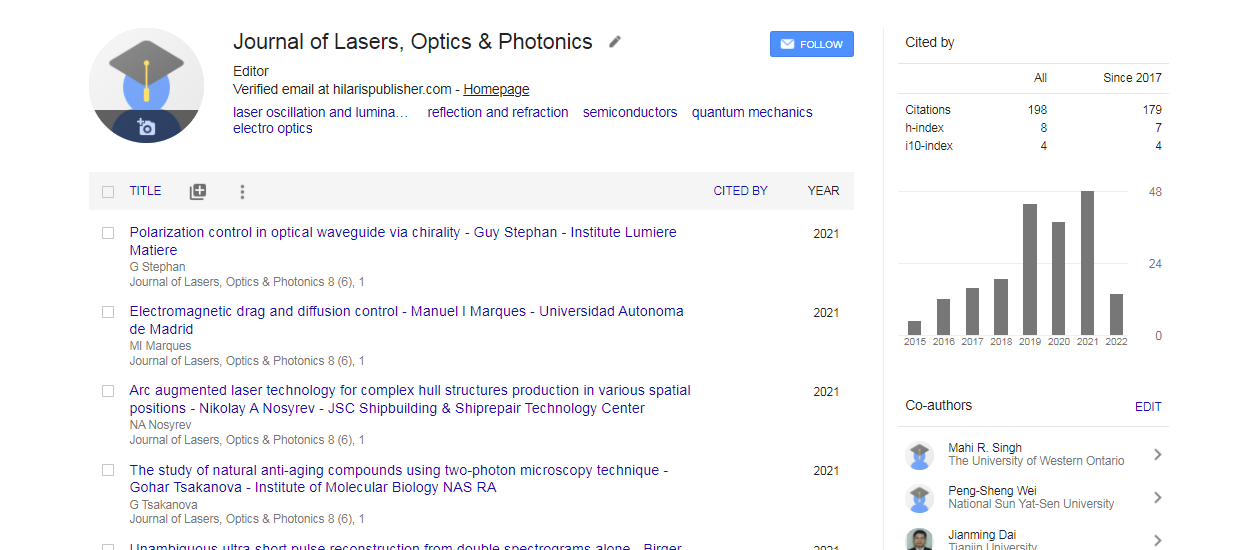
Journal of Lasers, Optics & Photonics received 279 citations as per Google Scholar report