Phylogenetic diversity has become invaluable for conservation biology in the last decades, reflecting its link to option values and to evolutionary potential. Phylogenetics is important because it enriches our understanding of how genes, genomes, species (and molecular sequences more generally) evolve. Through phylogenetics, we learn not only how the sequences came to be the way they are today, but also general principles that enable us to predict how they will change in the future. This is not only of fundamental importance but also extremely useful for numerous applications. The tips of a phylogenetic tree can be living taxa or fossils, and represent the 'end', or the present, in an evolutionary lineage. A phylogenetic diagram can be rooted or unrooted. A rooted tree diagram indicates the hypothetical common ancestor, or ancestral lineage, of the tree. An unrooted tree diagram makes no assumption about the ancestral line, and does not show the origin or "root" of the taxa in question or the direction of inferred evolutionary transformations.
Research Article: Journal of Phylogenetics & Evolutionary Biology
Research Article: Journal of Phylogenetics & Evolutionary Biology
Research Article: Journal of Phylogenetics & Evolutionary Biology
Research Article: Journal of Phylogenetics & Evolutionary Biology
Research Article: Journal of Phylogenetics & Evolutionary Biology
Research Article: Journal of Phylogenetics & Evolutionary Biology
Mini Review: Journal of Phylogenetics & Evolutionary Biology
Mini Review: Journal of Phylogenetics & Evolutionary Biology
Research Article: Journal of Phylogenetics & Evolutionary Biology
Research Article: Journal of Phylogenetics & Evolutionary Biology
Posters & Accepted Abstracts: Molecular and Genetic Medicine
Posters & Accepted Abstracts: Molecular and Genetic Medicine
Posters & Accepted Abstracts: Molecular and Genetic Medicine
Posters & Accepted Abstracts: Molecular and Genetic Medicine
Scientific Tracks Abstracts: Molecular and Genetic Medicine
Scientific Tracks Abstracts: Molecular and Genetic Medicine
Scientific Tracks Abstracts: Journal of Tissue Science and Engineering
Scientific Tracks Abstracts: Journal of Tissue Science and Engineering
Keynote: Journal of Metabolic Syndrome
Keynote: Journal of Metabolic Syndrome
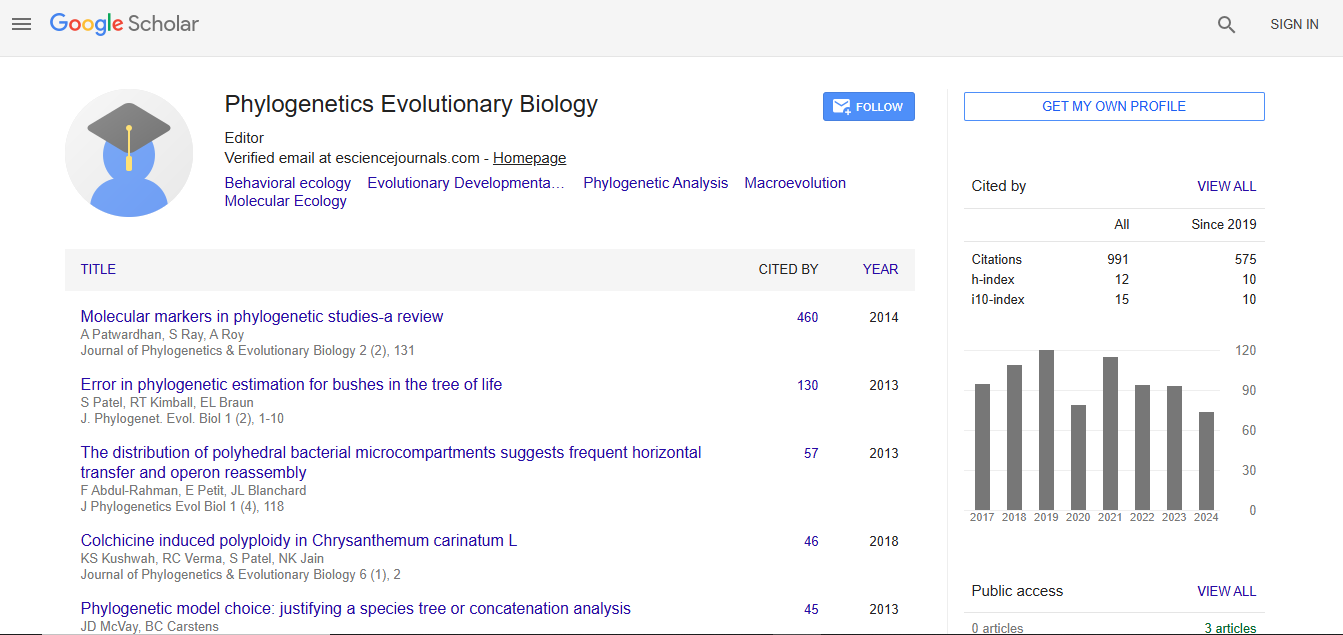
Journal of Phylogenetics & Evolutionary Biology received 911 citations as per Google Scholar report

 Spanish
  Chinese
  Russian
  German
  French
  Japanese
  Portuguese
  Hindi
Hindi 